A Hundred Steps That Can Change Your Health
(What Yoga and Modern Science Both Say About It)
You’ve probably heard the old saying from yoga and Ayurveda:
“After every meal, walk a hundred steps.”
It sounds simple, almost too simple.
However, modern science is now catching up to what yogic wisdom has known for centuries: gentle, consistent movement after meals and throughout the day can significantly transform your digestion, blood sugar levels, and mental clarity.
The magic isn’t in the number, it’s in the message:
Move a little, often, and with awareness.
What Ancient Wisdom Says
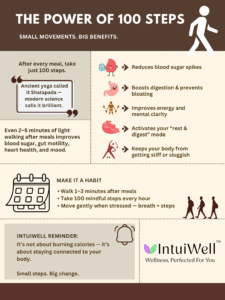
In yogic tradition, post-meal movement is called “Shatapada,” literally, the practice of walking a hundred steps.
This isn’t about burning calories; it’s about supporting digestion (Agni), balancing energy, and calming the nervous system.
Yoga texts describe light walking or gentle standing postures after eating as a way to:
- Aid digestion by stimulating circulation in the abdomen.
- Prevent bloating and heaviness after meals.
- Keep the mind alert and calm instead of sluggish.
In Ayurveda, sitting or lying down immediately after eating is discouraged. Instead, slow, mindful walking keeps the energy (prana) moving, creating what’s called “Sama Agni”, or balanced digestive fire.
What Modern Science Confirms
Turns out, science agrees.
Small bouts of light movement, even as little as 2 to 5 minutes of walking after meals, can have remarkable health benefits.
Key Research Findings
- Blood Sugar Balance:
A 2022 meta-analysis in Sports Medicine found that 2 minutes of light walking after a meal significantly reduces blood sugar spikes compared to sitting still.
→ Source: Aoyagi et al., Sports Medicine, 2022 - Digestive Support:
Gentle walking stimulates the gastrointestinal tract and improves gut motility, easing bloating and discomfort.
→ Supported by Harvard Health Publishing (2021): “Walking helps digestion by improving circulation and encouraging intestinal movement.” - Heart and Metabolic Health:
Short walks after meals improve insulin sensitivity and lower triglycerides.
→ The American Diabetes Association recommends light post-meal activity to regulate glucose. - Mood and Energy Boost:
Gentle walking increases oxygen flow and endorphins, reducing post-meal drowsiness in what yogis call the “tamas” state.
Why 100 Steps Works
Let’s do the math.
100 steps = roughly 1 minute of slow walking.
It’s not much, but it’s enough to:
1. Reduce after-meal blood sugar spikes
2. Stimulate digestive enzymes
3. Prevent stiffness after sitting
4. Calm the mind before returning to work
In yoga, it’s about rhythm and awareness; the body moves, the breath follows, and the mind settles.
Modern physiology calls this “parasympathetic activation,” your rest-and-digest mode.
How to Make It a Habit
You don’t need structure, just awareness.
After meals: Take a 1–3 minute walk around your home or outside.
After a long time, every hour, stand up and take 100 steps mindfully.
During stress: Step away, breathe, and walk slowly to match movement to your breath.
If walking isn’t possible, try seated cat-cow movements, shoulder rolls, or ankle rotations.
What matters is movement, not mileage.
The Intuiwell Takeaway
“100 steps” isn’t a fitness goal; it’s a mindfulness ritual.
A small, conscious pause to honor what your body just received.
It’s not about intensity.
It’s about intimacy with your body’s rhythm, your food, and your breath.
So next time you finish a meal, don’t rush to your phone or couch.
Take a few soft steps, feel your body digest, and let ancient wisdom meet modern science, right under your feet.
References
- Aoyagi, Y. et al. (2022). Light walking after meals reduces blood glucose spikes. Sports Medicine.
- Harvard Health Publishing (2021). Why walking helps digestion.
- American Diabetes Association (2022). Physical activity and blood sugar management.
- Ayurveda Charaka Samhita, Sutrasthana Chapter 5 – Dinacharya: The Yogic Daily Routine
Summary
Most people underestimate how much impact tiny habits have. The ancient yogic advice to “walk 100 steps after every meal” sounds trivial, but modern research proves it was right all along. Yogic tradition used this to support digestion, balance energy, and calm the mind — long before anyone talked about glucose spikes or insulin sensitivity.
Science now confirms that even 2–5 minutes of light walking after meals reduces blood sugar spikes (Sports Medicine, 2022), improves gut motility (Harvard Health), and boosts metabolic health (ADA). The point isn’t the number — it’s the principle: move lightly, frequently, and with awareness. Walking 100 steps takes barely a minute but is enough to aid digestion, prevent lethargy, reduce stiffness, and shift the body into a rest-and-digest state.
Building this into your day is simple: a short mindful walk after meals, 100 steps every hour, or gentle movements if walking isn’t possible. It’s not a workout — it’s a ritual that aligns ancient wisdom with modern physiology.
FAQs
1. Why specifically 100 steps?
Because it’s short enough that you have no excuse and long enough to trigger physiological benefits like better glucose control and digestive stimulation. The number is symbolic — the movement is what matters.
2. Can I do this indoors?
Yes. A hallway, living room loop, office corridor — doesn’t matter. The benefits come from movement, not scenery.
3. Is slow walking enough?
Absolutely. This is not cardio. Light movement is more effective post-meal than intense exercise because it doesn’t divert blood away from the digestive process.
4. What if I can’t walk after meals?
Use alternatives such as seated cat-cow, shoulder rolls, ankle rotations, or standing twists. Anything that gently moves your core and spine supports digestion.
5. How soon should I walk after eating?
Immediately or within 5 minutes. Waiting 30–60 minutes is less effective for blood sugar control.
6. Can this help with weight management?
Indirectly, yes — by improving glucose response, insulin sensitivity, and reducing cravings triggered by energy crashes.
7. Is this suitable for people with diabetes?
Yes, and research strongly supports post-meal movement for glucose regulation. Still, they should get personalised guidance from a clinician.
Ready to understand what your body actually needs — not what trends tell you?
Book a consultation call or request a call back with IntuiWell to get a personalised movement and digestion plan tailored to your lifestyle.