Imagine you just hit your biggest goal.
You could have aced the final exam. Maybe you closed a massive deal. You could finally get that promotion you worked toward for three years.
Everyone around you is cheering. They see a winner.
But you don’t feel like a winner. You don’t feel the rush of joy you expected. Instead, you feel a heavy, gray exhaustion.
Later that day, a friend asks a simple question. You snap at them. You answer with anger. Afterward, you stare at the wall and wonder, “Why did I do that?”
You are talking to people all day, but you feel alone. You are “communicating,” but you aren’t connecting.
If this sounds familiar, you aren’t crazy. You aren’t ungrateful. And it isn’t just “stress.”
You are experiencing the High-Performer’s Paradox.
The Trap of External Optimization
In our world, we love to optimize things. We are obsessed with making things run better, faster, and cheaper.
- We optimize our schedules down to the minute.
- We optimize our study habits or our team structures.
- We optimize our bank accounts and budgets.
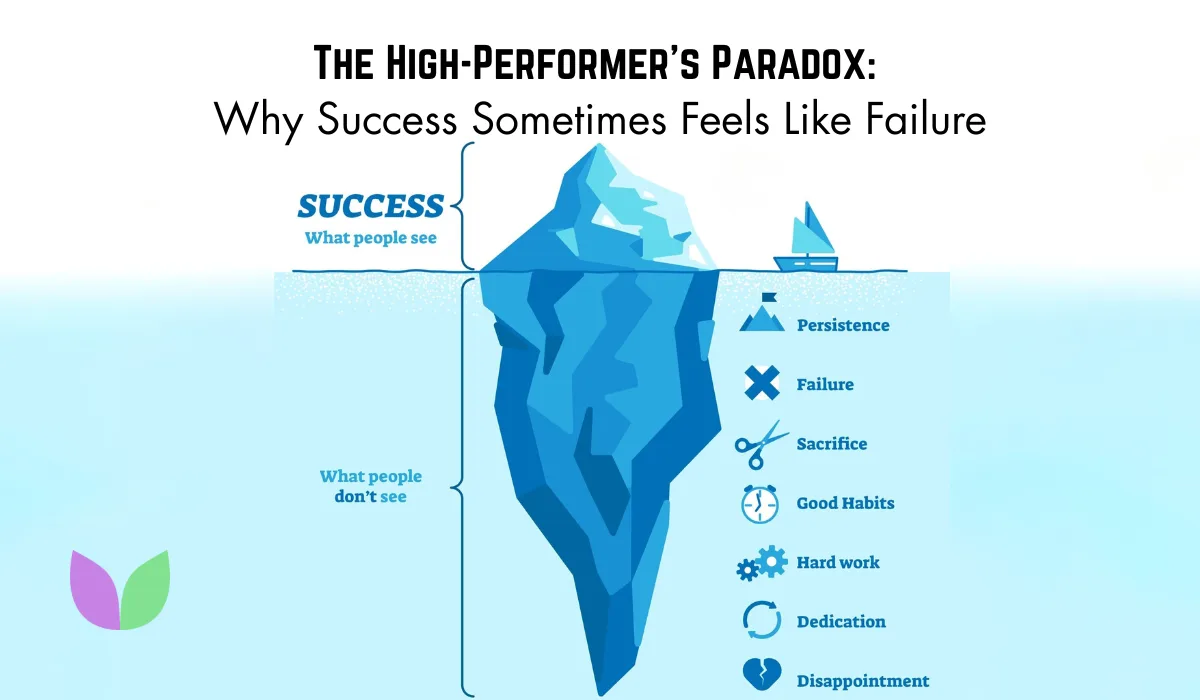
We spend all our energy polishing the “visible” parts of our life—the tip of the iceberg. We fix the things people can see.
But we completely ignore the engine below the water.
You are running on an internal “Operating System” (OS). This OS controls how you process emotions, how you handle pressure, and how you see yourself.
Most of us haven’t updated this operating system in years. We are running complex, modern lives on outdated software.
The Skyscraper on a Cracked Foundation
Think of your life and career as a skyscraper.
Your skills, your grades, and your achievements are the floors. You keep building higher and higher. You add more floors (responsibilities) every year. From the outside, it looks magnificent. It touches the clouds.
But what about the foundation?
If your internal OS is corrupted, your foundation is cracked.
When you build a skyscraper on a cracked foundation, it might stand up for a while. But eventually, the wind will blow. The pressure will rise. And the building will shake.
This “shaking” looks like:
- Sudden burnout when you should be happy.
- Anger outbursts at people you love.
- Impulsive decisions because you are overwhelmed.
If you don’t know your specific emotional triggers or your actual capacity, you are navigating in the dark. You are guessing your way through your own life.
Why “Soft Skills” Are Actually Hard Ceilings
Society tells us that self-awareness is a “soft skill.” They treat it like a nice bonus, something you do if you have extra time.
This is a lie.
Self-awareness is not soft. It is the ceiling of your leadership.
You cannot lead others if you cannot understand yourself. You cannot build a sustainable career if you don’t know your own breaking point.
Self-awareness is the filter for every decision you make.
- It tells you when to push and when to rest.
- It tells you why a certain comment made you angry.
- It is the only thing standing between you and total burnout.
Stop Guessing. Start Knowing.
You perform maintenance on your car. You update the software on your phone. Why don’t you do the same for your mind?
Don’t wait until you wake up ten years from now. Don’t wait until you are “successful” on paper, but a stranger to yourself.
You need to audit your Operating System. You need to find the bugs in the code.
- Identify your triggers: What specific situations make you shut down or lash out?
- Measure your capacity: How much emotional weight can you actually carry before the foundation cracks?
The Mirror
At IntuiWell, we believe you can’t fix what you can’t see.
We built a Baseline Assessment to help you see clearly. It is not a test. You cannot pass or fail it.
It is a mirror.
This assessment shows you where your internal load is leaking. It shows you the cracks in the foundation so you can fix them before you add another floor to your skyscraper.
It is free. It is simple. And it might be the most important thing you do today.
Take the Free Baseline Assessment Here
Build high, but build on solid ground with IntuiWell’s Personal Growth Program.
Author
Vallabh Chitnis is the Co-founder of IntuiWell and a Mindshift Strategist. A former tech industry leader with over two decades of experience in product and operations, Vallabh helps high-performers build practical inner systems for resilience and clarity. He moves beyond talk therapy and vague wisdom, using structured, outcome-focused methods to turn self-awareness into a competitive advantage.
FAQs
1. What is the High-Performer’s Paradox?
It’s the experience of feeling burned out, emotionally flat, or disconnected despite achieving major goals or career milestones.
2. Is this just normal stress?
No. Stress is temporary. The paradox appears when success consistently leads to exhaustion, irritability, or numbness—signs of internal system overload.
3. Why do high achievers face this more often?
Because they optimize results relentlessly but ignore emotional capacity, recovery, and self-awareness until something breaks.
4. What does IntuiWell’s Baseline Assessment measure?
It helps identify emotional triggers, internal load, and capacity limits—areas most people never consciously evaluate.
5. Is the assessment a psychological test?
No. There’s no pass or fail. It’s a clarity tool designed to show you where pressure is leaking internally.
6. Who should take this assessment?
Founders, leaders, professionals, and high performers who feel constantly “on edge,” drained after wins, or disconnected from people despite success.
Blog Summary
High achievers often expect success to bring satisfaction, confidence, and peace. Instead, many experience exhaustion, irritability, and emotional disconnection at the very moment they “should” feel fulfilled. This contradiction is what IntuiWell calls the High-Performer’s Paradox.
The problem isn’t a lack of discipline or ambition. It’s over-optimizing the visible parts of life—goals, performance, results—while neglecting the internal operating system that processes pressure, emotions, and self-worth. Like a skyscraper built on a cracked foundation, external success eventually exposes internal weaknesses.
The blog challenges the myth that self-awareness is a “soft skill.” In reality, it is the hard ceiling that determines leadership capacity, resilience, and long-term success. Without understanding emotional triggers and personal limits, high performers unknowingly drift toward burnout.
IntuiWell’s Baseline Assessment acts as a mirror—helping individuals identify internal overload, emotional leaks, and stress thresholds before they collapse under their own success.
Stop guessing what’s wrong. Start seeing it clearly.
- ✅ Take the Free Baseline Assessment
- 📞 Book a 1:1 Consultation Call
- 📩 Or request a callback from the IntuiWell team
Build high—but don’t build on cracks.