The 3 AM Reality Check
It is 3:00 AM. The house is silent. The fan cuts through the humid air.
You are exhausted, but your eyes are wide open.
Your body is in bed, but your mind is fighting a war.
“Why did the client pause after I quoted the price?”
“Is my team judging me for leaving early?”
“What if the appraisal next month is average?”
This is the story of the modern professional. Physically comfortable but mentally bruised.
This is overthinking.
In India, we grow up on a diet of worry. We learn that worrying means you care.
If you are not stressed about your child’s marks or your next promotion, people call you “casual.”
Here is the brutal truth: Worrying is not work.
You feel like you are solving the problem by obsessing over it. You are not.
>You are revving your car engine while the gear is in Neutral.
You burn fuel. You make noise. You go nowhere.
In my work mentoring mid-career professionals and founders, I see this pattern almost every week. The details change. The mental loop is the same.
This guide will not tell you to “think positive.”
It will give you a mechanical tool to fix the engine.
WHAT: The Mechanics of Overthinking
Let’s simplify the science.
Overthinking is friction.
Imagine you walk on a smooth road. That is action.
Now imagine walking through wet cement. That is overthinking.
You replay a past you cannot change.
You predict a future you cannot see.
>You get stuck in a loop.
- Thinking: “I need to prepare for the meeting.” (Useful.)
- Overthinking: “What if I prepare and they still hate it? What if I stutter? What if I look stupid?” (Useless.)
Psychologists often refer to this as rumination or chronic worry. It feels like control. It is actually drag.
WHY: Why We Do It (The “Safety” Lie)
Why does your brain do this to you?
Because your brain does not care about your happiness.
It cares about your survival.
Thousands of years ago, the human who sat in the cave was worrying,
“Is that a tiger outside?”
Often survived.
The human who said, “Relax, it’s probably the wind,” sometimes did not.
Your brain is hardwired to scan for threats.
Today there are no tigers.
There are emails, performance reviews, and EMI reminders.
Your brain treats a “Bad Appraisal” like a “Tiger Attack.”
It floods you with anxiety to keep you “safe.”
In the wild, this reaction helps you run.
In the corporate world, it freezes you.
You do not move. You do not decide. You just spin.
WHEN: The Danger Zones
Overthinking attacks you in the gaps.
- The Commute: Stuck in traffic, staring at the bumper ahead, spiraling about the day.
- The Shower: You win arguments that happened three years ago.
- The Pillow: The moment your head touches the pillow, your brain opens the “Files of Regret.”
You rarely overthink when you are deeply doing.
You overthink when you are waiting.
HOW: The Solution – Stop Overthinking with the “Bin or Build” Method
You cannot out-think overthinking.
You cannot fight a thought with another thought.
>You need a process.
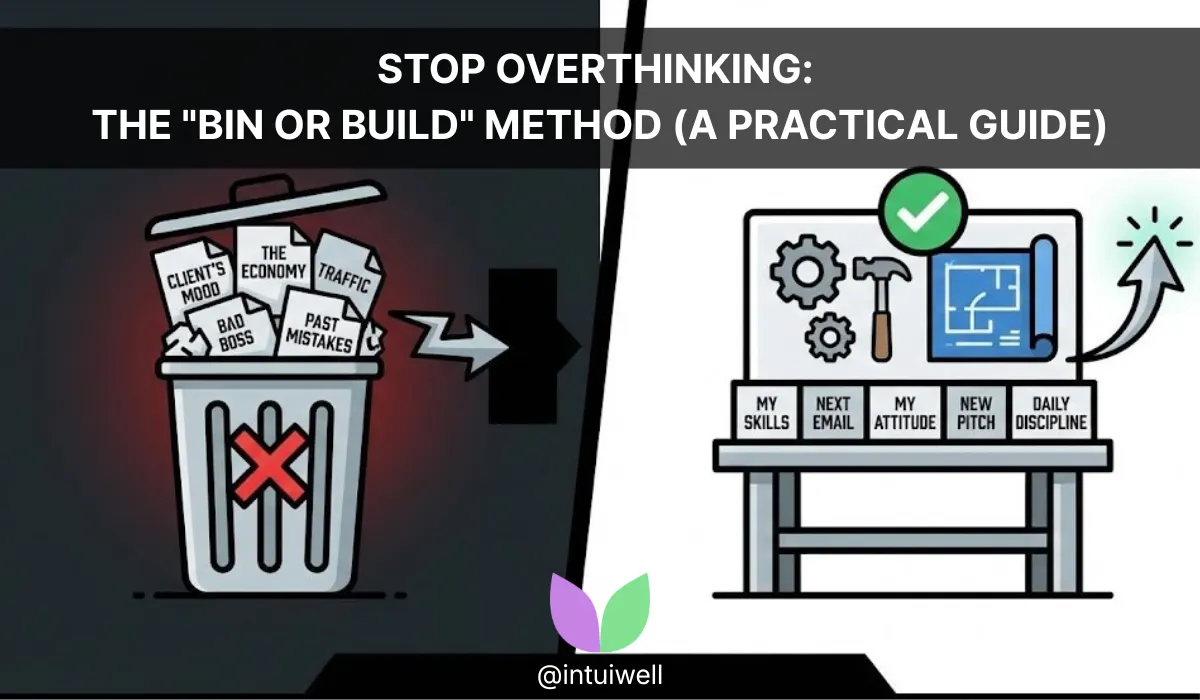
Here is the “Bin or Build” method.
Whenever you feel the loop starting:
- Grab a pen and paper. Not your phone.
- Draw a vertical line down the middle of the page.
Column 1: THE BIN (Garbage)
In this column, write every thought related to:
- The Past: “I shouldn’t have said that in the meeting.” (It is gone.)
- Other People: “Why is my boss so moody?” (You cannot control him.)
- The Future: “What if the economy crashes?” (You are not the stock market.)
Action: Look at this list.
Admit that these items are outside your control.
Say it clearly: “This is not under my control.”
If you want, tear this half of the page and throw it.
These thoughts go into the mental dustbin.
Column 2: THE BUILD (Construction)
In this column, write only what sits inside your circle of control:
- Your Actions: “I can update the slide deck.”
- Your Words: “I can send a clarifying email.”
- Your Skills: “I can learn how to negotiate better.”
- Your Plans: “I can create a backup plan.”
Action: Pick one item from this column.
Do it now, or schedule it for a clear time today.
This is how you convert spinning into movement.
Example: Bin vs Build
| Thought | Category | Fix |
| “My colleague hates me.” | BIN IT | Not your business. No action. Focus on your work. |
| “I missed the deadline.” | BUILD IT | Send an apology. Share a revised plan. Deliver on the new promise. |
| “What if I get fired?” | BIN IT | Pure speculation. Waste of energy. |
| “I need a backup plan.” | BUILD IT | Update your CV. Apply to three roles this weekend. |
Rule: If your hands cannot fix it, your brain should not hold it.
When You Need More Than a Tool
The “Bin or Build” method works well for everyday worry loops.
It helps you shift from fear to action.
But if you notice any of this, please take it seriously:
- You have panic attacks or constant chest tightness.
- You cannot sleep for days at a stretch.
- You feel hopeless, numb, or think life is pointless.
In those cases, this method is not enough.
Reach out to a mental health professional.
There is no weakness in asking for help. That is a Build action.
Conclusion: Physics Always Wins
Your daily energy is finite. Like a phone battery.
You can spend 80% of it trying to predict the weather.
That is overthinking.
Or you can spend that 80% building a stronger roof.
That is focused action.
The next time you stare at the ceiling fan at 3 AM, ask one question:
“Can I build this, or should I bin this?”
If it is Bin, let it go.
If it is Build, note the action and do it when the sun comes up.
Then, go back to sleep.
You have real work to do tomorrow.
If you want to apply similar methods to your own life, you can explore the IntuiWell Personal Growth Program here.
It’s a 90-day, practical, outcome-driven program that helps you build exactly what this post talks about.
Summary
Most professionals burn mental energy worrying about things they can’t control — replaying past mistakes, predicting imaginary failures, and spiraling during the “gaps” of the day. The blog explains that overthinking is just friction: it freezes action and drains energy because the brain is wired for survival, not clarity.
To break the loop, the blog introduces the Bin or Build Method, a mechanical process to separate useless thoughts from actionable ones. You draw two columns — BIN for anything about the past, other people, or uncontrollable future events; and BUILD for actions you can actually execute. You discard the Bin items and immediately act on one Build item.
The message is simple: if your hands can’t fix it, your brain should not hold it. Use energy to build, not obsess. And if anxiety becomes overwhelming (insomnia, panic, hopelessness), seek professional help.
FAQs
1. What is the Bin or Build Method?
A decision filter that forces you to separate uncontrollable worries (Bin) from actionable steps (Build), so your mind stops looping and starts moving.
2. How does this method reduce overthinking?
It removes ambiguity. Overthinking thrives in mental clutter. Once you classify a thought as Bin or Build, the loop loses power.
3. When should I use the method?
Use it the moment your thoughts start spiraling — during commutes, at night, or whenever you feel stuck.
4. What kind of thoughts go into the Bin?
Anything you cannot directly control: other people’s behavior, past events, and imaginary future disasters.
5. What goes into the Build column?
Any specific action you can execute today — updates, communication, preparation, skill improvement.
6. Is this method enough if I have severe anxiety?
No. If you’re dealing with panic attacks, insomnia, or hopelessness, seek professional support. That itself is a Build action.
7. Does this require journaling daily?
Not mandatory. Use it only when the mind starts spinning. The tool is situational, not a ritual.
Want help applying the Bin or Build Method to your real life?
Book a consultation call or request a call back here → IntuiWell Personal Growth Program