Every time you overthink, hesitate, or freeze, it’s because your mind is living in a future that doesn’t exist yet.
Most people never notice this.
We grow up believing that hope is good and fear is bad.
So we chase one and avoid the other.
But both emotions can quietly sabotage your momentum in the exact same way.
Hope feels noble. Fear feels negative.
But both drag your mind away from the present.
Both pull you into imagined futures.
Both weaken your ability to act.
This is the part almost no one talks about:
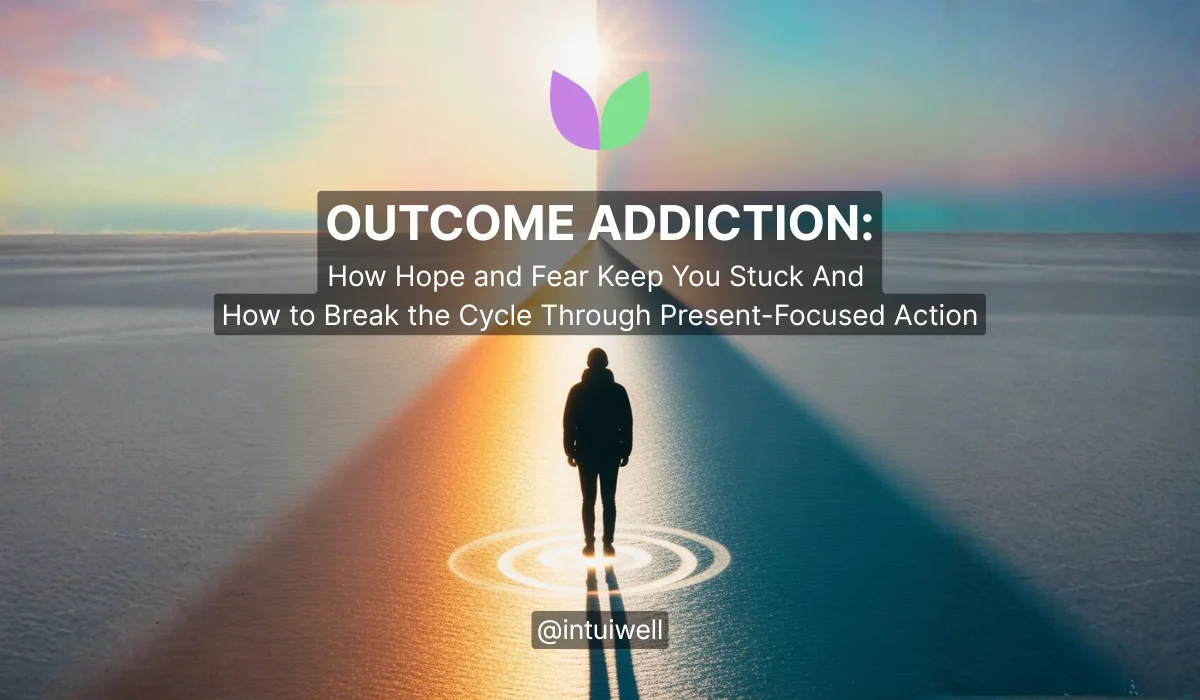
Hope and fear are not opposites. They are future projections. And future projections dilute your ability to move in the now.
I learned this during a phase where everything around me felt uncertain. One of the most difficult times of my life.
On good days, I hoped things would fall into place.
On bad days, I feared they wouldn’t.
Yet my body reacted the same way each time — tension, restlessness, and constant mental noise.
Nothing outside me had changed.
Only the story in my head had.
This pattern shows up most when life enters uncertainty —
before results,
before decisions,
before conversations,
before turning points.
That’s when hope and fear take over.
And that’s when your mind leaves the present.
font-weight: 400;”>That’s when your clarity disappears.
If you want to achieve better mental health, stronger resilience, and a more grounded sense of direction, this shift is essential.
Let’s break down the mechanics behind this — and how to break the cycle.
Why Hope and Fear Feel Opposite but Work Exactly the Same
People assume hope helps and fear harms.
But psychologically, they operate identically.
You don’t get stressed because of what is.
You get stressed because of what might be.
Hope imagines a future that works out.
Fear imagines a future that collapses.
Different colors.
– Same projection.
– and the same distance from the present.
– Same emotional cost.
A Harvard study notes that we spend 47% of our waking hours thinking about the future.
And this future-focused mind-wandering — whether positive or negative — raises stress levels and lowers well-being.
That means:
- hopeful fantasies
- fearful spirals
Both activate the same anxious circuitry.
This explains why you can feel overwhelmed even when imagining something good.
Your brain simply reacts to uncertainty, not to positivity or negativity.
Your Brain Is Wired to Predict — Not To Stay Calm
To understand this pattern, it is essential to understand your biology.
The amygdala scans for danger.
The prefrontal cortex creates future scenarios.
Both get hyperactive when you lack clarity.
This is why:
- before an appraisal
- before a medical report
- before a crucial meeting
- before a conflict
- before a business review
- before a big decision
your mind starts constructing stories.
It is not trying to torture you.
It is trying to protect you.
But protection turns into projection.
Projection turns into paralysis.
Your brain prepares for every possibility except the one thing that actually matters — the present moment.
The Real Problem: Outcome Addiction
Here is the truth most people avoid:
You are not stressed because of the outcome.
You are stressed because you want something you cannot guarantee.
That desire for a specific outcome creates addiction.
Outcome addiction shows up when you attach peace, confidence, or self-worth to:
- the promotion
- the salary
- the approval
- the relationship
- the health report
- the business result
- the recognition
- the perfect scenario
When your emotional state depends on something you cannot fully control, stress becomes your constant companion.
This addiction creates:
- overthinking
- procrastination
- emotional swings
- delayed decisions
- avoidance
- restlessness
- tension
- rumination
- self-doubt
It’s not a weakness.
It’s a misdirected focus.
A Table That Explains Your Entire Emotional Pattern
| Emotion | What You Think | What You Do |
| Hope | “It will work out.” | You wait, assume, delay. |
| Fear | “It might not.” | You freeze, avoid, protect. |
| Both | Future projections | You stop acting in the now. |
Opposite emotions.
Identical result.
Your life slows down.<span style=”font-weight: 400;”>
>Your decisions weaken.
>Your clarity dissolves.
Everyday Symptoms That Most People Ignore
Outcome addiction is subtle.
It hides in common patterns people mistake for “stress” or “overthinking.”
You’ll see it here:
- waiting for clarity before acting
- worrying before any result
- inability to focus
- checking your phone constantly
- tension in the chest or stomach
- imagining worst-case or best-case scenarios
- impulsive behaviour when anxious
- freezing when decisions matter
- difficulty sleeping
- panic during uncertainty
These are signs your mind is living ahead of reality.
And mental peace begins when you bring it back.
The IntuiWell Micro-Diagnosis That Helps 90% of People
When someone shares their anxiety — job, health, relationship, money — we ask:
“Can you guarantee this outcome?”
The answer is always no.
Then we ask the real question:
“So why is your mind living in a future you cannot control?”
This reframes the problem instantly.
The stress isn’t coming from the future.
It’s coming from the mind’s attachment to it.
Awareness alone reduces emotional load.
Because now you’re seeing the pattern, not drowning in it.
The Framework: Name → Notice → Narrow
A simple method that works in real life, not theory.
Step 1: NAME the emotion.
Say it cleanly:
“This is fear.”
“This is hope.”
“This is anxiety.”
Labels calm the brain.
Affect labeling reduces intensity by up to 50%.
Step 2: Notice where it appears in your body.
Your mind lies.
Your body does not.
Look for:
- chest tightness
- stomach heaviness
- jaw tension
- dry throat
- rapid heartbeat
When you shift focus from thoughts to sensations, the emotional loop breaks.
Step 3: NARROW your focus to one action you control.
One small action.
- one email
- one message
- one glass of water
- one stretch
- one bullet point
- one step
- one conversation
- one decision
Action switches your brain from prediction mode to execution mode.
Execution ends paralysis.
This is how emotional reactivity weakens.
This is how clarity rebuilds.
How This Framework Builds Resilience, Mental Strength, and Character
Consistent practice triggers deeper psychological changes:
1. Less emotional reactivity.
You stop getting hijacked by hope or fear.
2. Higher clarity during uncertainty.
Action cuts through mental fog.
3. More confidence.
You trust your ability to act, not the outcome.
4. Nervous system stability.
Cortisol reduces when you stay grounded in the present.
5. Stronger character.
Discipline replaces imagination as your primary fuel.
Resilience isn’t about surviving storms.
It’s about responding to them with controlled action.
Real Stories That Reveal This Pattern Everywhere
1. The Employee Waiting for a Promotion
He hoped it would come.
He feared it might not.
Both kept him silent and stuck.
When he narrowed focus to making his work visible, he grew faster than he expected.
2. The Founder Afraid of Cashflow
Hope said, “New clients will come.”
Fear said, “We won’t survive.”
Both froze him.
When he shifted to one daily business development action, momentum returned.
3. The Parent Worried About Their Child
Hope said, “They will improve.”
Fear said, “What if they don’t?”
Both created stress.
When they focused on one supportive action each day, the relationship changed.
The pattern is universal:
Future projections → paralysis
Present action → progress
Your Daily Present-Moment Protocol
A simple routine that resets your mind.
Morning (1 minute)
“What is one thing I control today?”
During the Day
Use Name → Notice → Narrow
(Works in under 60 seconds.)
Night (1 minute)
“What did I act on today instead of waiting?”
This practice builds mental strength faster than motivation ever will.
Seven Questions to Break Outcome Addiction
Use these to reset your mind when it drifts into the future:
- What am I hoping for that I cannot guarantee?
- What am I fearing that hasn’t happened yet?
- What story is my mind creating about the future?
- What am I avoiding because I want certainty first?
- What action can I take in the next 10 minutes?
- What small win can I create today?
- What would my life look like if I stopped waiting?
Better questions create better awareness.
The Mindset Shift That Changes Everything
Here’s the truth that breaks the entire cycle:
The future does not build your life.
Your next action does.
Hope and fear will always exist.
They are part of being human.
But they should never control your decisions.
– Your power lives in the present moment.
– Your clarity lives in small actions.
– Your resilience grows every time you choose presence over projection.
This is where real transformation begins.
The IntuiWell Perspective
At IntuiWell, we don’t teach motivation.
We teach mental clarity, emotional skill, and disciplined action — the three pillars of personal transformation.
Our Personal Growth Program uses neuroscience-backed tools, weekly protocols, and real-time behavioral strategies to help you:
- Reduce emotional reactivity
- Build resilience
- Strengthen clarity
- Break outcome addiction
- Respond instead of react
- Take purposeful action every day
If you want to stop overthinking and start living with intention, this is the path.
Because sustainable change isn’t built through wishful thinking.
It’s built through action — one grounded step at a time.
Summary of the Blog
Most people assume hope pushes them forward and fear holds them back. In reality, both trap the mind in imaginary futures and sabotage real-world action. This pattern is called outcome addiction — the habit of tying peace, confidence, and self-worth to results you can’t control. When that happens, your brain shifts into prediction mode, triggering stress, restlessness, paralysis, and endless overthinking.
The blog explains how hope and fear work identically in the brain, why uncertainty activates protective mental loops, and how the desire for guaranteed outcomes creates emotional instability. The solution is not more motivation or positivity — it’s present-focused action. The Name → Notice → Narrow framework brings the mind back to the body, interrupts projections, and forces a single controllable action that rebuilds clarity.
Real stories illustrate how this pattern appears in careers, relationships, parenting, and business. The blog ends with daily protocols, reflective questions, and a shift in mindset: life improves only when action replaces anticipation. IntuiWell’s approach focuses on clarity, emotional skill, and disciplined execution — not motivation — to break outcome addiction and build lasting resilience.
FAQs
1. What is outcome addiction?
It’s the tendency to attach emotional stability to results you can’t fully control. This keeps you stuck in the future and prevents effective action.
2. How are hope and fear similar?
Both pull your attention into imagined futures. Both activate uncertainty and stress. The emotional color differs, the mental trap is identical.
3. Why do I feel anxious even when imagining good outcomes?
Your brain reacts to unpredictability, not positivity. Uncertainty — whether hopeful or scary — triggers the same stress circuitry.
4. How do I stop overthinking outcomes?
Shift attention from thoughts to sensations, then to one small action you control. Action breaks prediction loops.
5. What is the Name → Notice → Narrow method?
A three-step grounding technique:
- Name the emotion
- Notice its physical location
- Narrow your focus to one immediate action
6. How does present-focused action help?
It forces the brain into execution mode, reducing anxiety, increasing clarity, and rebuilding confidence through momentum.
7. How can IntuiWell help me with outcome addiction?
Through neuroscience-backed tools, weekly protocols, and behavior-focused strategies designed to reduce emotional reactivity and build disciplined, grounded action.
Ready to break outcome addiction and rebuild clarity?
Book a consultation call or request a call-back with IntuiWell today.