
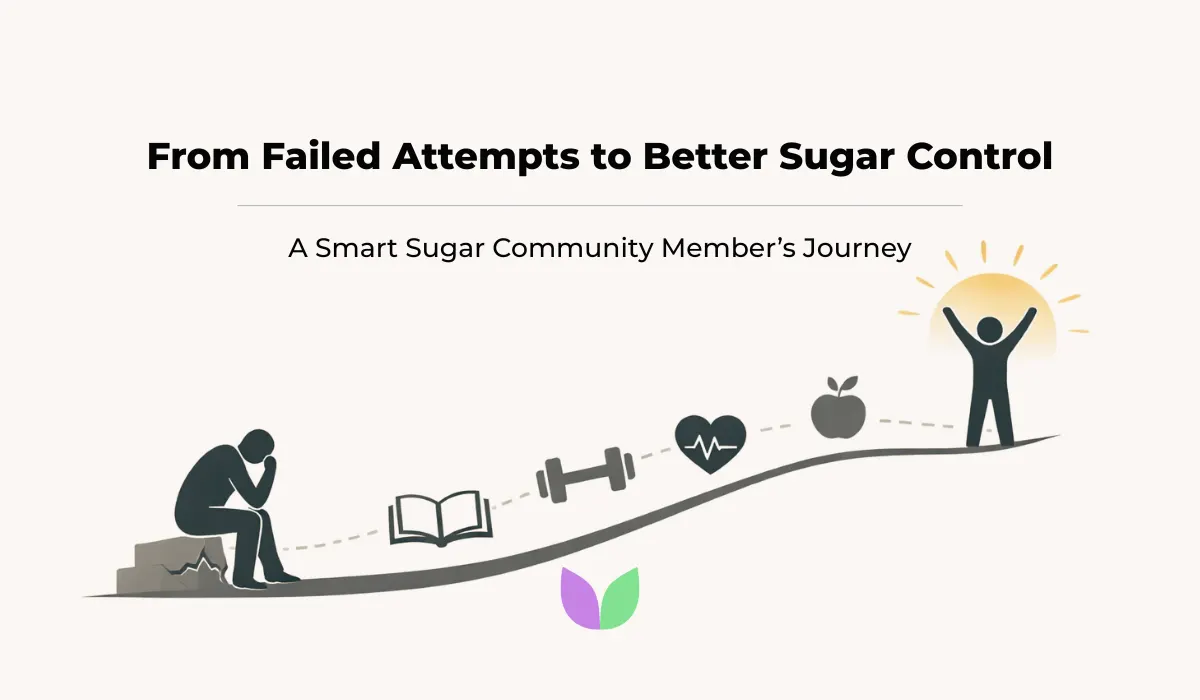
One member’s journey of mindset change, disciplined routines, and practical health shifts, with IntuiWell notes throughout.
Editor’s Note
This story was shared with IntuiWell by a member of our Smart Sugar Community after a detailed discussion around his sugar patterns and health journey. We are publishing it because it reflects a struggle many people quietly go through: repeated failed attempts, short bursts of progress, frustration, and then finally, a more structured shift. This story is shared with the member’s approval and has been lightly edited for clarity.
In August 2025, my health numbers forced me to stop pretending that things were under control.
My HbA1c was 10.
My BMI was 32.2.
My weight was 96.4 kg.
My fasting blood sugar was 172.
My post-meal sugar was 165.
My blood pressure was 150/90.
I did not need another warning sign. I needed a real change.
This was not just about one lab report. It was bigger than that. I knew my weight had to come down. My sugar had to improve. My blood pressure could not keep moving in the wrong direction. For some time, these were issues sitting in the background. Then they stopped being background issues. They became the issue.
What also stayed with me was this: I did not come from a family where this felt inevitable. There was no strong family pattern of diabetes, obesity, or hypertension. That made me reflect even more deeply on my own lifestyle, habits, and the direction I was heading.
IntuiWell Note:
Many people think in extremes. “It runs in the family, so I am bound to get it.” Or, “It does not run in the family, so I am safe.” Real life does not work that neatly. Family history matters. But daily habits, stress, sleep, movement, and food patterns matter too.
The harder truth was this: this was not my first attempt.
Before this, I had already tried at least six times to lose weight and manage my sugar better. Every time, the pattern was almost the same. I would begin with motivation. I would push hard. I would see some progress. Then something would break. My routine would slip. My discipline would weaken. I would go cold. Then I would have to begin again.
That cycle is tiring. Not just physically. Mentally too.
More than the numbers, I was tired of restarting my health journey again and again.
After a point, the problem is not only your weight or your sugar. The problem becomes your faith in yourself. You start wondering whether you can really stay the course.
That is where the real change had to happen for me.
I realized I did not just need a plan. I needed a different mindset. I needed a different way of looking at the whole situation.
Till then, I had treated this like a problem to solve. This time, I had to treat it like a life shift to commit to.
That changed everything.
I spent time learning more about these conditions. I read books like End of Diabetes by Dr. Joel Fuhrman, The Spectrum and Undo It by Dr. Dean Ornish, along with a few others that helped me think differently about belief, discipline, and change.
But reading alone was not enough. I had read it before, too. I had tried before, too.
This time, I wrote my goals down clearly. Not vague wishes. Real targets.
I wanted my BMI to be below 25.
I wanted my fasting blood sugar in the 80 to 100 range.
I wanted my post-meal sugar to be around 120.
I wanted my blood pressure to be at 120/80.
It became less about “I should improve,” and more about “This is where I am going.”
IntuiWell Note:
This is one of the strongest parts of his story. The shift was not only physical. It was mental first. Many people do not fail because they lack information. They fail because their mind is still operating from doubt, all-or-nothing effort, and emotional reactions. Structure works better when the mind stops treating every setback like a personal collapse.
The biggest shift was in belief.
I had to build a real belief that better sugar control was possible. Not borrowed motivation. Not two days of excitement. Real belief.
I had to stop telling myself that this was now just part of life. That poor health was the price of years of hard work, stress, and career pressure. I had to believe change was possible before I could stay consistent long enough to create it.
Then I had to face my own self-sabotage.
One of my patterns was clear. I would go very hard at the start, see some results, relax too early, drift, and then stop. That pattern had to break.
I also had to prepare for failure differently.
Earlier, if something went wrong, I would get discouraged. This time, I wanted a different response. If something failed, I would not turn it into a judgment about myself. I would treat it as data. Something went wrong. Fine. Find the issue. Fix it. Move on.
That helped me a lot. It made the process feel less emotional and more practical. I also knew I had to stop being selective about the changes I needed to make. This was not about fixing one thing in isolation. Food, movement, sleep, stress, and consistency had to work together. That was the mindset shift. Then came implementation.
My food changed first.
I removed milk products. I reduced portion sizes. My lunch, which earlier felt like a full event, came down from a three-course meal to one course. I started intermittent fasting. I stopped the habit of eating something every two hours. I increased protein intake.
These were not glamorous changes. They were basic. But basic things, done daily, can change a lot.
I should also say this clearly: this was the routine I chose for myself. It may not be practical or necessary for everyone.
My routine changed, too.
I started sleeping around 11 pm and worked on making my sleep more regular. I focused more on consistency than perfection.
Exercise became non-negotiable.
I did yoga twice a day for about 90 minutes each session. I added walking, about 5,000 steps, around my main meals. I also practised the Nitric Oxide Dump routine around breakfast, lunch, and dinner.
I was not looking for one magic bullet. I was building a system.
That made a big difference.
IntuiWell Note:
What stands out here is not intensity alone. It is consistency. The body responds to patterns. Meal load, meal timing, movement, sleep, hydration, stress, and mindset all work together. This is also why isolated tips often fail. A more structured approach usually works better than random effort.
Over time, the numbers started to move.
And more importantly, they stayed moved.
Today, my BMI is 23.4.
My weight is 71.3 kg.
My fasting blood sugar is usually between 80 and 100.
My post-meal sugar is usually between 110 and 120.
My blood pressure is around 110/65.
I am now off diabetes medication under my doctor’s guidance, and my hypertension medication has also been reduced under medical supervision.
From where I started to where I am now, the difference feels huge.
The only real problem now is the cost of refurbishing my wardrobe.
That part, nobody warned me about.
IntuiWell Note:
We like this line because it makes the story human. Health change is serious. But it is also deeply personal. Sometimes the small signs, a looser shirt, a changed belt notch, a wardrobe problem, say a lot.
If I had to keep my learnings simple, I would say this:
First, the mind has to believe change is possible. If you start with defeat, it becomes very hard to stay the course.
Second, regular exercise matters. Not once in a while. Not only when you feel motivated. Regularly.
Third, avoiding constant snacking helped me.
Fourth, stress matters more than most people admit.
Fifth, sleep matters. In a real way. Not just in theory.
Sixth, hydration matters too. I made it a point to stay hydrated and aim for around 3 litres of water a day.
This journey taught me something deeper as well.
Health problems are not always about a lack of knowledge. Sometimes they are about a lack of structure. Sometimes they are about inconsistency. Sometimes they are about emotional fatigue. Sometimes they are about losing faith after too many failed attempts.
I had to stop treating this like a temporary project and start treating it like a serious rebuild.
That changed things.
Not overnight. But steadily.
And steady is what finally worked.
What stood out to us at IntuiWell:
This story is powerful for one main reason: the biggest change did not start on the plate. It started in the mind.
He had already tried multiple times before. At least six by his own count. That matters. Because many people think failed attempts mean a lack of discipline or lack of seriousness. Often, that is not true. Sometimes people are trying very hard. But they are trying with the wrong mental frame.
What shifted here was not just food or movement. It was the approach.
He moved from:
- Trying hard for short periods
- To build belief for the long run
He moved from:
- Emotional disappointment after setbacks
- To data-driven correction
He moved from:
- Scattered effort
- To structured routines
That shift is bigger than it looks.
This is also one reason we at IntuiWell value deeper pattern interpretation. Numbers matter. But what matters even more is what sits behind the numbers. Habits. Timing. Food patterns. Sleep. Stress. Movement. Mindset. Consistency. The visible result often begins with an invisible shift.
A Note from IntuiWell:
This is one member’s personal story. It reflects what worked for him, in his context, with his choices, his routines, and his level of commitment.
It should not be read as a one-size-fits-all formula.
At IntuiWell, our philosophy is not built around forcing extreme restrictions or making people follow rigid routines that do not fit real life. Our core approach is integrative. We look at nutrition and diet, physical fitness, mindset shift, lifestyle patterns, and medical parameters together. We believe the goal is not short-term intensity. The goal is sustainable change that the body and mind can live with.
That is where real progress becomes more likely.
Final Thoughts:
If you are reading this while feeling frustrated, tired, or stuck in your own cycle of starting and stopping, this story should remind you of one thing:
A failed attempt is not a final verdict.
Sometimes it is just incomplete learning.
The next shift may not come from trying harder.
It may come from trying differently.
With more honesty.
More structure.
More patience.
And a better understanding of what your body is really telling you.
That is where real change begins.
If you’re stuck in the cycle of starting and stopping, guessing and failing—stop trying randomly.
👉 Book a consultation call with IntuiWell to understand your patterns and build a structured, realistic plan.
👉 Or request a call back to get personalized guidance on your health journey.
Real change doesn’t come from trying harder. It comes from trying smarter
Blog Summary
This IntuiWell story highlights a powerful transformation driven not by shortcuts, but by a fundamental shift in mindset and consistency.
The individual began with alarming health markers—high HbA1c, obesity, elevated blood sugar, and hypertension—after multiple failed attempts to improve. What changed this time wasn’t just diet or exercise, but the approach itself.
Instead of treating health as a temporary fix, he committed to a long-term lifestyle rebuild. He set clear, measurable goals and shifted from emotional decision-making to structured, data-driven adjustments.
Key changes included:
- Simplifying meals and reducing portion sizes
- Practicing intermittent fasting
- Increasing protein intake
- Establishing consistent sleep patterns
- Making exercise (yoga + walking) non-negotiable
- Managing stress and hydration consciously
Over time, these consistent habits led to dramatic improvements:
- BMI dropped from 32.2 to 23.4
- Blood sugar normalized
- Blood pressure improved significantly
- Medications were reduced under medical supervision
The core lesson: real health transformation doesn’t start with food—it starts with belief, structure, and consistency. Quick bursts of motivation fail, but sustainable systems win.
FAQs
1. What is the most important factor for better sugar control?
Not diet alone. Mindset and consistency are the foundation. Without them, even the best plan fails.
2. Can sugar levels improve without medication?
Yes, in some cases, with lifestyle changes. But medication changes should always be done under medical supervision.
3. Is intermittent fasting necessary?
No. It worked for this individual, but it’s not mandatory. The key is structured eating patterns.
4. Why do most people fail repeatedly?
They rely on short-term motivation rather than on building sustainable systems and habits.
5. How long does it take to see results?
There’s no fixed timeline. Consistent habits over months—not days—create lasting change.
6. Is extreme discipline required?
No. What’s required is consistency, not intensity. Extreme efforts often lead to burnout.


