Practical, personalised support for the things that keep getting in the way – without labels, jargon or a fixed syllabus.
Maybe nothing is seriously wrong.
You are going to work, managing responsibilities, making decisions and getting through the week. From the outside, life may look reasonably normal.
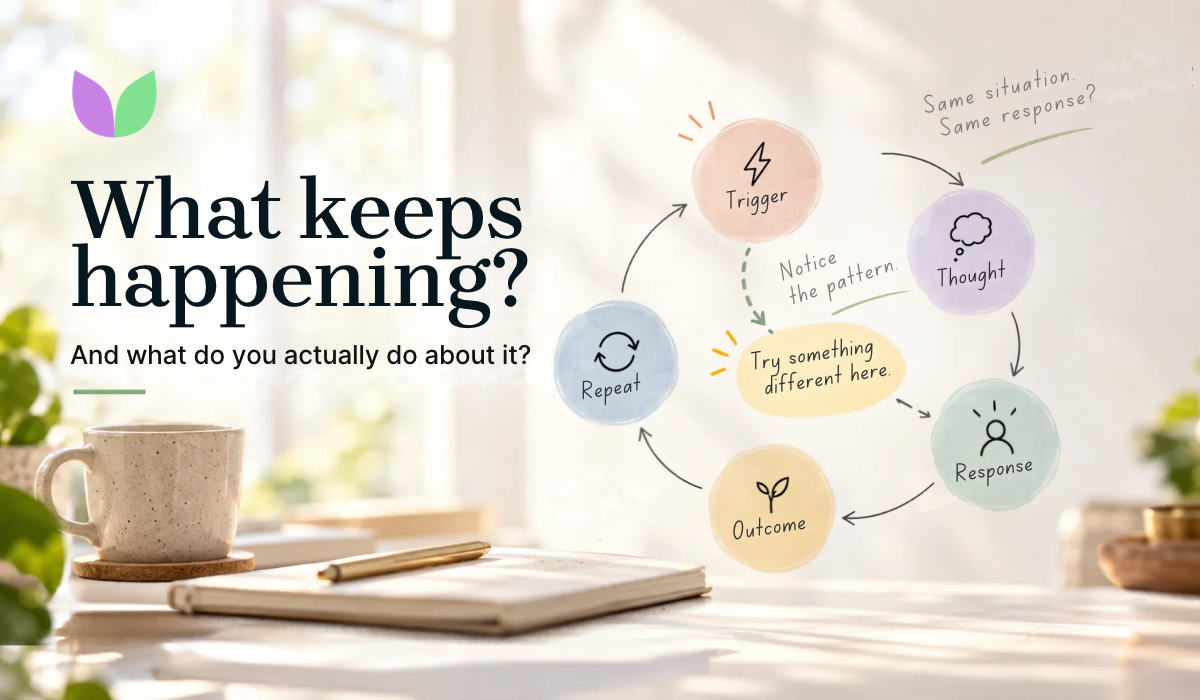
But something keeps happening that you have not quite figured out.
You replay a conversation long after it ended. You know you should say no, but still say yes and regret it later. You make a decision, then one person’s opinion makes you question the whole thing again.
Perhaps you know exactly what you should do, but getting yourself to start remains difficult. Or a small comment affects you much more than you think it should. Your mind stays occupied even when there is nothing urgent to solve.
Sometimes you cannot even explain the problem neatly.
You just know:
“This keeps happening. I don’t really know why, and I haven’t found a good way to handle it.”
Then comes another question.
Who do I even speak to about this?
A friend? A mentor? A coach? A psychologist? A psychiatrist?
Do I need therapy? Do I need advice? Or do I simply need someone objective to help me see what I am missing?
In my experience, knowing what kind of help to ask for can be harder than recognising that you need some help in the first place.
That is one of the reasons we created Transform You: Personal Growth.
What Is Transform You: Personal Growth?
Transform You: Personal Growth is IntuiWell’s founder-led, one-to-one Personal Growth program.
It is designed for people who are generally functioning in everyday life but repeatedly get stuck in patterns around decisions, stress, boundaries, difficult conversations, consistency, self-trust, avoidance, attention or follow-through.
But I would rather not start by deciding which label fits you.
If you tell me:
“I am an overthinker,”
I am more interested in asking:
“What happened the last time?”
Two people can both call themselves overthinkers and be describing completely different patterns.
One may keep researching because making the wrong decision feels unacceptable. Another may decide comfortably until someone they respect disagrees. Someone else may replay conversations because they are worried they upset somebody.
The label sounds the same.
What is keeping the pattern going may be completely different.
And that is what we need to understand.
Do I Need Personal Growth Support or Therapy?
This distinction matters.
Personal Growth at IntuiWell is not psychotherapy. We do not diagnose or treat mental-health conditions.
Therapy can also help with everyday stress, relationships, life transitions and recurring emotional or behavioural difficulties. So the distinction is not simply that Personal Growth is for “normal problems” and therapy is for “serious problems.”
The distinction is one of scope.
Our Personal Growth work is non-clinical and focuses on practical patterns in how you respond, decide, communicate and follow through. Psychotherapy is delivered by qualified mental-health professionals and can address both clinical conditions and wider life difficulties.
If what you are experiencing involves significant psychological distress, major disruption in daily functioning, persistent or severe symptoms, trauma-related difficulties, obsessive symptoms, safety concerns or something else requiring clinical assessment or treatment, a qualified mental-health professional may be the more appropriate starting point.
You do not need to work this out perfectly before speaking to us.
Part of our responsibility is recognising where our role ends.
If something falls outside the scope of Personal Growth, we say so. IntuiWell has qualified professionals within its extended team, and where appropriate we can help guide you towards the right support instead of trying to make every problem fit our program.
Different problems need different kinds of help.
There is no benefit in putting the wrong person into the wrong program.
We Don’t Start With a Program. We Start With Understanding the Problem.
Before you enrol, you complete a structured questionnaire.
I review your responses and prepare a short report at a high level. It captures what I think may be happening, what appears to need attention, where I would suggest beginning, and what kind of program duration may make sense.
Then we discuss it.
The report is not a diagnosis or a verdict. It is my initial understanding.
You may say:
“Yes. That is exactly what is happening.”
You may add something important that did not come through in the form.
Or you may say:
“No. I don’t think that is the real issue.”
That is useful too.
I would rather change my understanding before you enrol than spend several weeks confidently working on the wrong problem.
Only after that do we discuss the suggested direction, duration and investment.
You should understand why I am recommending something before deciding whether you want to proceed.
What Happens in a Personal Growth Session?
Sometimes you need a mirror.
Imagine you tell me:
“I keep agreeing to things at work even though I already have too much to do.”
The obvious response is to teach you how to say no.
But perhaps you already know the words.
So we look at what happened the last time. What were you asked? What went through your mind? What did you think might happen if you refused? What did you eventually say, and how did you feel afterwards?
We may discover that you do not actually have a “how to say no” problem.
The difficult part may be tolerating the possibility that somebody will be disappointed with you.
That changes what we work on.
Sometimes you need a reframe.
You may say:
“I have no discipline. I keep failing to exercise.”
But when we look at the week, we notice that once you start, you usually complete the activity.
The repeated difficulty happens before the start.
Now perhaps we do not need another lesson in discipline.
We need to understand what happens in those few minutes before you begin.
Sometimes you need to see another side.
Someone questions your proposal in a meeting. You answer, the meeting ends, but you continue replaying it for the rest of the day.
Your mind quickly arrives at:
“They don’t trust my capability.”
Maybe that is true.
But is it the only reasonable explanation?
Could they have been questioning the proposal rather than you? Were they trying to understand the risk before agreeing? Is challenging an idea simply part of their role?
The objective is not to force a positive interpretation.
It is to stop treating the first interpretation as the only possible truth.
And sometimes you simply need one practical thing to try when the situation happens again.
Then we see what actually happens.
We Work With Patterns, Not Labels
People naturally use labels because they make complicated experiences easier to explain.
“I am an overthinker.”
“I am a people pleaser.”
“I have no discipline.”
“My boss is a narcissist.”
A label can sometimes give useful language to an experience. But it can also end the investigation too early.
So rather than beginning with:
“What kind of person are you?”
we look at what actually happened, what you thought it meant, what you did next, what happened afterwards and where else the same pattern appears.
That gives us something practical to work with.
We also try to understand what may be driving or sustaining the pattern — what people commonly call the root cause.
I use that phrase carefully because human behaviour rarely has one neat root cause.
Fear of disappointing somebody, the need for certainty, avoidance, habit, past experiences and current circumstances can all play a part.
We are not trying to invent one dramatic explanation for everything you do.
We are trying to get closer to what is keeping the pattern going, rather than repeatedly managing only what appears on the surface.
How Is the Program Personalised and Adaptive?
The program is structured, but it is not scripted.
That distinction matters.
Personalised does not mean we get on a call every week and simply talk about whatever comes up.
We define what we are trying to improve. Where useful, we measure it. Your check-ins and observations during the week give me information, and I use that information to prepare the next session.
So the work has direction.
What it does not have is a standard syllabus where everyone does confidence in Week 1, boundaries in Week 2, stress in Week 3 and decision-making in Week 4.
Real life does not behave that neatly.
Suppose you come in saying:
“I need to become more consistent.”
We begin there.
But your week shows us that once you start something, consistency is not really the problem. The difficulty is starting.
Then the next useful conversation should probably focus on starting.
Or perhaps we are working on worry. You use something we discussed, the worry still appears, but you notice it earlier and return to what you were doing much faster.
That tells us something.
Another week, the same approach barely helps.
That tells us something too.
The plan should respond to the evidence coming from your life. Not the other way around.
What Happens Between Sessions Is Part of the Work
A useful conversation can create clarity.
But the real test comes when the situation happens again: when the message arrives, somebody questions your decision, you wake up thinking about the issue, or you are about to postpone the thing you had decided to do.
That is why support between sessions can include WhatsApp check-ins, simple trackers, brief follow-ups and SOS calls depending on what the person needs.
These SOS calls are brief support around an unfolding program situation. They are not emergency or crisis mental-health services.
The intention is not to give you more homework.
It is to capture what happens in real situations while they are still real.
For one client, a simple tracker captured a moment when he was waiting for somebody else’s approval and found himself repeatedly rehearsing what else he should say.
He recognised that he had already done his part, decided when he would follow up, returned to his pending work and recorded a 12-minute Return Time — the time between noticing the replay and getting back to what he had planned.
That small piece of information tells us far more than:
“I think the week was better.”
How Do We Track Progress?
Not everything meaningful needs a score.
But when something can be measured simply and usefully, I prefer to measure it.
In one session, a client rated her worry at 6/10. After working through a simple practical response, it came down to 3/10 by the end of the session.
Later check-ins were around 4/10 and then 3–4/10, with her generally reporting a return to normal activity within about 5–10 minutes.
That does not mean one tool “cured” worry.
It tells us she could recognise the pattern, use the response outside the session and give us useful feedback on whether it was helping.
Another client described a highly active mind and difficulty directing attention. During the discovery conversation, his mental-activity rating moved from 5/10 to 3/10 after a simple attention-redirection exercise, while his sense of choice over where to direct his attention moved from 8–9/10 to 10/10.
That was an immediate in-session shift, not a long-term result.
But it told us the approach was worth testing further.
And sometimes measurement stops us from declaring victory too early.
For another client, confidence in recovering after difficult thoughts or symptoms moved from 5/10 to 8/10, while his mental replay/worry score remained at 5/10.
So the honest conclusion was not:
“Everything is better.”
It was:
Recovery confidence is improving. Mental replay still needs attention.
That is why we measure where measurement helps.
Individual experiences vary. These examples show how we use feedback and measurement; they are not promises of what another person will experience.
What If Something We Try Doesn’t Work?
Then we learn from it.
Sometimes the person simply did not use what we had agreed.
That happens.
But I do not want the automatic conclusion to be:
“You didn’t follow the tool properly.”
Maybe the tool was too complicated to remember when the real situation arrived. Maybe we misunderstood the problem. Maybe the timing was wrong. Maybe something changed during the week.
Or perhaps the approach simply does not suit the person.
Then we adjust.
There is no value in protecting my favourite technique if it is not helping you.
The more useful question is:
“What did this week teach us?”
Progress Can Change the Program Too
Adaptive work is not only about changing things when they fail.
Sometimes we change direction because something is working.
A person may begin because one particular worry repeatedly occupies their attention. As that concern settles and they start returning naturally to family, work or normal activities, repeatedly bringing every session back to the original worry may no longer make sense.
Someone else may initially want to work on lethargy or consistency. Over the next few weeks, we may notice that activity improves freshness, but sleep interruption and thoughts pulling attention away also matter.
Now we know more than we knew on Day 1.
A useful program should use that information.
Adaptive does not mean directionless.
The goals remain visible.
The route can change as we understand the person better.
What Does Progress Actually Look Like?
It does not necessarily mean:
“I never worry anymore.”
Or:
“I never overthink.”
Or:
“Nothing affects me now.”
Those are unrealistic standards.
Progress is often quieter.
At first:
“This happened again. What should I do?”
Later:
“This happened again. I think I know what triggered it.”
Then:
“I noticed it starting. I used what we had discussed.”
And eventually:
“I handled it. I don’t think we have much to work on this week.”
That last sentence matters.
Because the purpose of the program is not to make you better at using the program.
The Goal Is Independence, Not Permanent Dependence
I do not want Personal Growth to work only while I am sitting beside you.
If the same familiar pattern appears months later and you still need somebody to explain exactly what to do every single time, something important is missing.
The aim is for you to gradually understand yourself better.
To recognise:
“I’ve seen this before. I know what tends to trigger it. I know what usually makes it worse. I know what I can try.”
And equally importantly:
“I know when I should not try to manage this on my own.”
Life changes. Work, relationships, health and responsibilities change. Something genuinely new may happen and you may need support again.
Independence does not mean never asking for help.
It means we do not want you to remain dependent on us for the same recurring pattern simply because nobody helped you learn how to recognise and handle it yourself.
That is what we mean by Capability Before Dependence.
Is What I Share Confidential?
Yes. What you share during Personal Growth work is treated as confidential.
These conversations can involve work, family, relationships, fears, health concerns and decisions you may not discuss easily elsewhere.
That privacy matters.
The exception is where something suggests a meaningful safety concern or clearly requires another professional to become involved. If that happens, we discuss the situation with you and help move it towards the appropriate support.
The purpose is simple: make sure the situation gets the kind of help it actually needs.
Who Is Transform You: Personal Growth For?
It may be worth exploring if you are generally managing everyday life but notice a pattern that keeps repeating and has not shifted through information, advice or willpower alone.
You do not need to know what the problem is called.
You do not need to arrive saying:
“I have a boundary issue.”
“I have low self-worth.”
“I need behaviour-change coaching.”
You can simply say:
“This keeps happening. I don’t fully understand why, and I haven’t found a useful way to handle it.”
That is enough to begin.
What Are We Ultimately Trying to Do?
Not give you more theory.
There is already enough information available.
Not give you psychological jargon for every experience.
And definitely not give you twenty tools that you struggle to remember when something actually happens.
The work is more grounded.
See what is happening. Understand the pattern. Get closer to what may be driving it. Try something practical. See what happens in real life. Adapt. Repeat.
Over time, you should need us less for the same familiar pattern.
Practical.
Personalised.
Adaptive.
No fluff.
Simple enough to use when real life is actually happening.
That is what Transform You: Personal Growth is designed to be.
Not Sure Whether This Is the Kind of Help You Need?
You do not have to work that out before speaking with us.
You start with the questionnaire. I review it, share my initial understanding of what appears to be happening, and explain where I think the useful starting point may be.
We discuss it together.
If Personal Growth makes sense, I explain the proposed direction, duration and investment.
If something simpler may be enough, I would rather tell you that.
And if another kind of professional support would be more appropriate, I would rather tell you that too.
We recommend. You decide.
Because sometimes the most useful first step is not joining a program.
It is finally understanding what kind of help you actually need.
About the Author
Vallabh Chitnis is Co-Founder of IntuiWell and leads its Personal Growth work. After more than 20 years across product, operations and leadership, he now works with individuals and professionals on practical patterns around decision-making, stress, consistency, boundaries, self-trust and follow-through.
His Personal Growth work is non-clinical and does not replace psychotherapy, psychiatric care or other appropriate healthcare.