
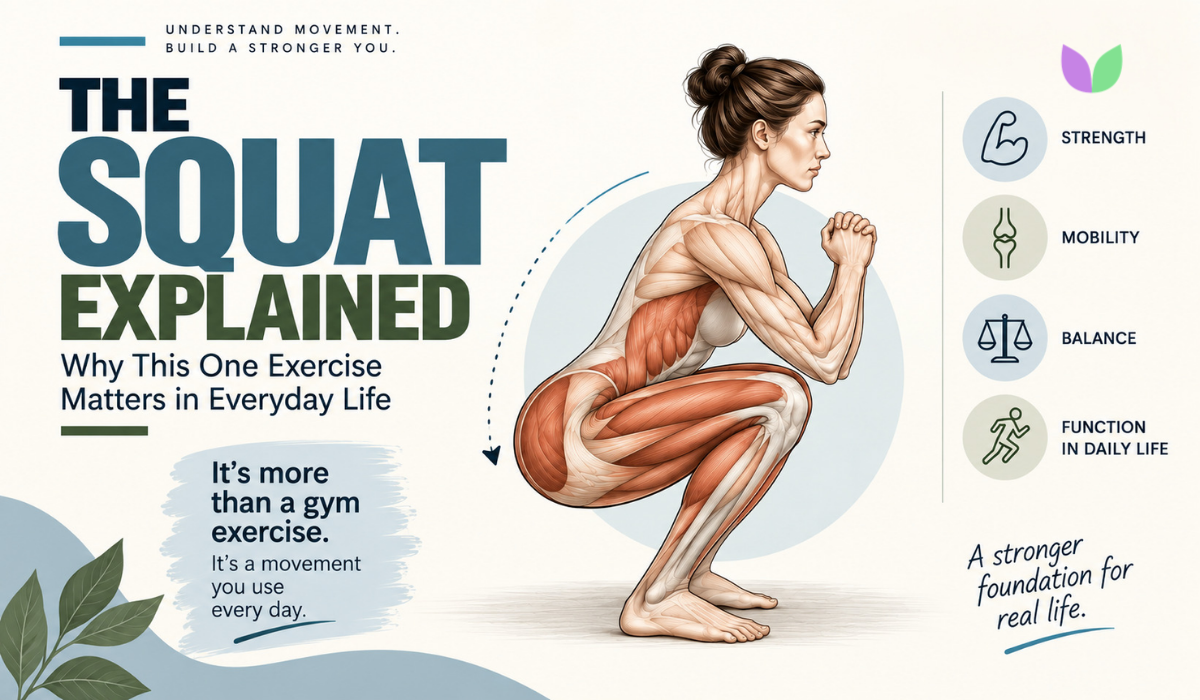
EXERCISE EXPLAINED – EPISODE 1: The Squat Explained: How to Squat, Modify It and Progress Safely
Written by:
Shivani Jain
Co-founder & Clinical Lead Nutritionist, IntuiWell
Mention squats and most people picture a gym.
A barbell. Heavy weights. Someone trying to squat as low as possible.
But you were squatting long before you ever heard the word “workout.”
Every time you sit down on a chair and stand back up, lower yourself toward a seat, or rise from a low surface, your body performs a squat-like movement.
That is what makes the squat so useful.
It isn’t simply an exercise for building bigger legs.
It is a way of training your body to lower and raise itself with strength, balance and control.
Quick Answer
The squat is a fundamental lower-body exercise that trains several muscle groups, including the quadriceps, glutes and muscles that help stabilize the hips and trunk. It also resembles everyday movements such as sitting down and standing from a chair.
There is no single perfect squat stance or depth for everyone. Individual anatomy, mobility, balance, strength and exercise experience influence how a squat looks. Beginners can start with sit-to-stand or supported mini-squats before progressing to unsupported and resisted variations.
Squats are not inherently harmful to the knees, but exercise depth, resistance and volume should match individual capacity. Significant pain, swelling, locking, giving way or worsening symptoms should be professionally assessed.
The practical goal is simple: learn the movement, control it, and gradually make it stronger.
Important Note
This article is for general exercise and movement education. It is not a diagnosis or a replacement for medical advice.
If you have severe knee or hip pain, significant swelling, joint locking or giving way, a recent injury or surgery, sudden inability to bear weight, or pain that continues to worsen, consult a qualified doctor or physiotherapist before starting or changing an exercise program.
About This Series
Exercise Explained is an IntuiWell series designed to make common exercises easier to understand.
We often hear instructions such as “Do squats,” “Strengthen your core,” or “Add resistance training.” But knowing the name of an exercise does not necessarily mean understanding what it does, why it matters, how to perform it, or how to modify it for your current ability.
Each episode takes one familiar exercise and breaks it down into practical questions:
- What does this exercise actually train?
- Why is it useful outside the gym?
- What does good technique look like?
- What mistakes should you avoid?
- How can beginners make it easier?
- How do you know when it is time to progress?
The goal is not perfect exercise.
The goal is to help you understand why you are moving and what your body is learning from it.
Today’s exercise is one of the most fundamental movements of all: The squat.
What Is a Squat?
A squat is a movement in which your hips, knees and ankles work together as you lower your body and return to standing.
Watch yourself sit on a chair.
Your knees bend.
Your hips move backward and downward.
Your ankles adjust.
Your trunk stays controlled.
Then your hips and legs generate force to bring you back to standing.
That is essentially a squat.
The exact movement will look slightly different from person to person because bodies differ in height, limb proportions, mobility, strength and anatomy.
So there is no reason everyone’s squat should look identical.
What Muscles Are Actually Working During a Squat?
A squat is a compound exercise, meaning several joints and muscle groups participate at the same time.
1. Quadriceps
The quadriceps are the large muscles at the front of your thighs.
They help straighten your knees as you rise from the squat.
These muscles are also important when you:
- Stand from a chair
- Climb stairs
- Get up from lower surfaces
- Control your body while lowering
2. Gluteal Muscles
Your gluteal muscles help extend your hips as you return to standing.
They contribute to lower-body strength and hip control.
3. Muscles Around the Hips
Several other muscles around the hips help stabilize and control your legs throughout the movement.
4. Calves and Ankle Muscles
Your ankles need to move and remain stable while you squat.
Muscles around the lower leg therefore contribute to maintaining balance and controlling the movement.
5. Core and Trunk Muscles
Your trunk muscles help stabilize your torso while your hips, knees and ankles move.
This is why squats aren’t simply a “thigh exercise.”
Your body has to coordinate several areas at once.
Why Squats Matter in Everyday Life
The squat pattern appears constantly outside exercise.
Think about an ordinary day.
You may squat when you:
- Sit down at the dining table
- Stand from your office chair
- Get off the sofa
- Use the toilet
- Lower yourself toward a low seat
- Perform household activities
These tasks become so automatic that we rarely think of them as physical skills.
But they require strength.
If lower-body strength declines, something as ordinary as getting out of a low chair can gradually become more difficult.
This is why strengthening exercises matter beyond appearance.
They help preserve physical capability.
How to Perform a Basic Bodyweight Squat
There isn’t one perfect squat technique for every body, but these basic steps provide a useful starting point.
Step 1: Find a Comfortable Foot Position
Stand with your feet approximately hip- to shoulder-width apart.
Your toes can point slightly outward if that feels natural.
You do not need to force your feet perfectly straight.
Step 2: Bend Your Hips and Knees
Begin lowering yourself as though you are going to sit on a chair behind you.
Allow both your hips and knees to bend.
Avoid thinking that the movement must come entirely from your knees or entirely from pushing your hips backward.
The joints work together.
Step 3: Keep Your Feet Stable
Maintain comfortable contact between your feet and the floor.
Your feet provide the base from which the rest of the movement happens.
Step 4: Lower Only as Far as You Can Control
You do not have to reach a particular depth.
Stop where you can maintain:
- Balance
- Control
- Comfortable joint positioning
- Stable foot contact
Step 5: Stand Back Up
Push through your feet and straighten your hips and knees until you return to standing.
Try not to rush.
A simple cue is:
“Lower with control. Stay balanced. Stand tall.”
How Deep Should You Squat?
This is where people often turn a useful exercise into a competition.
One person squats until their thighs are parallel with the floor.
Another can comfortably squat much deeper.
Someone else can manage only a shallow squat.
That does not automatically make one squat correct and another incorrect.
Squat depth can be influenced by:
- Hip mobility
- Ankle mobility
- Strength
- Balance
- Limb proportions
- Previous injuries
- Exercise experience
- Comfort
Your useful squat depth is the range you can control comfortably.
As your mobility, strength and confidence improve, that range may change.
Do Your Knees Have to Stay Behind Your Toes?
One of the most persistent squat instructions is:
“Never let your knees go past your toes.”
This is not a universal rule.
Your knees naturally move forward during many squatting movements. How far they travel depends on factors including your anatomy, ankle mobility, stance and squat depth.
Instead of obsessing over whether your knees cross an imaginary vertical line from your toes, focus on whether the movement is:
- Controlled
- Balanced
- Comfortable
- Appropriate for your ability
Exercise technique should adapt to the person rather than forcing every person into exactly the same shape.
Common Squat Mistakes
Mistake 1: Trying to Copy Someone Else’s Squat
Your body proportions are not identical to another person’s.
Your stance and depth may therefore look different.
Use technique principles rather than trying to reproduce someone’s exact position.
Mistake 2: Going Too Deep Too Soon
A deeper squat is not automatically a better squat.
If reaching greater depth causes you to lose balance or control, reduce the range.
Build depth gradually if it is appropriate for you.
Mistake 3: Dropping Down Quickly
A squat isn’t only about getting back up.
Controlling your body while lowering is also part of the exercise.
Slow down enough to remain in control.
Mistake 4: Adding Weight Too Early
More weight does not automatically mean more effective training.
First learn to perform a comfortable movement that you can control.
Resistance can be added gradually when appropriate.
Mistake 5: Treating Pain as Proof the Exercise Is Working
Muscle effort and fatigue can be normal during strengthening exercise.
Sharp or significant joint pain is different.
Don’t use “no pain, no gain” as a reason to repeatedly force a painful movement.
If a Regular Squat Feels Too Difficult
You don’t have to abandon squats.
Change the squat.
One of the simplest options is a chair.
Start With Sit-to-Stand
Sit on a stable chair with your feet comfortably positioned.
Lean slightly forward.
Stand using your legs.
Then slowly lower yourself back onto the chair.
Repeat only as many times as you can comfortably control.
The NHS includes both sit-to-stand and supported mini-squats among simple strengthening exercises that can be performed at home.
A chair gives you a clear destination and reduces the fear of lowering yourself without support.
How to Progress Your Squat
Progress doesn’t have to mean immediately picking up heavier weights.
Think of squat training as a ladder.
Level 1: Sit-to-Stand
Use a chair.
Level 2: Supported Mini-Squat
Hold a stable surface and practice a smaller squat.
Level 3: Bodyweight Squat
Squat without external support.
Level 4: Slow Squat
Take approximately three seconds to lower yourself.
This increases the muscular challenge without adding external weight.
Level 5: Add Appropriate Resistance
Once the basic movement is comfortable and controlled, resistance can gradually be introduced according to your fitness level and goals.
The progression can therefore look like:
Support → Control → Range → Repetitions → Resistance
You do not have to jump from beginner squats directly to heavy weights.
How Many Squats Should You Do?
There is no magical daily squat number.
Your appropriate amount depends on your:
- Fitness level
- Strength
- Exercise experience
- Squat variation
- Resistance
- Goals
For muscle-strengthening exercise, CDC guidance notes that 8–12 repetitions can constitute one set, with at least one set providing benefit and additional sets potentially providing further benefit.
But beginners don’t need to force themselves immediately to reach a particular number.
If five controlled chair sit-to-stands are challenging today, start there.
As they become easier, gradually progress.
Consistency and progressive challenge matter more than chasing an arbitrary number.
Are Squats Bad for Your Knees?
Squats sometimes get blamed for knee problems because the knees bend during the exercise.
But bending the knee is a normal part of everyday movement.
The better question is:
“Is this squat appropriate for my current ability?”
Someone’s tolerance for squatting can be affected by:
- Existing knee conditions
- Arthritis
- Previous injury
- Recent surgery
- Strength
- Squat depth
- Training volume
- Resistance
- Movement control
If a squat is uncomfortable, possible modifications include:
- Reducing depth
- Using a chair
- Holding support
- Reducing resistance
- Reducing repetitions
- Trying a different squat variation
Squats do not need to be either “always good” or “always bad.”
The appropriate exercise depends on the individual.
Do Squats Replace Walking or Cardio?
No.
Walking and squatting train different components of fitness.
Walking primarily contributes to aerobic physical activity.
Squats can contribute to muscle-strengthening exercise.
Current CDC recommendations for adults generally include both:
- At least 150 minutes of moderate-intensity aerobic activity each week, and
- Muscle-strengthening activity on at least two days each week
So you don’t have to choose between walking and strength training.
A balanced fitness routine can include both.
When to Get Professional Help
Stop or modify squatting and seek appropriate professional assessment if you experience:
- Sudden or severe pain
- Significant knee or hip swelling
- Joint locking
- Repeated giving way
- Sudden inability to bear weight
- Pain following a significant injury
- Symptoms that progressively worsen
- Persistent pain that interferes with normal daily activities
People recovering from surgery or significant musculoskeletal injuries may also need individualized guidance before progressing resistance exercises.
The goal is not to prove that you can push through symptoms.
The goal is to find an exercise level that appropriately challenges your body.
The Bigger Picture
A squat looks like one exercise.
But underneath it are several physical abilities working together:
Strength. Mobility. Balance. Coordination. Control.
That’s why learning to squat has value beyond completing repetitions at the gym.
A stronger squat can support the same movement pattern you use when sitting down and standing up throughout your day.
And that is the central idea behind Exercise Explained.
An exercise becomes much more useful when you understand why you are doing it.
Key Takeaway
You don’t need the deepest squat.
You don’t need the heaviest squat.
And your squat does not need to look identical to someone else’s.
Start with a range you can control.
Use support if you need it.
Build strength gradually.
Then progress as your body becomes more capable.
A good squat isn’t the one that looks most impressive. It’s the one your body can perform with control and progressively improve.
Frequently Asked Questions
1. Are squats good for beginners?
Yes. Beginners do not have to start with deep or weighted squats. Chair sit-to-stands and supported mini-squats can provide easier starting points.
2. How many squats should a beginner do?
There is no mandatory number. Start with a number you can perform comfortably and with good control, then gradually increase the challenge.
3. Should my knees go past my toes?
They may. Some forward knee movement is normal during many squat variations. Anatomy, ankle mobility, stance and squat depth all influence knee position.
4. How low should I squat?
Use a depth that you can comfortably control. You do not have to reach parallel or perform a deep squat for the exercise to be useful.
5. Can I squat if I have knee pain?
Some people can continue squatting with modifications such as reducing depth, using a chair or reducing resistance. Persistent or significant knee pain should be professionally assessed.
6. Do squats strengthen the core?
Your trunk muscles work to stabilize your body during a squat, although squats should not necessarily replace all other trunk-strengthening exercises.
7. Do I need weights to make squats effective?
No. Bodyweight squats, supported squats and sit-to-stands can all provide useful muscular work. Resistance can be introduced when appropriate.
8. How do I know when to make my squats harder?
If your current variation becomes consistently easy while your technique remains controlled, you can gradually increase repetitions, range of motion, movement control or resistance.
Coming Next in Exercise Explained
Episode 2: The Plank Explained — What Is Your Core Actually Doing?
Episode 3: Calf Raises Explained — The Simple Exercise Most People Ignore
Episode 4: Lunges Explained — Why They Feel So Much Harder Than Squats
Episode 5: Rows Explained — The Upper-Body Exercise Desk Workers Should Know
How This Article Was Created
This article was created by IntuiWell as part of the Exercise Explained Series.
The goal of this series is to simplify exercise education so people understand what common exercises train, how they relate to everyday function, how they can be modified, and how to progress them safely.
This post is based on:
- General principles of resistance and functional exercise
- Lower-body movement and strengthening principles
- Practical exercise modification and progression
- Publicly available guidance from trusted health and exercise organizations
The content is educational. It does not diagnose musculoskeletal conditions or replace individualized medical or physiotherapy care.
Understanding an exercise is the first step toward using it well.
At IntuiWell, we simplify movement, fitness, nutrition and everyday wellness so healthy habits become easier to understand and apply in real life.
No perfect workouts. No unnecessary complexity. Just practical, evidence-based movement for everyday life.
Start with a simple conversation.