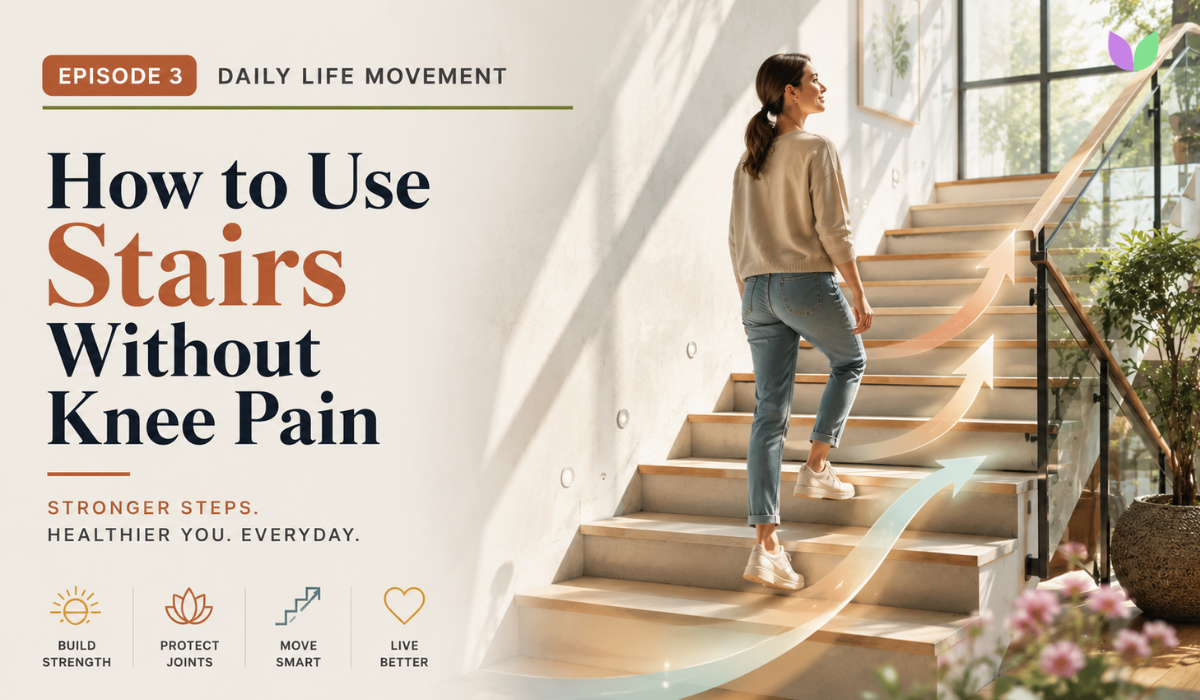
Daily Life Movement Series Episode 3: How to Use Stairs Without Knee Pain – A Simple Guide for Everyday Movement
Important Note
This article is for general movement education. It is not a diagnosis or a replacement for medical advice.
If you have severe knee pain, swelling, locking, giving way, recent injury, sudden pain, or pain that keeps getting worse, consult a qualified doctor or physiotherapist before trying new exercises.
About This Series
Daily Life Movement focuses on improving how you move during everyday activities, not just during workouts.
Most strain does not come from one dramatic movement. It often comes from small repeated movements done with poor control, poor posture, weak muscles, or lack of awareness. These movements look ordinary, but they reveal a lot about real-life strength, balance, mobility, and independence.
If you missed the earlier posts, start with Episode 1: Getting Up from the Floor Safely, where we explained why rising from the floor is a powerful sign of real fitness.
Then read Episode 2: How to Get In and Out of a Car Without Back or Knee Pain, where we looked at how twisting, poor control, and uneven loading can create daily strain.
Today’s movement is stairs.
This matters because stairs are not occasional for most people. They are repeated almost every day at home, at work, in buildings, in public places, and while travelling. The way you climb and descend stairs can either build strength and confidence or keep irritating your knees over time.
How to Use Stairs Without Knee Pain
Most people blame stairs for their knee pain. But stairs are not always the real problem.
Stairs are not the enemy. Weak hips, poor control, rushing, poor foot placement, and existing knee issues can make stairs painful.
Climbing and descending stairs is one of the most repeated movements in daily life. Every step asks your body to manage strength, balance, alignment, and body weight transfer. When that movement is rushed or uncontrolled, the knee often absorbs more stress than it should.
But when you use stairs with better control, they can become a simple way to build leg strength, improve balance, and move with more confidence.
The goal is not to fear stairs. The goal is to understand how to use them better.
Why Stairs Can Trigger Knee Pain
Using stairs requires more from your body than most people realize.
It needs single-leg strength, knee stability, hip control, balance, good foot placement, and controlled body weight transfer. If your hips, thighs, and glutes are not strong enough, the knee often takes over more load than it should.
This is one reason many people feel pain while climbing or descending stairs. The knee may be where the pain shows up, but the real issue may also involve the hip, thigh, foot, balance, or overall movement control.
Going down stairs is usually harder than going up because your muscles have to slow your body against gravity. If that braking control is weak, the knee absorbs more impact. This is why descending stairs often feels more painful than climbing, especially for people who already have knee sensitivity.
This is also why hip strength matters. Harvard Health explains that building strength in the muscles around the knee, pelvis, and core can help reduce pressure on the joints and support better movement.
In simple words, the knee should not work alone. Your hips, thighs, feet, and balance system must help.
How to Climb Stairs Safely
Going up stairs should feel controlled, not rushed. Many people climb stairs on autopilot, but small changes in foot placement and body control can reduce unnecessary knee strain.
Here is a safer way to climb.
Step 1: Place Your Whole Foot on the Step
Keep your full foot on the step as much as possible.
Avoid climbing only on your toes. When you place only the front part of your foot on the step, your calf and knee may take more load, while your hip and thigh support may reduce.
A fuller foot placement gives your body better support and control. It also helps you push through the leg more evenly instead of forcing the knee to do most of the work.
Step 2: Push Through Your Heel and Mid-Foot
As you climb, push through your heel and mid-foot.
Do not pull yourself up only through the knee. This small change helps you use your glutes and thigh muscles better, which can reduce pressure around the knee.
A useful cue is:
“Push the step away from me.”
This cue often improves control immediately because it shifts your focus from dragging the body upward to using the whole leg with better strength.
Step 3: Use Your Hips, Not Just Your Knees
Your hips should help you climb stairs. Your knee should not do all the work.
Think:
“Push up using my hip, not pull up with my knee.”
When your hips and glutes are active, the knee gets better support. This does not mean the knee will not bend or work. It simply means the knee is not carrying the entire burden alone.
This principle is similar to what we discussed in Episode 2 on getting in and out of a car. When one joint does too much and the rest of the body does too little, strain increases.
Step 4: Keep Your Knee Aligned
Watch the direction of your knee as you climb.
Your knee should move in line with your toes. Avoid letting the knee collapse inward, especially when you are tired or climbing quickly.
A simple check:
Your knee, second toe, and hip should roughly point in the same direction.
This does not have to be perfect, but awareness matters. Better alignment gives your knee more support and reduces unnecessary inward stress.
How to Go Down Stairs Safely
Going down stairs is usually harder on the knees than going up.
This is where many people feel pain, pressure, or fear. The reason is simple. When you go down, your muscles have to slow your body down. If your muscles do not control the movement well, your joints absorb more impact.
Descending stairs is not just stepping down. It is controlled lowering.
Step 1: Lower Yourself Slowly
Do not drop your body weight onto the next step.
Lower yourself with control. Slow movement builds strength and confidence, while fast dropping increases impact.
If you hear a heavy thud with every step, slow down. Your goal is a quiet, controlled landing.
This one habit can make stairs feel very different.
Step 2: Use the Railing When Needed
Using the railing is not weakness. It is smart movement.
The railing gives support, reduces fear, and improves balance. If you already have knee pain, back pain, balance issues, or fear of falling, use the railing without hesitation.
Control matters more than ego.
This is especially important for older adults, people recovering from pain, people carrying bags, or anyone using stairs when tired.
Step 3: Keep Your Body Slightly Forward
Avoid leaning back while going down stairs.
A slight forward lean can help you control the descent better. This does not mean bending excessively or hunching forward. It simply means avoiding a stiff, backward-leaning posture where your body weight falls heavily into the knee.
Your body should feel balanced, not rigid.
Step 4: Land Softly
Try to land quietly.
A hard landing usually means your knee is absorbing more impact. A softer landing means your muscles are helping you control the movement.
Think:
“Step down with control, not with force.”
This cue is simple, but powerful. It trains your body to slow down instead of collapse onto the next step.
Common Mistakes While Using Stairs
Mistake 1: Rushing Up or Down
Rushing reduces control.
When you rush, your knee, hip, and foot alignment often become poor. You may also land harder, skip proper foot placement, or overuse one leg without realizing it.
Slow down first. Speed can come later.
Mistake 2: Letting the Knees Collapse Inward
This is common while climbing stairs.
The knee moves inward while the foot stays forward. Over time, this can increase stress around the knee and reduce movement control.
Focus on keeping your knee in line with your toes. You do not need to overthink every step, but you do need to become aware of your pattern.
Mistake 3: Using Only One Strong Leg
Many people unknowingly overuse one leg.
One leg always climbs first. One leg always carries more load. One side feels stronger, so the body keeps depending on it.
This may feel easier in the moment, but it can create imbalance over time. Try to notice which leg you trust more and which leg feels weaker, less stable, or more painful.
Awareness is the first step before correction.
Mistake 4: Ignoring Pain Signals
Pain is information.
Do not panic every time you feel discomfort, but do not ignore repeated pain either. If the same pain keeps coming back every time you use stairs, your body may be asking for better support, better strength, better movement control, or proper assessment.
Pushing through pain without understanding it is rarely a good strategy.
If You Already Have Knee Pain
If stairs already hurt, do not try to prove strength by forcing through pain.
Use a safer approach.
- Take one step at a time
- Use the railing
- Reduce speed
- Avoid carrying heavy bags on stairs
- Avoid rushing when tired
- Focus on soft landing
- Keep your knee aligned with your toes
You can also use this simple rule:
Going up: lead with the stronger leg.
Going down: lead with the painful or weaker leg.
This can reduce the load on the painful knee and give you better control. Use this as a temporary support strategy, not as a permanent habit. Over time, the goal should be to improve strength and confidence on both sides.
If you need this rule for a long time, it may be a sign that your knee, hip, thigh strength, or balance needs proper attention.
When to Get Professional Help
Do not push through stair pain if you have swelling, sharp pain, knee locking, knee giving way, pain after a fall or injury, pain that is getting worse, pain that affects daily walking, or sudden inability to bear weight.
In these cases, stairs are not just a movement issue. You need proper assessment.
Mayo Clinic advises medical attention when knee pain follows major injury, the knee cannot bear weight, pain is intense, or sudden swelling appears.
A qualified doctor or physiotherapist can help identify whether the pain is coming from the knee joint, muscles, hip weakness, balance issues, injury, arthritis, or another underlying cause.
Exercises That Make Stairs Easier
You do not need complicated exercises to improve stair movement. You need strength, control, and confidence.
Simple exercises such as step-ups, sit-to-stand, and bridging are commonly used in knee-strengthening guidance, including NHS Inform’s knee exercise recommendations.
Start small. Focus on quality. Stop if you feel sharp pain.
1. Step-Ups
Step-ups build strength for climbing stairs.
Use a low step first. Hold the railing or wall for support if needed. Step up slowly, bring the second foot up, and then step down with control.
Do not bounce. Do not rush.
Focus on pushing through your heel and keeping your knee aligned with your toes. If the knee collapses inward or you feel sharp pain, reduce the height or stop and get guidance.
2. Controlled Step-Downs
Step-downs train control for going down stairs.
This is important because descending stairs usually irritates knees more than climbing. Your muscles have to control your body weight against gravity, and that requires strength as well as confidence.
Start with a very low step. Slowly lower one foot toward the floor. Do not drop your body weight suddenly.
Control the movement from your hip and thigh.
If this causes sharp pain, stop and get assessed.
3. Glute Strengthening
Strong hips reduce unnecessary knee stress.
Two simple options are hip bridges and sit-to-stand.
For hip bridges, lie down, bend your knees, and lift your hips slowly while focusing on your glutes. For sit-to-stand, sit on a chair, stand up slowly without letting your knees collapse inward, and sit back down with control.
These exercises help your hips and thighs support your knees better during stairs.
Strong hips usually mean better knee control. Harvard Health also highlights that exercises strengthening the muscles supporting the knees and hips can be especially helpful for knee and hip problems through regular, appropriate exercise.
The Bigger Picture
Your knees are not always the main problem.
Very often, the knee is the place where the pain shows up, but the reason may be poor control from the hips, weak thighs, poor foot placement, rushing, or lack of balance. The knee ends up taking extra load because other parts of the body are not doing enough.
This is the same core principle behind this entire Daily Life Movement Series.
In Episode 1, getting up from the floor showed us how strength, balance, mobility, and confidence work together.
In Episode 2, getting in and out of a car showed us how twisting under load can quietly strain the back, hips, and knees.
In this episode, stairs show us how repeated daily movement can either overload the knee or train the body to become stronger.
When your hips, thighs, feet, and balance improve, your knees often feel more supported. Stairs then become less threatening. They become a daily strength-building opportunity.
Key Takeaway
Use your hips. Control your movement. Do not rush.
Place your foot properly. Keep your knee aligned. Land softly. Use support when needed.
Stairs are not harmful by default. They can become a safe way to build strength when you use them with better control.
Real fitness is not only what you do in a workout.
It is how confidently and safely you move through daily life.
Blog Summary
Stairs often trigger knee pain because they require strength, balance, hip control, and knee stability. Poor foot placement, rushing, weak hips, and uncontrolled descent can increase knee stress, especially when the same movement is repeated every day.
To use stairs safely, place your whole foot on the step, push through your heel and mid-foot, keep your knee aligned with your toes, use your hips, and descend slowly with control. If you already have knee pain, use the railing, slow down, avoid carrying heavy loads, and follow the stronger-leg-up, painful-leg-down rule when needed.
Simple exercises like step-ups, controlled step-downs, hip bridges, and sit-to-stand can improve strength and control over time. However, sharp pain, swelling, locking, giving way, or worsening pain should not be ignored. In those cases, professional assessment is important.
FAQs
1. Why do my knees hurt while using stairs?
Knee pain on stairs can happen because of weak hips, weak thighs, poor knee control, poor foot placement, rushing, or existing knee conditions. Going down stairs often hurts more because your muscles have to control your body weight against gravity.
2. Is climbing stairs bad for knees?
Stairs are not bad for everyone. For many people, stairs can help build leg strength and confidence when done with good control. But if you already have knee pain, swelling, injury, arthritis, or poor strength, stairs may feel painful and should be managed carefully.
3. Why does going down stairs hurt more than going up?
Going down stairs requires more braking control. Your thigh and hip muscles have to slow your body down. If this control is weak, the knee may absorb more stress.
4. Should I avoid stairs if I have knee pain?
Not always. Mild discomfort may improve with better control, slower movement, support, and strengthening. But you should avoid pushing through sharp pain, swelling, locking, giving way, or worsening pain.
5. What is the safest way to climb stairs with knee pain?
Use the railing, go slowly, place your full foot on the step, keep your knee in line with your toes, and lead with the stronger leg while going up.
6. What is the safest way to go down stairs with knee pain?
Use the railing, go one step at a time, lower yourself slowly, and lead with the painful or weaker leg while going down. This can reduce load on the painful side.
7. Which exercises help with stair pain?
Step-ups, controlled step-downs, hip bridges, and sit-to-stand exercises can help improve strength and control. Start with low intensity and stop if you feel sharp pain.
8. When should I see a doctor or physiotherapist for knee pain?
Get help if you have swelling, sharp pain, locking, giving way, pain after injury, sudden inability to bear weight, or pain that keeps getting worse.
Related Posts in This Series
- Episode 1: Getting Up from the Floor Safely — A Simple Skill That Shows Real Fitness
- Episode 2: How to Get In and Out of a Car Without Back or Knee Pain
How This Article Was Created
This article was created by IntuiWell as part of the Daily Life Movement Series.
The goal of this series is to simplify everyday movement education so people can understand how daily habits affect strength, mobility, balance, joint comfort, and long-term independence.
This post is based on:
- Practical movement education used in daily wellness coaching
- Common knee pain patterns seen during stair climbing and descending
- General principles of functional strength, hip control, knee alignment, balance, and safe load management
- Publicly available references from trusted health and research sources
The content is educational. It does not diagnose knee conditions or replace medical care.
References
- NHS Inform — Exercises to help with osteoarthritis of the knee
- Harvard Health Publishing — Take control of your knee pain
- Harvard Health Publishing — Exercising with knee or hip pain
- Mayo Clinic — Knee pain: When to see a doctor
- Mayo Clinic — Knee pain: Symptoms and causes
Pain during daily movement is often your body asking for better support, not fear.
At IntuiWell, we help you understand your daily habits, movement patterns, nutrition, strength, and lifestyle together so your body can feel more supported in real life.
If you are struggling with energy, pain, stiffness, weight, digestion, hormones, or lifestyle consistency, explore IntuiWell’s personalized wellness guidance.
Start with a simple conversation.