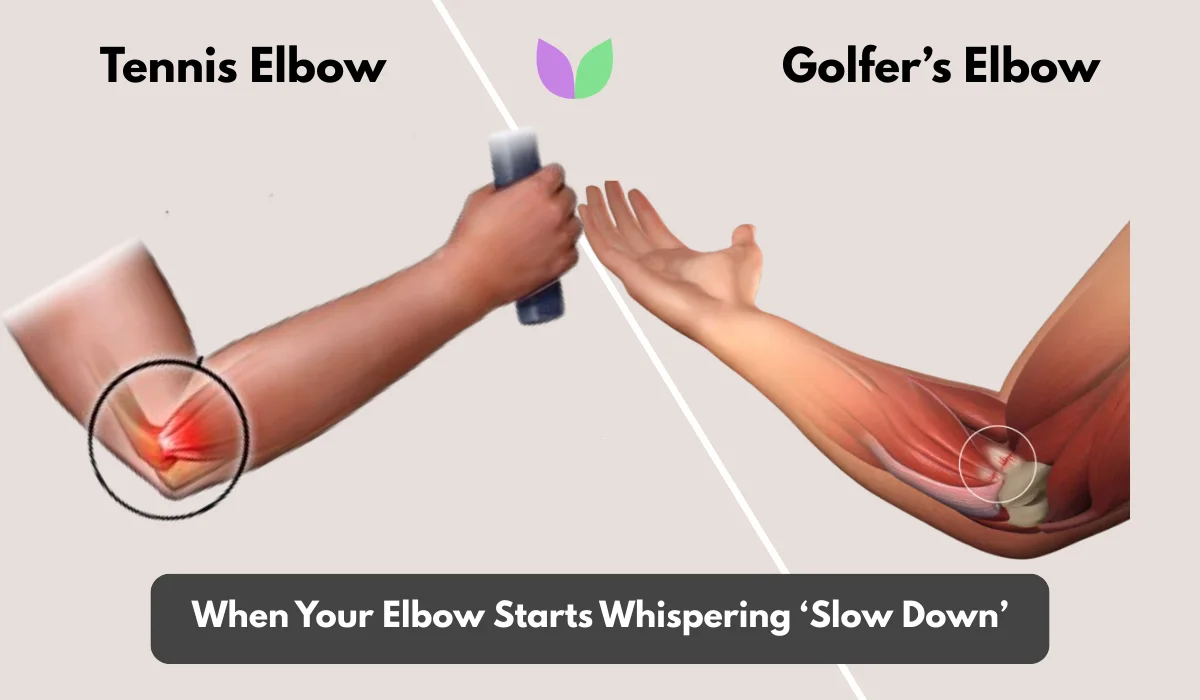
When Your Elbow Starts Whispering ‘Slow Down’
You know that sharp ache that shows up after a long game of pickleball, a few too many backhands, or even typing all day?
That’s your elbow trying to start a conversation.
It’s easy to ignore it or label it “just sore,” but that mild pain could be a sign of tendon overload, better known as tennis elbow or golfer’s elbow.
They sound similar, but they’re actually opposites, different sides, different muscles, same message:
Your body is asking you to balance effort with recovery.
Tennis Elbow Pain on the Outside
If you feel pain on the outer side of your elbow (the part that faces away from your body), it’s usually tennis elbow.
What you might notice:
- A burning or dull ache when gripping or lifting things.
- Pain when picking up a coffee cup, racket, or even your laptop.
- Stiffness that worsens after repetitive motions.
Why does it happen?
The muscles that straighten your wrist get overworked, especially with gripping or lifting.
Over time, small microtears form in the tendon that attaches to the outer bone of your elbow.
And it’s not just athletes — desk workers, painters, or anyone who repeats the same wrist motion can get it.
Golfer’s Elbow Pain on the Inside
Pain on the inner side of your elbow? That’s likely a golfer’s elbow.
What you might notice:
- Tenderness near the bony bump inside your elbow.
- Pain when curling, gripping, or twisting your wrist.
- Weakness when holding a ball, cup, or phone.
Why does it happen?
This time, it’s the muscles that bend your wrist that are irritated.
Repetitive wrist flexion, such as swinging a golf club, lifting weights, or carrying heavy grocery bags, can strain the tendons on the inner elbow.
Quick Check: Which One Might You Have?
| Feature | Tennis Elbow | Golfer’s Elbow |
| Where it hurts | Outside of the elbow | Inside of the elbow |
| Main cause | Overuse of wrist extensors | Overuse of wrist flexors |
| Common in | Tennis, pickleball, typing | Golf, weightlifting, carrying |
| Pain trigger | Lifting with the palm facing down | Lifting with palm facing up |
How to Heal (the Intuiwell Way)
1. Pause, Don’t Panic
Pain is feedback, not failure.
Take a few days off from the motion that caused it. Keeping your arm moving gently slows stiffness, which hinders recovery more than rest ever helps.
2. Strengthen Small, Heal Big
Once the pain calms, rebuild tendon strength through slow, mindful movements:
- Light wrist curls (palms up and down)
- Gentle twisting motions with a small dumbbell or even a water bottle
- Squeezing a stress ball for 5–10 seconds at a time
Eccentric movements (slowly lowering) are magic for tendon repair they strengthen without overload.
3. Stretch Like You Mean It
- For tennis elbow: extend your arm and gently bend your wrist down.
- For golfer’s elbow: extend your arm and gently bend your wrist up.
Hold each for 20–30 seconds. A little daily consistency beats long, painful sessions.
4. Check Your Technique
Your body remembers patterns.
- If you play a racquet sport, relax your grip, don’t muscle every shot.
- In the gym: keep wrists straight and neutral during curls and presses.
- At your desk: adjust mouse and keyboard height to keep elbows relaxed.
5. Strengthen the Chain, Not Just the Spot
Elbow pain often starts higher up weak shoulders, tight forearms, or poor posture can all pass stress down.
Train your shoulders and back. Stretch your chest. Let your posture help your joints, not fight them.
Healing Reminder
Your elbow pain isn’t a sign of weakness; it’s an invitation to reconnect.
To listen.
To move with more awareness and less autopilot.
Every ache is your body’s way of saying:
“Something small needs your care before it becomes something big.”
Move smarter. Rest deeper. Strengthen slower.
That’s the Intuiwell way to balance burnout.
References
- American Academy of Orthopaedic Surgeons (AAOS) – Elbow Pain & Overuse Injuries. https://orthoinfo.aaos.org
- Coombes, B.K. et al. (2015). Eccentric Exercise for Tendinopathy. Journal of Hand Therapy.https://www.jospt.org/doi/epdf/10.2519/jospt.2015.5841
- Cleveland Clinic (2023) – Tennis Elbow vs. Golfer’s Elbow: Key Differences.https://my.clevelandclinic.org/health/diseases/7049-tennis-elbow-lateral-epicondylitis
- Harvard Health Publishing (2022) – Understanding Tendon Pain.https://www.health.harvard.edu/diseases-and-conditions/tendonitis-a-to-z
Summary
The blog breaks down the real difference between tennis elbow and golfer’s elbow—two tendon overload injuries that show up when your body has had enough repetitive wrist and forearm strain.
Tennis elbow hits the outer side of the elbow due to overworked wrist-extensor muscles. You’ll feel pain when gripping, lifting, or performing repetitive wrist movements.
Golfer’s elbow affects the inner side due to irritated wrist-flexor muscles, showing up as pain when curling, gripping, or twisting the wrist.
The blog lays out a simple, practical recovery blueprint: pause the activity that triggered the pain, keep the arm moving gently, rebuild tendon strength through slow controlled movements, use targeted stretches, correct sport/gym/desk technique, and strengthen the entire upper-body chain to avoid recurrence. The core message: pain isn’t a failure; it’s early feedback that your body needs better balance between effort and recovery.
FAQs
1. How do I know if I have tennis elbow or golfer’s elbow?
Check where it hurts.
Outside = tennis elbow.
Inside = golfer’s elbow.
The side alone gives you your answer 90% of the time.
2. Should I stop all activity if my elbow hurts?
No. Stop the movements that caused the pain, but keep gentle mobility. Full rest slows recovery; controlled movement speeds it up.
3. How long does healing take?
Anywhere from 4–12 weeks, depending on how consistently you strengthen and stretch. Tendons heal slowly—don’t expect overnight results.
4. Do I need a scan or X-ray?
Not unless the pain is severe, persistent for months, or associated with swelling/numbness. Most cases are diagnosed clinically.
5. What exercises help the fastest?
Slow eccentric wrist curls, light forearm rotations, grip-strength holds, and daily stretching. These rebuild tendon load tolerance without flaring symptoms.
6. Can desk workers get these injuries?
Absolutely. Repetitive mouse/keyboard use is one of the biggest culprits.
7. When should I see a specialist?
If your pain doesn’t improve in 2–3 weeks, gets worse, or affects daily activities, get a guided rehab plan.
Want a personalised recovery plan?
👉 Book a consultation call with Intuiwell or request a call-back now.