
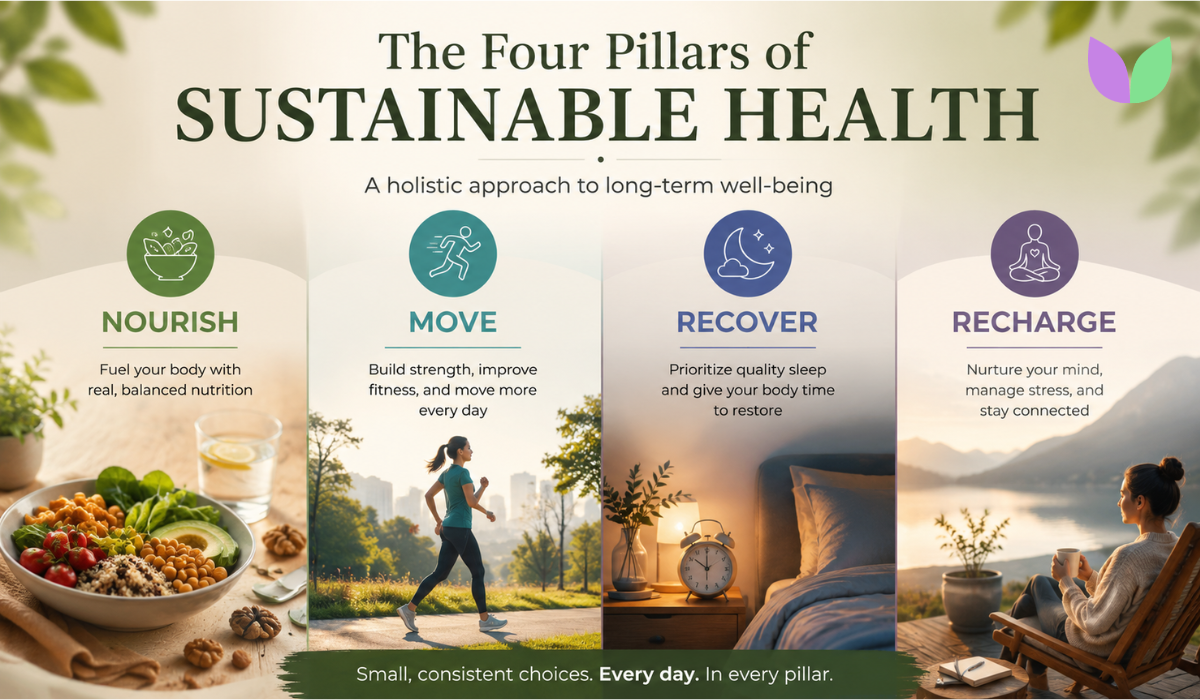
The Four Pillars of Sustainable Health: Why Being Healthy Is About More Than Eating Well
She was doing almost everything we are told to do to stay healthy.
She ate reasonably well, avoided junk food most days, and tried to exercise whenever she could.
Yet by afternoon, she was exhausted. By evening, cravings took over. And every night came the same thought:
“Tomorrow, I’ll be more disciplined.”
But was discipline really the problem?
Look beyond her diet and a different picture appears.
She was sleeping barely six hours. Sitting for most of the day. Eating lunch between meetings. Carrying stress from one day into the next.
Her diet wasn’t necessarily the missing piece.
She was trying to build health on one strong pillar while the others were struggling.
At IntuiWell, we look at sustainable health through four interconnected pillars:
Nutrition. Movement. Sleep. Mental well-being.
Each carries part of the load. And when one is consistently neglected, the others often have to work harder.
1. Nutrition: Nourish Before You Restrict
Think about a typical busy day.
You rush breakfast. Lunch gets delayed. By 5 PM, you are starving. Dinner becomes larger than planned, and you think:
“I really need to control my diet.”
But the problem may not have started at dinner.
Your sleep can influence your appetite. Your schedule influences when you eat. Stress can affect what and how much you eat.
This is why sustainable nutrition is about more than choosing “healthy foods.”
Your body needs adequate nourishment: protein, fibre-rich foods, healthy fats, minimally processed sources of carbohydrates, vitamins, minerals, hydration, and enough energy to meet your individual needs.
Instead of always asking:
“What should I stop eating?”
Try asking:
“What is my body consistently missing?”
Maybe it is protein at breakfast. More vegetables and fibre. Better hydration. Regular meals. Or simply enough food earlier in the day so that you are not ravenous by evening.
Did you know?
Sleep and nutrition are more connected than they appear. Research suggests that insufficient sleep can influence appetite, cravings, and the way the brain responds to food, which may make high-calorie foods more appealing.
So sometimes, persistent cravings are not simply a question of willpower.
Try this
Build most meals around a simple foundation:
Protein + vegetables or fruit + minimally processed carbohydrates + healthy fats
It does not have to be perfect at every meal. It needs to be practical enough to repeat.
2. Movement: Your Body Needs More Than a Workout
You exercise for 45 minutes in the morning.
Then you sit at breakfast, during your commute, at your desk, through meetings, and again in the evening.
You exercised. But did you move enough throughout the day?
A well-rounded approach to movement includes more than just a scheduled workout.
Everyday movement keeps your body active throughout the day.
Aerobic activity supports cardiovascular fitness and endurance.
Strength and mobility work help support muscle, physical function, balance, and the ability to move well.
You do not need to do everything every day. But focusing only on a workout while spending most of your remaining hours sedentary misses part of the picture.
Did you know?
The World Health Organization recommends regular physical activity for adults, including aerobic and muscle-strengthening activity, while also encouraging people to limit sedentary time.
In other words:
Being active matters. Sitting less matters too.
Try this
Instead of asking only:
“Did I exercise today?”
Also ask:
“How often did I give my body a chance to move?”
A ten-minute walk after a meal, taking the stairs, standing during a phone call, or getting up between long periods of sitting may seem small.
Repeated daily, small movements add up.
3. Sleep: Don’t Sacrifice Recovery in the Name of Health
Imagine waking up an hour earlier every morning to exercise, but still going to bed at the same time.
You are exercising more…
but sleeping less.
Soon, you are tired. Coffee intake increases. Cravings increase. Exercise feels harder.
Sometimes, we sacrifice one pillar while trying to improve another.
Sleep is often that pillar.
Sleep supports physical recovery, cognitive function, emotional well-being, metabolism, immune function, and appetite regulation.
When sleep suffers, other healthy habits can become harder to maintain.
Did you know?
For most adults, getting at least seven hours of sleep each night is generally recommended, although sleep needs vary with factors such as age and individual health.
Sleep quality and consistency matter too.
Try this
Before adding another wellness habit to your morning, ask whether your body is getting enough recovery first.
Sometimes the healthier choice is not another workout, another supplement, or another elaborate morning routine.
It is going to bed.
4. Mental Well-Being: When Wellness Itself Becomes Stressful
Did I eat enough protein?
Did I walk 10,000 steps?
Did I drink enough water?
Did I exercise?
Did I sleep enough?
Ironically, even trying to be healthy can become another source of pressure.
Mental well-being does not mean eliminating stress. It means having ways to cope with it, recover from it, and stay connected to the things and people that matter to you.
For one person, that may be meditation.
For someone else, it may be gardening, prayer, music, walking outdoors, talking to a friend, spending meaningful time with family, or simply sitting quietly with a cup of tea.
Social connection matters too.
Supportive relationships and a sense of belonging are not extras around our health. They are part of our overall well-being.
The question is not:
“What should I be doing for stress?”
It is:
“What actually helps me feel restored?”
There is a difference between distraction and recovery.
Endless scrolling may distract you for thirty minutes.
A walk, meaningful conversation, quiet time, or something you genuinely enjoy may leave you feeling different afterward.
Try this
Identify one thing that genuinely helps you mentally recharge and intentionally make room for it during your week.
It does not have to look like a “wellness practice” to support your well-being.
Your Weakest Pillar May Be Limiting Your Strongest One
Someone can eat exceptionally well but consistently sleep only five hours.
Someone can exercise every day but live under constant stress.
Someone can sleep well but spend almost the entire day sitting.
Someone can do everything “right” physically while feeling mentally exhausted and disconnected.
This is why health cannot be reduced to one habit.
Poor sleep can affect hunger and energy.
Low energy can make movement harder.
Stress can influence sleep and eating patterns.
Nutrition influences energy and recovery.
One struggling pillar can pull on the others.
But here is the encouraging part:
The reverse can happen too.
Sleep better, and you may have more energy to move.
Move regularly, and you may sleep better.
Eat balanced meals, and your energy may become more stable.
Manage stress better, and healthy choices may begin to feel easier.
Strengthening one pillar can create a positive ripple effect across the others.
Sustainable Health Does Not Mean Perfect Balance
You do not need to give all four pillars equal attention every single day.
Your needs change.
During a demanding work period, sleep and mental recovery may need more attention.
At another stage, nutrition or movement may be where you need to focus.
Ask yourself:
Nutrition: Am I nourishing my body consistently?
Movement: Am I moving throughout my day, not just during workouts?
Sleep: Am I giving my body enough time and consistency to recover?
Mental well-being: Do I have genuine ways to manage stress, connect, and recharge?
One answer may stand out.
Start there.
Not with five changes.
With one.
Maybe it is eating a proper breakfast.
Walking for ten minutes after dinner.
Going to bed thirty minutes earlier.
Calling someone you enjoy talking to.
Or creating twenty quiet minutes in your day without feeling the need to be productive.
Small enough to do.
Realistic enough to repeat.
The IntuiWell Perspective: Can Your Health Routine Survive an Ordinary Tuesday?
Healthy living feels easier when everything is going according to plan.
The groceries are stocked. You have time to cook. You slept well. Motivation is high.
But what about an ordinary Tuesday?
You slept late.
Work is hectic.
Dinner is not planned.
Someone at home needs your attention.
And exercise is the last thing you feel like doing.
Can your healthy lifestyle survive that day too?
That is where sustainability really matters.
At IntuiWell, we believe health should not depend on perfect days.
Some days, one pillar will be stronger than another. Some weeks, sleep may need more attention. During stressful periods, simply maintaining your basic routines may be enough.
The goal is not perfect balance every day.
The goal is to keep returning to your foundation.
The Four Pillars at a Glance
If there is one thing to remember from this article, remember these four:
NOURISH
Give your body the nutrients and energy it needs through balanced, varied eating.
MOVE
Combine regular physical activity with more opportunities to move throughout everyday life.
RECOVER
Protect sufficient, good-quality sleep and give your body the time it needs to restore.
RECHARGE
Support your mental well-being through stress management, meaningful connection, and activities that genuinely restore you.
Nourish. Move. Recover. Recharge.
You do not need to perfect all four every day.
Notice which one needs you most, strengthen it, and keep returning to the four.
Because sustainable health is rarely built through one dramatic transformation.
It is built through ordinary choices, repeated consistently enough that they begin to support one another.
And that is what makes health sustainable.
References
Healthy Diet — World Health Organization
WHO Guidelines on Physical Activity and Sedentary Behaviour — World Health Organization
About Sleep — Centers for Disease Control and Prevention
Getting Sufficient Sleep Reduces Calorie Intake — National Institutes of Health
Mental Health: Strengthening Our Response — World Health Organization
Social Connection — World Health Organization


