Why You Can’t Sleep Even When You’re Exhausted: The Mind Loop Behind Fatigue, Brain Fog, and Racing Thoughts
Quick Summary
What this is about: Why exhaustion, brain fog, and a mind that won’t switch off at night can be driven by more than sleep habits alone.
The pattern: Daytime pressure keeps your system on alert into the evening. Sleep suffers. You compensate with caffeine, which keeps the alert state running, and tomorrow repeats.
Why sleep hygiene may not be enough: It addresses the last part of a day that has been building pressure for fourteen hours.
Rule this out first: Sleep apnea, thyroid dysfunction and iron deficiency can produce overlapping symptoms. See a doctor before assuming this is behavioural.
What you can try tonight: A five-minute Evening Handover. A practical five-step version is included below, along with a simple way to track whether it may be helping over seven days.
The Day Ends. Your Mind Doesn’t.
You close the laptop. You’ve finished what needed finishing, and by any reasonable measure the workday is done.
But the thinking continues. The replay of what was said in that meeting, the rehearsal of what you’ll say tomorrow, the low background hum of everything unresolved: the decision still pending, the message you didn’t reply to, the conversation left half-open.
By the time you get into bed, your body is exhausted. Your mind has other plans.
And in the morning you wake up already behind, not because of anything that happened overnight but because sleep didn’t do the repair work it was supposed to do. So you start the day at a deficit. An extra coffee, then another, and by mid-afternoon you’re pushing yourself to stay sharper than you should have to, for longer than you should have to. By evening you’re wired again, and the whole thing runs one more time.
For some people, this is not only a sleep problem. It is also a pattern problem, and there may be a specific place where that pattern can be interrupted.
What I Mean by a Mind Loop
I work with professionals under sustained pressure, people who are by most external measures doing perfectly well, and underneath a wide range of complaints I keep finding the same shape.
Tiredness that sleep doesn’t fix. Difficulty concentrating even after a good weekend. Reacting to small things more sharply than the situation deserves. A constant low-grade sense of running slightly behind, no matter how much gets done.
None of that is a character flaw, and none of it is something you should have been able to think your way out of. Often what’s happening is a loop: a cycle where each step quietly creates the conditions for the next one, until you arrive back where you started and begin again.
Let me show you the one I see most often, and let me show it the way I actually encountered it.
A Call I Took Last Year
This is a composite example based on real conversations. Identifying details have been changed to protect privacy, and the dialogue has been reconstructed to represent the recurring pattern accurately.
She was in her late thirties. Senior role, large company, well regarded. She came on the call wanting to talk about energy, specifically about why she had none.
She’d done her homework, and she listed it for me: no screens after ten, bedroom cool and dark, magnesium supplement, a wind-down playlist. She’d read the books. She was following the advice properly.
“I do everything right,” she said. “And I still lie there for an hour.”
“What are you thinking about,” I asked, “in that hour?”
She paused.
“Work, mostly. Things I didn’t finish. Things I need to say to people.”
“Anything in particular?”
“There’s a conversation I’ve been avoiding with someone on my team. Three weeks now.”
“Do you think about it during the day?”
“Not really. I’m too busy.”
I sat with that for a second.
“So the only time your mind gets to process it — is the moment you stop moving.”
There was a long pause on the line.
“I hadn’t thought of it like that.”
Here’s what was actually happening.
Her sleep hygiene was excellent and it made little difference, because the pressure wasn’t building at 11 PM. It was building at three in the afternoon, when she deferred that conversation for the fourteenth day running, and again at six when she moved from her last meeting straight into dinner without a gap anywhere in between, and again at nine when she checked email “just quickly” before bed.
Her mind wasn’t racing at night because it was overactive. It was racing because that was the first quiet moment it had been given all day.
The unfinished conversation was never only a sleep problem. It was a daytime problem that became visible at night.
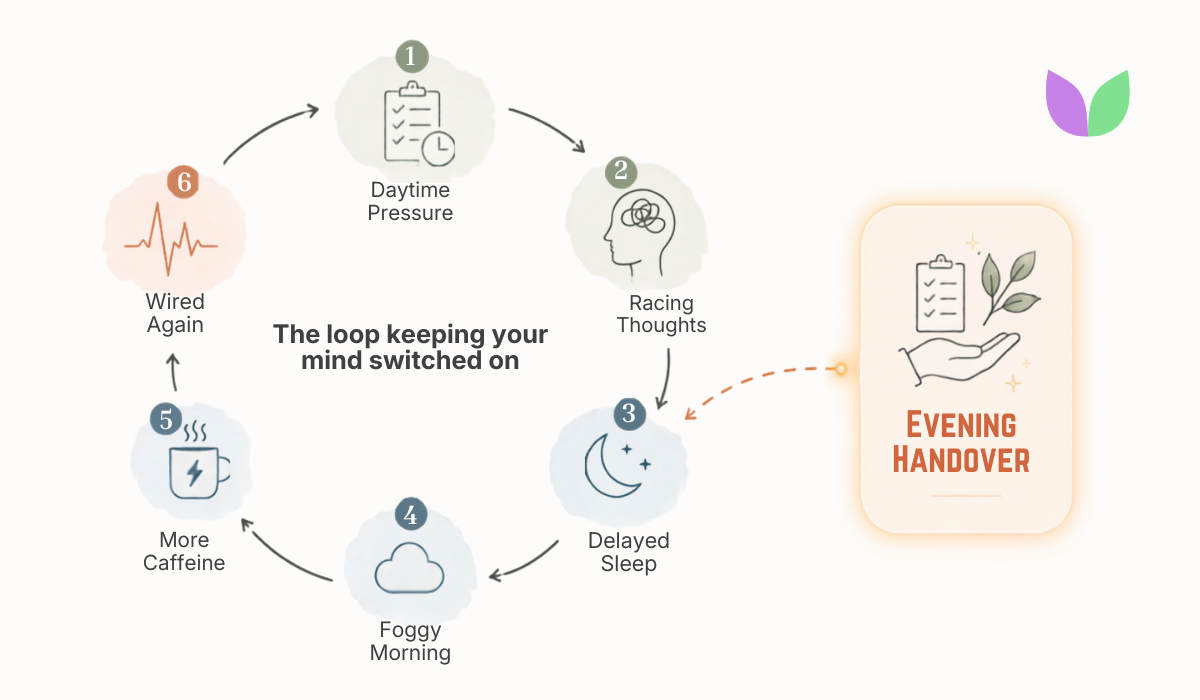
The Loop, Laid Out
Here is the shape it takes. Most people find themselves somewhere in the first four steps.
- A full day of decisions, meetings, and unresolved tensions. No genuine gap anywhere.
- Your stress response stays switched on into the evening. It’s designed to wind down as the day fades, but sustained pressure can override that.
- You get into bed. Your mind finally has space, and uses it: reviewing, planning, rehearsing.
- Falling asleep takes considerably longer than it should.
- Sleep is lighter and more broken than it should be. Or you wake at four and can’t get back.
- Morning: foggy, slow, short-tempered. Decisions feel harder than they are.
- Two or three strong coffees to bridge the gap.
- Caffeine temporarily reduces the feeling of sleep pressure. It does not replace the sleep your body still needs.
- So you run on borrowed energy, and being pushed awake becomes another input your system has to manage.
- By afternoon you’re reactive. More decisions get made from a depleted baseline, and more things get deferred.
- Evening arrives. You’re wired again.
Back to step one.
The poor sleep and the exhaustion are real. In this particular pattern, though, they may be outputs of the loop rather than its only cause.
Before You Read Further: Rule This Out First
Not all exhaustion is a pattern problem, and I’d rather say this early than bury it at the bottom.
Sleep apnea, thyroid dysfunction and iron deficiency can all produce overlapping symptoms, including persistent fatigue and poor concentration. A doctor should assess those possibilities before you assume the problem is entirely behavioural.
Obstructive sleep apnea is worth particular attention here because it is common and frequently missed. A 2023 systematic review of eight Indian studies estimated pooled prevalence at around 11% overall, roughly 13% in men and 5% in women [1]. The individual studies varied considerably, so this is best understood as a burden estimate rather than an exact count. On that basis the authors extrapolate to something in the order of 104 million working-age Indians, around 47 million of them with the moderate-to-severe form. A cross-sectional paper from western Gujarat notes that the cost and limited availability of sleep studies can contribute to underdiagnosis [2].
Please see a doctor first if: you snore heavily, you’ve been told you stop breathing or gasp in your sleep, the tiredness is severe and unrelenting rather than fluctuating, or you have other physical symptoms alongside it.
It’s also worth knowing that for chronic insomnia, cognitive behavioural therapy for insomnia (CBT-I) is strongly recommended by the American Academy of Sleep Medicine [3]. Nothing in this article is a substitute for that.
The Evening Handover described below is an educational behavioural tool. It is not a diagnosis, and it is not a replacement for medical assessment or for evidence-based treatment of persistent insomnia. If what you describe on a call sounds medical to me, I’ll say so and ask you to get it checked before we do anything else.
Why Sleep Hygiene and an Earlier Bedtime May Not Be Enough
Much of the standard sleep advice people encounter focuses on the final part of the day.
Fixed bedtime. No screens. Cool room. Maybe a supplement.
None of it is wrong, and for many people it genuinely helps. What it may not do is lower the pressure your system has been carrying since morning, or change what your mind was doing for the three hours before bed.
The person in the composite example had near-perfect sleep hygiene and still couldn’t drop off, because the day was never actually closed. It just kept going, right up to the pillow.
The fix point may not be bedtime at all. It may be the transition between work and the rest of your evening, the point where your mind needs a clear signal that the workday is closed.
At IntuiWell we call this the Evening Handover.
The Evening Handover
A handover is what you do at the end of a shift. You write down what’s outstanding, you pass it to the next person, and you go home. You don’t carry it with you, because it’s been placed somewhere.
Most people never do this with their own day. They stop working, but they never actually hand the day over, so the mind keeps holding everything, waiting for somewhere to put it down.
Here is a basic version you can use tonight. It takes five to ten minutes.
- Write down every unfinished item still occupying your attention. All of it, not just work.
- Give each item one clear next action. Not the whole solution, just the next step.
- Decide when that action will happen. A day and a rough time is enough.
- Name the conversation or decision you may be avoiding. You don’t have to resolve it. Naming it is the point.
- Close the workday deliberately, and don’t reopen it unless something is genuinely urgent.
There is some experimental support for the underlying principle. In a small polysomnography study, 57 adults aged 18 to 30 wrote for five minutes before bed, either a to-do list for the days ahead or a list of what they’d already completed. Those writing the to-do list fell asleep significantly faster, and the more specific the list, the faster they fell asleep [4].
Two honest caveats. It’s a small study in a narrow age group, so it doesn’t validate an entire method. And it tested the writing at bedtime, whereas I suggest doing it when you close the laptop. That’s a deliberate difference: in my experience people who leave it until bedtime tend to start problem-solving rather than offloading. The evidence supports the principle of getting unfinished tasks out of your head and onto paper. The timing is my own recommendation, not the study’s finding.
What the Evening Handover is not
A meditation practice, if you resist meditation. A journal, if you don’t write. A generic routine borrowed from someone else’s morning-person podcast.
In one of the real cases reflected in this composite, it started with exactly the unglamorous version described here, five minutes at the end of the workday. She wasn’t solving anything. She was placing things somewhere that wasn’t her head.
Within a couple of weeks the time it took her to fall asleep had dropped substantially. One technique didn’t fix everything, and she was working on the daytime side too, but that was the change she pointed to when I asked her what had shifted.
The difficult conversation still had to happen. She just stopped rehearsing it at midnight.
Try it for seven days and track one number: how long it takes you to fall asleep. That will give you an early indication of whether this may be a useful lever for you.
The Other Half: The Daytime Load
The Evening Handover can help stop unfinished work from following you into the night. On its own it won’t change a day that generates more pressure than it can clear by evening, so the second half of the work is finding where that load is actually coming from.
Where in your day does the pressure peak? Where is there genuine recovery, and be honest here, because scrolling isn’t recovery. Which of your habits are quietly generating stress rather than resolving it?
One of the most common patterns I find is avoidance. A deferred conversation, a decision you keep putting off, a piece of work you know you aren’t doing well: these produce a constant low hum of anxiety all day, even when you’re not consciously thinking about them. Especially when you’re not consciously thinking about them.
And I want to be honest that this is the harder half. Writing a list at 6 PM is a change you can make on a Tuesday. Having the conversation you’ve been avoiding for three weeks is not, which is usually where structured support earns its place. The answer is rarely complicated. Doing it alone is what’s difficult.
Where Nutrition Comes Into This
Shivani and I often work together on clients with this pattern, for a practical reason.
Caffeine has a much longer tail than most people assume. A meta-analysis of twenty-four controlled studies found caffeine reduced total sleep time by around forty-five minutes on average, and its model estimated that a standard 107 mg cup of coffee should be finished roughly nine hours before bed to avoid reducing total sleep time [5]. For a 10 PM bedtime that puts your last cup at about 1 PM, which surprises almost everyone. That is a population-level estimate rather than a universal cutoff, and the effect varies with dose, timing, habitual use and individual sensitivity.
On magnesium I’d rather be accurate than convenient, because the evidence is thinner than the internet suggests. A systematic review of trials in older adults found sleep onset improved by around seventeen minutes compared with placebo, while rating the underlying quality of that evidence as low to very low [6]. It may help some people, but the evidence does not support treating it as the main answer to this pattern. If a supplement is expected to do all the heavy lifting, the plan is probably missing the larger drivers.
For some people this pattern spans both behavioural and nutritional factors, which means working on only one side can leave another contributor untouched. That’s why our Transform You programs cross over rather than sitting in separate lanes.
What I Listen For on a Clarity Call
When you speak with me I’m not simply noting that you sleep badly. I’m building the shape of your particular pattern.
When does the thinking start. What it circles back to. What you reach for to manage it. How the next morning goes. And where in your day the pressure is actually being generated, because that’s almost never where people expect it to be.
From that I look for your fix point, the one place where a small precise change is most likely to move things. For some people it’s the Evening Handover. For others it’s a structural change to how the workday ends, or a single avoided thing that’s been running in the background for months.
One or two changes, not a lifestyle overhaul. And a simple way to track it, usually time to fall asleep, morning energy and afternoon focus.
The response varies from person to person. We track those signals from the first week, and if nothing shifts, if symptoms worsen, or if the picture starts to suggest a medical cause, we reassess rather than applying the same tool harder.
If your pattern turns out to be layered and long-running, which it often is, I’ll tell you plainly what structured support would involve. Then you decide.
A Note Before You Book
If you’ve been carrying this for a while, there’s a good chance you’ve stopped mentioning it to people. Partly because it sounds minor said out loud, I’m tired, I don’t sleep well, and partly because you’ve already been told to try chamomile tea and put your phone in another room.
I’d like to offer you a different conversation. No script, no pitch, just someone working through the actual shape of your days with you and telling you honestly what they see, including if what you need is a doctor rather than us, or something simple you can do on your own.
That’s worth forty-five minutes.
Online. Works across India. 30 to 45 minutes. Free. We recommend, you decide.
Frequently Asked Questions
Is this therapy? No. IntuiWell’s personal growth work is not therapy and is not treatment for a mental health condition. It’s a practical framework for identifying and changing patterns that affect your energy, focus, and day-to-day functioning. If what you’re describing needs clinical support I’ll tell you directly, and our extended team includes psychologists and a psychiatrist, so you won’t be left without a direction.
How do I know if mine is medical or a pattern? You often cannot separate the two from symptoms alone. A clear relationship with workload may suggest behavioural patterns are contributing, but it does not rule out a medical or sleep-related cause. Persistent, severe or worsening fatigue or sleep disruption deserves medical assessment. The two can also exist together.
I’ve tried meditation apps and they didn’t work. Why would this? Meditation and mindfulness help some people, but they may not address the specific reason your mind is active. The Evening Handover does something different: it externalises unfinished tasks, decisions and conversations so your mind no longer has to keep rehearsing them. It isn’t about emptying your mind. It’s about giving unresolved work somewhere concrete to go.
Should I be taking magnesium? Possibly, though not as your main strategy. The trial evidence is modest and mostly low quality, so magnesium should not be treated as the default answer to persistent sleep difficulty. Shivani assesses whether supplementation is appropriate rather than recommending it automatically.
How long before something changes? The response varies. We track sleep-onset time, morning energy and afternoon focus from the first week. If nothing changes, symptoms worsen, or the pattern suggests a medical cause, we reassess rather than repeatedly applying the same tool.
Summary
Exhaustion, brain fog, and a mind that won’t switch off are often driven by more than sleep habits alone. For some people, these symptoms are part of a loop: daytime pressure keeps the system on alert into the evening, sleep suffers, caffeine compensates, and the alert state carries into the next day.
Some cases are medical. Sleep apnea in particular is common and under-diagnosed in India, and chronic insomnia has an established evidence-based treatment in CBT-I. Rule those out first.
Where a pattern is contributing, sleep hygiene addresses the end of the day, which is why it may not be enough on its own. The Evening Handover works at the transition out of work, giving unfinished tasks and unresolved decisions somewhere concrete to go. The other half is reducing the daytime load, particularly the things being avoided.
At IntuiWell, finding your specific pattern is where everything starts. Try the five-step version tonight and track your sleep-onset time for a week. If it helps, you may have found a useful lever. If it doesn’t, that’s useful information too.
Author and Review
Author: Vallabh Chitnis (Co-Founder, IntuiWell) Vallabh is a Mindshift Strategist and former tech industry leader with 20+ years in product and operations. He helps high-performers build practical inner systems for clarity, resilience, and follow-through using structured, outcome-focused methods.
Nutrition review: Shivani Jain (Co-Founder, IntuiWell) Shivani is a clinical nutritionist. She reviewed the nutrition, caffeine and supplementation sections of this article.
This article is educational and does not constitute medical advice. It has not been reviewed by a physician or sleep specialist. If you have persistent sleep difficulty or unexplained fatigue, please consult a qualified doctor.
References
- Suri TM, Ghosh T, Mittal S, Hadda V, Madan K, Mohan A. Systematic review and meta-analysis of the prevalence of obstructive sleep apnea in Indian adults. Sleep Medicine Reviews, 2023.
- Parmar N, et al. Assessment of Obstructive Sleep Apnea Risk in Western Region of Gujarat: A Cross-Sectional Study. Journal of Pharmacy and Bioallied Sciences, 2026.
- Edinger JD, et al. Behavioral and psychological treatments for chronic insomnia disorder in adults: an American Academy of Sleep Medicine clinical practice guideline. Journal of Clinical Sleep Medicine, 2021.
- Scullin MK, Krueger ML, Ballard HK, Pruett N, Bliwise DL. The effects of bedtime writing on difficulty falling asleep: a polysomnographic study comparing to-do lists and completed activity lists. Journal of Experimental Psychology: General, 2018.
- Gardiner C, Weakley J, Burke LM, et al. The effect of caffeine on subsequent sleep: A systematic review and meta-analysis. Sleep Medicine Reviews, 2023.
- Mah J, Pitre T. Oral magnesium supplementation for insomnia in older adults: a systematic review and meta-analysis. BMC Complementary Medicine and Therapies, 2021.