Why You Keep Switching—and How to Finally Close the Decision
It is 10:38 PM on Thursday.
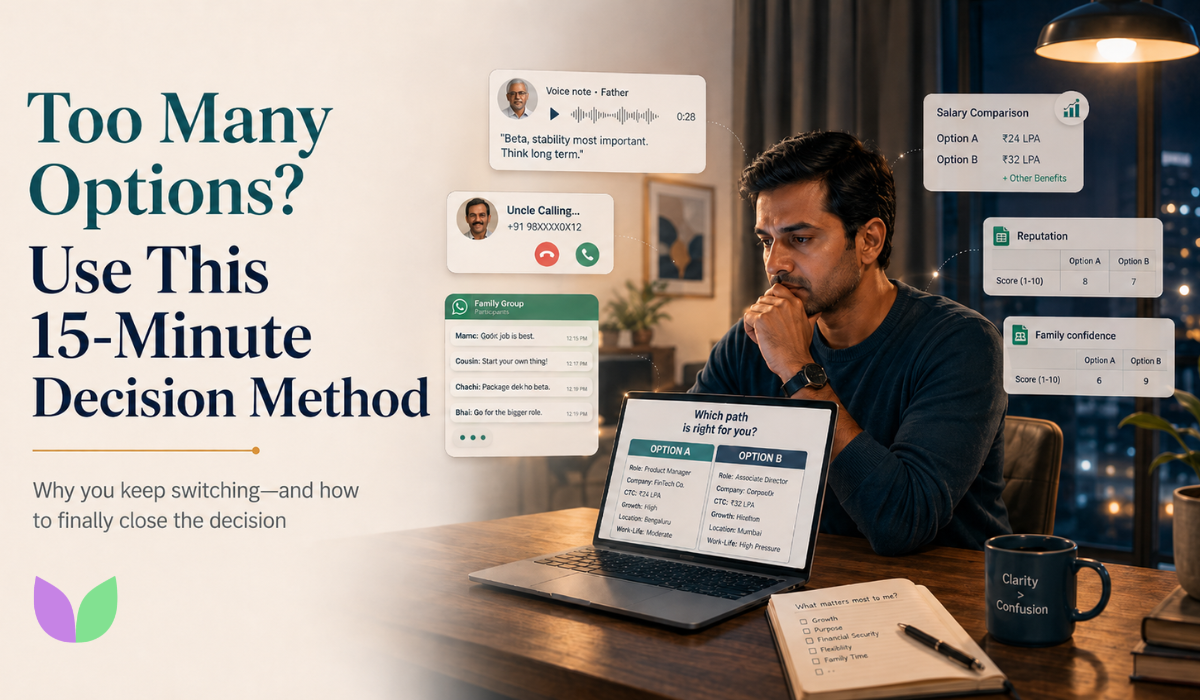
Aditya is sitting at the dining table with two job offers open on his laptop.
On Monday, he had decided to accept the role at the smaller company. The work was more interesting. The manager seemed better. The role offered room to grow.
Then his father sent a voice note.
“Why leave a stable company right now?”
An uncle called and asked about the brand name.
His cousin shared his latest salary increase in the family WhatsApp group.
A friend warned him that joining a smaller company could look like a step backwards.
Aditya opens his comparison sheet again.
He adds another column.
“Reputation.”
Then another.
“Family confidence.”
The deadline is tomorrow.
He is no longer comparing two jobs.
He is trying to find a decision that nobody can question later.
That option does not exist.
Most capable people do not have an option problem. They have a closure problem.
They know enough to move.
They just do not feel safe enough to stop comparing.
This article gives you a practical 15-Minute Decision Method to reduce the options, choose what fits, and stop reopening the decision without a valid reason.
Why Trust This Article
For more than 20 years, I worked across product management, operations, strategy, and leadership roles where decisions rarely came with complete information.
There were always trade-offs.
Waiting also carried a cost.
Today, through IntuiWell, I work with professionals, founders, managers, and high-achieving individuals who face the same pattern in their careers and personal lives.
They are not careless decision-makers.
They think deeply. They anticipate consequences. They want to choose responsibly.
But careful thinking becomes a trap when every decision stays mentally open.
The examples in this article combine recurring patterns from leadership, mentoring, and personal growth conversations. Names and identifying details are illustrative.
Quick Answer
When you have too many options, do not keep searching for the perfect choice.
Give yourself 15 minutes to:
- Define the actual decision.
- Cut the list to three realistic options.
- Choose using priorities, facts, and reversibility.
- Lock the choice until a clear review date.
A decision is not complete when you select an option.
It is complete when you stop comparing it with every option you did not choose.
Why Too Many Options Keep You Stuck
More choice can help when the options are clearly different and you know what matters.
But more choice does not always create more clarity.
A major review of choice-overload research found that people are more likely to struggle when the options are difficult to compare, the task is complex, their preferences are unclear, or they are trying to identify the absolute best choice. [Reference: Chernev, A., Böckenholt, U. and Goodman, J. (2015). Choice Overload: A Conceptual Review and Meta-Analysis. Journal of Consumer Psychology, 25(2), 333–358.\
Four similar options can be harder than ten clearly different ones.
The difficulty is not always the number.
It is the pressure to find one perfect answer among several reasonable possibilities.
This pressure creates three loops.
The Comparison Loop
You keep comparing because another option may be slightly better.
The Reassurance Loop
You ask more people because agreement temporarily makes the choice feel safer.
The Reopening Loop
You make a choice, feel uncertain, and treat that discomfort as proof that the decision was wrong.
Research on maximising—the tendency to search for the best possible choice—has linked it with greater regret, perfectionism, social comparison, and lower satisfaction with decisions. [Reference: Schwartz, B., Ward, A., Monterosso, J., Lyubomirsky, S., White, K. and Lehman, D. R. (2002). Maximizing Versus Satisficing: Happiness Is a Matter of Choice. Journal of Personality and Social Psychology, 83(5), 1178–1197.]
The problem is not having high standards.
The problem is expecting a good decision to remove every reason for doubt.
It cannot.
Uncertainty remains because the future has not happened yet.
A 2025 experimental study found that intolerance of uncertainty can directly increase indecisiveness. When uncertainty itself feels unbearable, people become more likely to delay, avoid, repeatedly check, or reopen personally relevant decisions. [Reference: Appel, H. and Gerlach, A. L. (2025). Intolerance of Uncertainty Causally Affects Indecisiveness. British Journal of Clinical Psychology, 64(3), 806–816.]
The repeated checking may give you a few minutes of relief.
Then the doubt returns.
You did not solve the uncertainty.
You briefly escaped the feeling of it.
Why Decisions Feel Different in Indian Lives
In India, many important decisions are not treated as fully individual decisions.
A job change affects the family.
A move to another city affects parents and in-laws.
A career break becomes a public discussion.
A marriage decision invites opinions from people who may know very little about the actual relationship.
A business risk affects not only your finances, but your image as a responsible son, daughter, spouse, or parent.
The spreadsheet may show salary, location, growth, and work culture.
But an invisible criterion often sits underneath it:
Log kya kahenge?
What will people say if this goes wrong?
That fear changes the decision.
You are no longer only calculating risk.
You are calculating the embarrassment of being seen taking a risk.
Advice can expand your perspective.
But too many opinions can quietly replace ownership.
You stop asking, “What fits my life?”
You start asking, “Whose approval can I least afford to lose?”
Priya Had Six People Inside One Decision
Priya received an offer to return to work after a three-year career break.
The role interested her. The timing was not perfect, but it seemed manageable.
Her husband supported her.
Her mother worried that the children would suffer.
Her mother-in-law asked why the family needed the extra stress.
A cousin suggested waiting for a better designation.
A former colleague told her to accept before the market changed.
Another friend warned that returning at the wrong level could damage her career.
Priya began with one decision.
By the end of the week, she was carrying six people’s fears.
Every conversation changed her mind.
She was not weighing whether the role fit her life.
She was waiting for a version of it that would cost her nothing with anyone.
No such version was coming.
Rahul Changed the Priority Three Times
Rahul leads a product team in Mumbai.
On Monday, he decides that improving customer onboarding will be the team’s main priority for the month.
The data supports it.
The team agrees.
Work begins.
On Tuesday, Rahul attends a leadership meeting where someone talks about retention.
He returns and changes the priority.
On Wednesday, a competitor launches a feature.
He changes it again.
By Friday, the team has attended three planning meetings, rebuilt the roadmap twice, and completed almost nothing.
Rahul sees each change as responsiveness.
His team has stopped treating any priority as final.
New information matters.
But not every new idea is important enough to change direction.
Rahul’s real difficulty is not making a decision.
It is staying with one after the first wave of uncertainty arrives.
The Cost Is Bigger Than Lost Time
Indecision does not only delay a project, course, purchase, or career move.
It slowly changes how you experience yourself.
You stop trusting your judgment.
Every confident opinion begins to sound more reliable than your own.
You remain in preparation because preparation feels safer than exposure.
Months pass.
Sometimes years.
One day, you realise you have spent more time deciding how to live than actually living.
You researched three career paths and committed to none.
You planned five businesses and tested none.
You waited for the perfect role, city, relationship, routine, or time.
The doors remained open.
But you did not walk through any of them.
The tragedy is not always choosing the wrong path.
Sometimes it is spending years at the junction.
The 15-Minute Decision Method
Use this method for everyday, professional, and reversible personal decisions where you already understand the basic choices.
Examples include:
- Which project should I prioritise?
- Which course should I take?
- Which idea should I test first?
- Which tool or vendor should I select?
- Should I accept, renegotiate, or decline this request?
- Which routine should I follow for the next month?
- Which opportunity deserves deeper exploration?
Do not use a 15-minute method to rush major medical, legal, personal-safety, or irreversible financial decisions.
For a larger decision, use it to identify the next step, not to force the entire life choice.
Set a timer.
Then begin.
Step 1: Define — 2 Minutes
Write one sentence:
I need to decide ______ by ______.
For example:
- I need to decide which project to prioritise this month by 4 PM today.
- I need to decide which course to enrol in by Friday.
- I need to decide which business idea to test for the next 30 days.
- I need to decide whether to accept, renegotiate, or decline this role.
Do not write:
“I need to decide my future.”
That is not one decision.
It is an entire life category.
Reduce it:
“I need to decide whether this role deserves a second interview.”
Or:
“I need to decide which career direction I will research for the next four weeks.”
A vague decision creates vague anxiety.
A defined decision gives your mind a boundary.
Step 2: Cut — 3 Minutes
Reduce the list to three realistic options.
Remove any option that:
- breaks an important non-negotiable
- requires resources you do not have
- exceeds your current capacity
- does not support the immediate goal
- exists mainly because someone else prefers it
- has already been rejected for a sound reason
You do not need to compare every option available.
You need to compare the options that can actually work.
When you have eight options, your first decision is not which one to choose.
Your first decision is which five no longer deserve your attention.
Step 3: Choose — 7 Minutes
Use three checks.
Check 1: What Matters Most?
Choose three criteria.
These may include:
- fit with the current goal
- time required
- financial cost
- energy required
- growth potential
- flexibility
- risk
- family impact
- ability to test before committing further
Do not use ten criteria.
Choose the three that matter most in this decision.
Then ask:
Which option fits these priorities best in my current reality?
Not in an imaginary future.
Not in someone else’s life.
Your current reality.
Check 2: What Do I Know, and What Do I Fear?
Divide the page into two.
What I know
Write verified facts, current constraints, and available evidence.
What I fear
Write predictions and imagined consequences.
For example:
What I know:
The role offers better learning, requires a longer commute, and includes a six-month probation period.
What I fear:
If I struggle initially, everyone will say I should have stayed where I was.
The fear matters.
But it should not quietly pretend to be a fact.
Check 3: Can I Reverse or Adjust This?
Ask:
Can I review, change, or reverse this choice within a reasonable period without serious harm?
When the answer is yes, stop treating the decision as a permanent identity statement.
Choosing one tool for 30 days does not mean using it forever.
Testing one business idea does not mean rejecting every other possibility for life.
Prioritising one project this month does not make the others worthless.
Some decisions are not lifetime commitments.
They are experiments that produce information.
Choose the option that:
- meets your three priorities
- fits your current reality
- carries a risk you can manage
- gives you a meaningful next step
Then stop comparing.
Step 4: Lock — 3 Minutes
Write four lines:
My decision:
I choose ______.
My next action:
Within 24 hours, I will ______.
My lock period:
I will not reopen this decision until ______.
I will reconsider only if:
A material new fact appears, such as ______.
This step turns a preference into a decision.
Without a lock period, your mind will restart the entire comparison when discomfort appears.
A lock period does not mean becoming stubborn.
It means giving your choice enough time to create real evidence.
Decision Value or Reassurance Value?
Early in a decision, information has decision value.
It helps you understand the choices.
It exposes risks.
It removes unsuitable options.
Later, more information may have only reassurance value.
You are no longer discovering anything that will change the choice.
You are trying to feel safer.
Before asking another person, reading another review, or watching another comparison video, ask:
What specific information am I missing, and how could the answer change my choice?
When you cannot answer clearly, you may not need more information.
You may need closure.
What Counts as a Material New Fact?
Reconsider the decision when:
- the cost changes significantly
- a major risk becomes visible
- a key assumption proves false
- the original goal changes
- the option causes meaningful harm
- your circumstances change
- reliable evidence shows the current approach is not working
Do not automatically reconsider because:
- the choice feels uncomfortable
- progress feels slow
- another option looks exciting
- someone else chose differently
- you had one difficult day
- you fear being judged
- you miss the options you closed
Discomfort is information. But it is not always instruction.
A new option often looks cleaner because you have not experienced its difficulties yet.
You are comparing the difficult reality of the current path with the clean imagination of the alternative.
That is not a fair comparison.
Healthy Change or Fear-Driven Switching?
Healthy flexibility says:
“The facts changed. The plan needs to change.”
Fear-driven switching says:
“I feel uncertain. A new plan may remove the feeling.”
The first responds to evidence.
The second responds to discomfort.
A team can work with a leader who changes direction after receiving important evidence.
It struggles with a leader who changes direction after every conversation.
The same applies to your personal life.
People do not need you to be rigid.
They need to know when your decision means something.
Track This for Seven Days
At the end of each day, ask:
Did I reopen or change a decision today without receiving material new information?
Score it:
0 — Closed
I followed the decision. I did not reopen it without a valid reason.
1 — Reopened Mentally
I started comparing again, but I noticed the pattern and did not switch.
2 — Switched
I changed direction, delayed action, or restarted the decision without meaningful new evidence.
Then write:
What triggered the reopening?
Common triggers include:
- another person’s opinion
- comparison
- fear of being wrong
- a difficult first step
- boredom
- seeing a new option online
- the desire for reassurance
- an imperfect early result
The aim is not to score zero every day.
The aim is to notice what repeatedly weakens your decisions.
Days 1–2: You See the Open Loops
You choose a course but keep watching reviews of competing courses.
You set the weekly priority but change it after every message.
You select a tool but continue comparing features.
You agree on a plan but ask three more people what they would do.
The choice is made.
The loop is not closed.
Seeing this may feel uncomfortable.
That awareness is the first change.
Day 3: You Close One Decision
A new suggestion arrives.
Your mind immediately says:
Maybe I should change the plan.
This time, you pause.
You ask:
Is this a material fact or simply another possible option?
You note the suggestion for the review date.
You do not rebuild the week around it.
The decision survives its first challenge.
Days 4–5: The Old Pattern Fights Back Hardest
These are often the difficult days.
The excitement of choosing has faded.
The chosen path now requires effort.
The course has assignments.
The project attracts scrutiny.
The new routine feels repetitive.
The business idea requires speaking to real customers.
This is when the alternative starts looking attractive again.
Not because new evidence has appeared.
Because the current choice has become real.
Your mind compares the messy reality of what you chose with the untouched promise of what you rejected.
Expect the urge to switch.
Do not obey it automatically.
Go back to your criteria, lock period, and material-fact rule.
Days 4–5 do not prove that the choice was wrong.
They often prove that commitment has begun.
Days 6–7: Self-Trust Starts Replacing Reassurance
You may not feel completely certain.
But you begin to trust that you can make a reasonable decision, observe what happens, and adjust intelligently.
Self-trust does not mean believing every decision will work.
It means believing you can respond even when one does not.
That is a much stronger form of confidence.
A Decision Is Not a Prediction
A decision does not prove what will happen.
It chooses how you will move based on what you know today.
A sound decision can produce a disappointing result.
A weak decision can occasionally produce a fortunate result.
The outcome alone does not tell you whether your thinking was responsible.
Review the decision based on:
- the information available at the time
- the priorities you identified
- the risks you considered
- the constraints you respected
- the quality of action that followed
Then learn from the result.
Do not use hindsight to punish the person you were before the future became visible.
When the Pattern Goes Deeper
The 15-Minute Decision Method can help with many everyday choices.
But some decision loops are connected to deeper patterns:
- fear of failure
- perfectionism
- external validation
- low trust in your judgment
- fear of disappointing family
- repeated self-criticism
- discomfort with uncertainty
- the belief that one wrong choice will expose you
In these cases, the sheet may help you make one decision.
But the emotional pattern may reopen the next one.
Inside IntuiWell’s Personal Growth Program, we look beyond the option in front of you.
We examine the pattern across several decisions:
- What makes closure feel unsafe?
- Whose approval are you trying to preserve?
- What does making a mistake mean about you?
- Why does another person’s confidence weaken your own?
- Why do you keep seeking certainty where certainty cannot exist?
- What happens emotionally after you commit?
You do not start with a salesperson.
You speak with a founder first.
When the tool is enough, use it.
That is real progress.
When you complete it and still find yourself reopening the same decision, the problem may not be the options.
It may be what choosing has come to mean inside you.
Get the 1-Page Tool: The 15-Minute Decision Sheet — Lite
Four steps. One page. Printable and fillable.
Define
What exactly am I deciding, and by when?
Cut
Which three options are genuinely realistic?
Choose
Which option fits my priorities and current reality best?
Lock
What will I do next, and when will I review the decision?
The tool also includes a seven-day tracker to help you notice when you reopen or change decisions without meaningful new information.
Get the 1-page tool: 15-Minute Decision Sheet
For support with the deeper pattern underneath repeated indecision, explore the IntuiWell Personal Growth Program.
Book a Personal Plan Call or message IntuiWell on WhatsApp.
A Safety Note
This method is for everyday and professional decisions where the choices are reasonably safe and reversible.
Do not use it to rush decisions involving medical treatment, legal matters, personal safety, abuse, large financial commitments, or other high-risk situations. Seek appropriate professional guidance.
When indecision, checking, reassurance-seeking, or obsessive doubt causes significant distress or repeatedly disrupts daily functioning, consider speaking with a qualified mental-health professional.
This article is educational. It is not diagnosis, therapy, or clinical treatment.
Frequently Asked Questions
1. Who Is This Article For?
It is for anyone who repeatedly compares, delays, seeks more opinions, changes plans, or reopens decisions after making them.
It is especially relevant for professionals managing competing priorities and Indian adults whose choices involve strong family or social expectations.
2. What Is Decision Paralysis?
Decision paralysis is difficulty choosing or acting because the options, possible consequences, or fear of making a mistake feel overwhelming.
It may look like excessive research, repeated advice-seeking, frequent switching, delay, or constant mental comparison.
3. Why Do I Keep Changing My Mind?
You may be treating uncertainty, discomfort, or another person’s opinion as evidence that your choice was wrong.
The decision may also lack a lock period or a clear rule for what would justify reconsidering it.
4. Can an Important Decision Really Be Made in 15 Minutes?
The method works for reversible decisions where you already know the basic facts.
For larger decisions, use the 15 minutes to define the next step, reduce the options, or identify the exact information still required.
5. How Many Options Should I Compare, and What if Two Are Equal?
Compare no more than three realistic options.
When two options fit equally well, choose the one that is easier to test, easier to reverse, or faster to produce meaningful information.
At that point, action will create more clarity than another hour of comparison.
6. Is Changing My Mind a Bad Thing?
No.
Change your mind when important evidence, circumstances, risks, or goals change.
The problem is not flexibility.
The problem is repeatedly switching without meaningful new information.
7. What if My Family Disagrees With My Choice?
Listen carefully to concerns that contain relevant facts or risks.
Separate those concerns from fear, comparison, reputation, and personal preference.
You can respect someone’s opinion without handing them ownership of your life.
8. How Is This Connected to Overcommitment, Freezing Under Pressure, and Thinking About Work at Night?
These patterns often share a deeper difficulty with uncertainty, judgment, and self-trust.
You may say yes at work because you fear another person’s reaction.
You may freeze when someone questions your work because being challenged feels like being exposed.
You may replay work at night because your mind wants a safer or more complete ending.
You may keep switching decisions because closure feels unsafe.
Different situations can activate the same underlying belief:
“I must get this exactly right, or something important about me will be exposed.”
That is why working on the deeper pattern often improves more than one area of life.
About the Author
Vallabh Chitnis, Co-Founder – IntuiWell
Vallabh works with individuals on personal growth, emotional patterns, mindset shift, and behaviour change through founder-led programs.
Final Thought
You do not build self-trust by waiting until every choice feels safe.
You build it by making a sound decision, staying with it long enough to learn, and discovering that you can handle what follows.
Define the decision.
Cut the options.
Choose what fits.
Then close the loop.
Let action give you the clarity that more comparison could not.