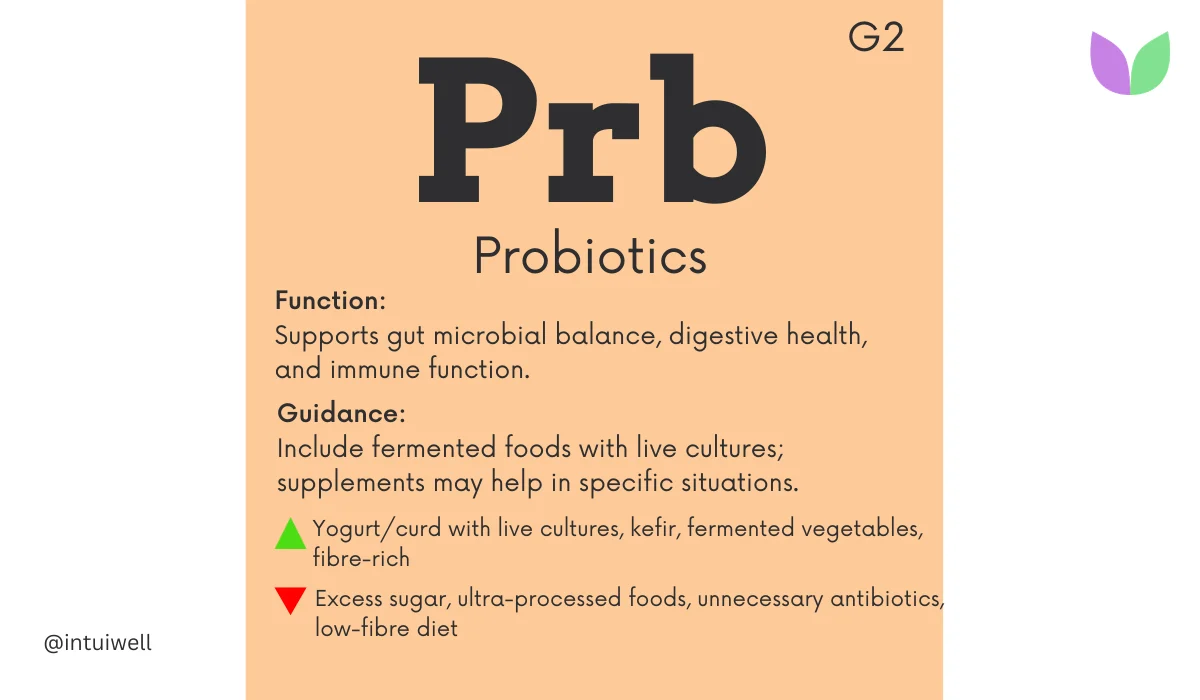
Deep Dive Into G2: Probiotics From IntuiWell Nutrient Periodic Table™
Quick Takeaways
- Probiotics are live microorganisms that can provide health benefits when consumed in adequate amounts.
- They help support the balance of the gut microbiome, the community of microbes living in the digestive tract.
- Different probiotic strains have different effects, so not all probiotic products work the same way.
- Some probiotic strains have evidence for reducing the risk of antibiotic-associated diarrhea.
- Fermented foods may support gut health, but not all fermented foods qualify as probiotics.
- Probiotics work best alongside prebiotic fibre, which feeds beneficial gut bacteria.
- Most people support gut health primarily through diet, fibre intake, and lifestyle habits, not supplements alone.
1. What Probiotics Are and How Your Body Uses Them
Probiotics are live beneficial microorganisms, mainly certain bacteria and some yeasts, that may support human health when consumed in adequate amounts.
The digestive tract contains trillions of microbes known collectively as the gut microbiome.
This microbial ecosystem includes:
- Beneficial microbes
- Neutral microbes
- Microbes that may become harmful when the balance is disrupted
Probiotics may help support this balance by:
- Competing with harmful microbes
- Interacting with immune cells in the gut
- Helping maintain normal gut barrier function
- Supporting microbial diversity
Probiotics do not permanently replace your natural gut bacteria. Instead, they may help support the gut environment under certain conditions.
2. Primary Functions of Probiotics
Research suggests probiotics may influence several aspects of health.
Digestive Support
Some strains may help:
- Support microbial balance
- Maintain stool consistency
- Support the recovery of gut balance after disruptions
Immune Interaction
The digestive tract interacts closely with the immune system.
Gut microbes influence immune signaling and help regulate immune responses.
Gut Barrier Function
Some probiotic strains may help support the integrity of the intestinal lining, which acts as a protective barrier between gut contents and the bloodstream.
3. Probiotics and Digestion
Probiotics are most often studied in digestive conditions.
Evidence suggests certain probiotic strains may help in situations such as:
- Antibiotic-associated diarrhea
- Some symptoms of irritable bowel syndrome (IBS)
- Improving lactose digestion in some individuals
However, results vary between strains and individuals.
This is why probiotic use is generally considered condition-specific rather than universal.
4. When Do People Commonly Consider Probiotics?
Probiotics are not necessary for everyone.
Many healthy individuals maintain gut balance through a diet rich in fibre and diverse whole foods.
However, probiotics are sometimes considered in situations such as:
- During or after antibiotic treatment
- After gastrointestinal infections
- During digestive disturbances such as bloating or irregular bowel patterns
- When trying to improve tolerance to lactose-containing foods
- During periods of dietary disruption or travel
Persistent digestive symptoms should be evaluated by a healthcare professional.
5. Fermented Foods vs Probiotics
Many fermented foods contain beneficial microbes, but not all fermented foods qualify as probiotics.
For a food to be considered probiotic, it must:
- Contain live microorganisms
- Provide them in adequate amounts
- Show evidence of health benefits
Examples of foods that may contain live cultures include:
- Yogurt or curd with live cultures
- Kefir
- Certain unpasteurized fermented foods
However, some fermented foods may not contain live microorganisms at the time they are consumed due to heating or processing.
6. Probiotics and Prebiotics
Probiotics are the microorganisms themselves.
Prebiotics are dietary fibres that feed beneficial microbes.
Examples of prebiotic foods include:
- Onions
- Garlic
- Oats
- Legumes
- Bananas
- Whole grains
A combination of probiotics and prebiotic fibre supports a healthier gut microbial environment.
7. Probiotics and Antibiotics
Antibiotics can disrupt the balance of gut microbes because they affect both harmful and beneficial bacteria.
Some probiotic strains have been studied for reducing the risk of antibiotic-associated diarrhea.
Examples that have shown evidence in research include:
- Saccharomyces boulardii
- Lactobacillus rhamnosus GG
When probiotics are taken alongside antibiotics, they are usually taken at a different time of day to reduce the chance of antibiotics affecting the probiotic organisms.
8. Do Probiotic Strains Matter?
Yes. Probiotic effects are often strain-specific.
This means the health effect depends on the exact microorganism used.
For example, research on antibiotic-associated diarrhea often focuses on specific strains such as:
- Saccharomyces boulardii
- Lactobacillus rhamnosus GG
However, not every probiotic product containing these species will produce the same results.
The exact strain, dose, and formulation all influence effectiveness.
9. How to Choose a Probiotic Supplement
If considering a probiotic supplement, it may help to look for:
- The full microbial name (genus, species, strain)
- CFU count listed at the end of shelf life
- Clear storage instructions
- Strains supported by research for the intended use
- Reputable manufacturers with quality testing
Higher CFU counts or multiple strains do not automatically mean better results.
10. Starting Slowly
Some people experience temporary bloating or gas when first introducing probiotics or fermented foods.
Starting with small amounts and increasing gradually may help improve tolerance.
11. Are Probiotics Needed Every Day?
Not necessarily.
For many people, gut health is supported primarily by:
- Fibre-rich foods
- Diverse plant foods
- Fermented foods with live cultures
- Balanced lifestyle habits
Probiotic supplements are typically used for specific purposes rather than as a universal daily requirement.
12. Safety Considerations
Probiotics are generally safe for most healthy individuals.
However, caution is advised in:
- Severely immunocompromised individuals
- Critically ill patients
- Premature infants
- Certain serious medical conditions
Medical guidance is recommended in these situations.
13. When to Seek Medical Advice
Consult a healthcare professional if you experience:
- Persistent abdominal pain
- Chronic diarrhea or constipation
- Unexplained weight loss
- Blood in stools
- Severe digestive symptoms
Self-treatment with probiotics should not delay medical evaluation.
14. IntuiWell Nutrient Table Insight
In the IntuiWell Nutrient Periodic Table™, Probiotics (G2) represent the living microbial component of gut health.
Their effectiveness depends heavily on surrounding dietary factors, particularly dietary fibre (G1), which feeds beneficial microbes.
A gut-supportive diet, therefore, includes:
- Foods containing beneficial microbes
- Fibre-rich foods that nourish them
Author
Written by: Shivani Jain
Co-founder & Clinical Lead Nutritionist, IntuiWell
Certified Nutritionist (Master’s in Foods & Nutrition)
Helping people simplify nutrition through science, tradition, and practical kitchen wisdom.
Key References
FAO/WHO Guidelines for the Evaluation of Probiotics in Food
https://openknowledge.fao.org/server/api/core/bitstreams/382476b3-4d54-4175-803f-2f26f3526256/content
World Gastroenterology Organisation Global Guidelines: Probiotics and Prebiotics
https://www.worldgastroenterology.org/UserFiles/file/guidelines/probiotics-and-prebiotics-english-2023.pdf
National Center for Complementary and Integrative Health – Probiotics Safety and Use
https://www.nccih.nih.gov/health/probiotics-usefulness-and-safety
International Scientific Association for Probiotics and Prebiotics
https://isappscience.org/topic/probiotics/
Blog Summary
Probiotics are live microorganisms that may support health when consumed in adequate amounts. They help maintain the balance of the gut microbiome, which consists of trillions of microbes living in the digestive system.
These beneficial microbes can help by competing with harmful bacteria, supporting the gut lining, and interacting with immune cells. However, probiotics do not permanently replace the body’s natural bacteria. Instead, they help maintain a healthy gut environment under certain conditions.
Research shows that specific probiotic strains may support digestion, help restore gut balance after antibiotic use, improve lactose digestion, and reduce the risk of antibiotic-associated diarrhea in some individuals. Their effects vary because probiotic benefits are strain-specific, meaning not every probiotic product works the same way.
Fermented foods like yogurt, kefir, and certain unpasteurized foods may contain beneficial microbes. However, not all fermented foods qualify as probiotics because some lose their live microorganisms during processing.
Probiotics also work best when combined with prebiotic fibre, which feeds beneficial gut bacteria. Foods like onions, garlic, oats, bananas, legumes, and whole grains support this microbial ecosystem.
For most people, gut health is primarily supported by a fibre-rich diet, diverse plant foods, and healthy lifestyle habits, while probiotic supplements are usually used for specific situations, such as after antibiotics or during digestive disturbances.
In the IntuiWell Nutrient Periodic Table™, probiotics (G2) represent the living microbial component of gut health, while dietary fibre (G1) acts as the fuel that helps these microbes thrive.
FAQs
1. What are probiotics?
Probiotics are live microorganisms, mainly beneficial bacteria and some yeasts, that may support health when consumed in adequate amounts.
2. How do probiotics support gut health?
They help maintain the balance of the gut microbiome by competing with harmful microbes, supporting gut barrier function, and interacting with immune cells.
3. Do probiotics help with digestion?
Certain probiotic strains may support digestion, help restore gut balance after antibiotics, and improve lactose digestion in some individuals.
4. Are fermented foods the same as probiotics?
Not always. Some fermented foods contain beneficial microbes, but they only qualify as probiotics if they contain live microorganisms in sufficient amounts with proven health benefits.
5. Do probiotics need to be taken every day?
Not necessarily. Many people maintain gut health through a balanced diet rich in fibre and diverse whole foods.
6. What foods support probiotics?
Foods rich in prebiotic fibre, such as onions, garlic, oats, bananas, legumes, and whole grains, help feed beneficial gut bacteria.
7. Are probiotic supplements necessary?
Supplements may be useful in certain situations like antibiotic use or digestive disturbances, but they are not essential for everyone.
8. Are probiotics safe?
They are generally safe for healthy individuals, but people with weakened immune systems or serious medical conditions should seek medical advice before using them.
Want personalized guidance for your gut health?
At IntuiWell, we help you simplify nutrition using science and practical dietary strategies tailored to your lifestyle.
👉 Book a consultation call with our nutrition experts
or
📞 Request a call back to discuss your gut health concerns
Start your journey toward better digestion and overall wellness with expert guidance.