How to Stay Consistent When You Don’t Feel Motivated
We’ve all said it —
“I just need to feel motivated again.”
“Once I’m in the mood, I’ll start.”
But that “mood” rarely comes.
And even when it does, it doesn’t last.
Motivation feels like a spark — bright, exciting, and short-lived. It gets you started but never carries you to the finish line.
That’s why your new morning routine, diet, or gym plan often fades after a week or two.
It’s not your fault. You didn’t fail because you lacked willpower.
You failed because motivation is emotional, and emotions change daily.
Why Motivation Fails
Motivation is energy that depends on your environment, stress, sleep, and even hormones.
One good day, you feel unstoppable.
Another day, you can’t even get out of bed.
Research from the American Psychological Association (APA, 2021) shows that motivation spikes when we expect quick results but drops fast when progress feels slow.
That’s why enthusiasm peaks on Day 1 of a new goal — and crashes by Day 10.
Motivation is great for starting, but terrible for sustaining.
It’s like waiting for perfect weather before going outside — comfortable, but inconsistent.
What Is Momentum (and Why It Wins)
Momentum is motivation’s calm, reliable cousin.
It’s not about hype — it’s about rhythm.
Momentum means doing small, consistent actions until they become natural.
That daily 5-minute walk, the one-line journal entry, the quick stretch before bed — each one builds rhythm.
That rhythm builds self-trust.
Neuroscience research shows that as habits form, your brain shifts from motivation-based circuits (dopamine and reward) to automatic behavior circuits in the basal ganglia.
In simple words: what starts as effort becomes effortless.
That’s the magic of momentum — motion creates motivation.
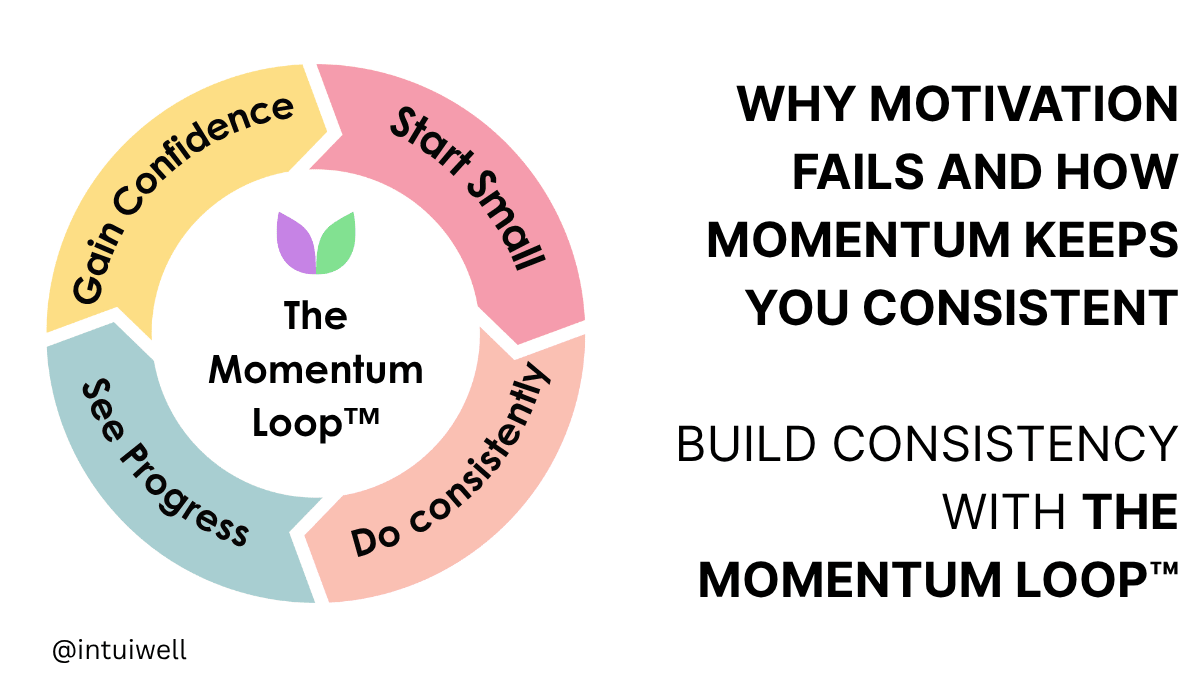
How to Build Momentum — The Momentum Loop™
The Momentum Loop™ is a simple, science-backed method created by IntuiWell to help you turn small actions into lasting habits.
Each step is easy, practical, and built for real life.
1. The 3-Minute Rule – Break the Start Barrier
What to do: Promise yourself just 3 minutes. The hardest part is beginning — not doing.
Once you start, your brain follows through naturally.
Example: “I’ll walk for 3 minutes.” You’ll usually walk for 10.
Why it works: Behavioral science shows that once you start, your brain releases dopamine — a “feel-good” chemical — that keeps you going.
When to use: Anytime you feel stuck or unmotivated.
2. The Friction Fix – Make Good Choices Easy
What to do: Change your environment instead of forcing willpower.
Keep your workout mat by your bed, your water bottle on your desk, and healthy snacks at eye level.
Why it works: Fewer barriers mean faster action (BJ Fogg, Stanford University).
When to use: Do an “environment reset” every weekend.
3. The Reward Swap – Rewire Your Brain
What to do: Link pleasure to progress, not distraction.
Enjoy your favorite coffee after a workout or your favorite show after finishing work.
Why it works: This retrains your dopamine system to associate joy with achievement instead of avoidance.
When to use: Daily — every time you complete a micro-goal.
4. The Micro-Streak – See Your Progress
What to do: Track small wins visually — tick a calendar, mark a habit tracker, or use a simple app.
Why it works: Visible proof builds self-confidence and identity.
When to use: Update your streak at the end of each day.
5. The Habit Sandwich – Stack New with Old
What to do: Add a new habit before or after an existing one.
Wake up → Drink water → 3 deep breaths → Brush teeth.
Why it works: The brain links familiar cues to new routines (The Power of Habit, Duhigg).
When to use: When adding new wellness habits like journaling, breathing, or stretching.
6. The 1% Rule – Small Wins, Big Change
What to do: Improve by just 1% daily. Ask every night, “What small thing did I do better today?”
Why it works: Consistent micro-progress (Kaizen method) compounds into big results.
When to use: End of each day as a reflection habit.
7. The Bounce-Back Rule – Never Miss Twice
What to do: If you miss one day, make the next day lighter, not skipped.
For example, walk 5 minutes instead of 30.
Why it works: Missing once has no effect; missing twice breaks momentum (Lally et al., 2010).
When to use: The day immediately after missing a routine.
8. The Energy Anchor – Match Your Body Clock
What to do: Align tasks with your energy peaks.
Mornings for focus work or workouts, evenings for reflection or light reading.
Why it works: Your circadian rhythm affects performance (Harvard Business Review, 2019).
When to use: Re-plan your schedule every Sunday for the coming week.
9. The Proof Journal – Track Effort, Not Emotion
What to do: Each week, note three things you did right —
✔ I showed up.
✔ I didn’t quit.
✔ I improved a little.
Why it works: Seeing evidence trains the brain to trust itself.
When to use: Sunday evenings or your weekly check-in time.
10. The No-Mood Rule – Act Anyway
What to do: Stop asking, “Do I feel like it?” Ask, “What would my consistent self do?”
Why it works: Acting despite mood strengthens the brain’s self-control center (prefrontal cortex).
When to use: On low-energy or “not in the mood” days — that’s when it matters most.
When to Use the Momentum Loop™
| Situation | Technique | Why It Works |
| Feeling lazy or stuck | 3-Minute Rule | Starting releases energy |
| Losing focus mid-week | Friction Fix | Simplifies action |
| Craving instant pleasure | Reward Swap | Rewires dopamine |
| Skipped a habit | Bounce-Back Rule | Prevents guilt spiral |
| Energy feels low | Energy Anchor | Works with body clock |
| End of week | Proof Journal | Builds confidence through reflection |
The Science Behind Momentum
Here’s what happens inside your brain:
- Dopamine rises when you finish small actions — fueling motivation.
- Basal ganglia automates repeated actions — turning effort into habit.
- Prefrontal cortex strengthens self-regulation — helping you stay calm and consistent.
You stop chasing motivation and start trusting your rhythm.
The Big Shift
Motivation says: “I’ll start when I feel ready.”
Momentum says: “I’ll feel ready once I start.”
The real transformation happens when you stop waiting for the perfect time and start taking small, imperfect actions.
Every tiny step adds up — not overnight, but over time.
Consistency creates confidence.
Confidence creates change.
Key Takeaway
The secret to lasting success isn’t to “stay motivated.”
It’s to stay in motion — especially on days when you don’t feel like it.
Momentum doesn’t rely on emotion.
It relies on action.
Keep stacking small wins.
One day, you’ll realize your habits carried you further than motivation ever could.
At IntuiWell, we help you build momentum — not just motivation.
Through personalized nutrition, lifestyle systems, and mindset coaching, we help you stay balanced, consistent, and calm — inside and out.
Contact Us or Book your online consultation and learn how to create lasting momentum for your mind, body, and life.
Summary: Why Motivation Fails and How Momentum Keeps You Consistent
Motivation is emotional and unreliable — it fades with stress, fatigue, or slow results. That’s why most routines fail after the first burst of excitement.
The solution isn’t more motivation — it’s momentum: small, consistent actions that build rhythm, self-trust, and lasting habits.
IntuiWell’s Momentum Loop™ turns effort into consistency through science-backed tools like the 3-Minute Rule, Friction Fix, Reward Swap, and Bounce-Back Rule — all designed to make action easy and automatic.
As habits repeat, your brain rewires — motivation becomes motion, and effort turns into ease.
The real shift:
Motivation waits for readiness.
Momentum creates it.
Bottom line: Stop chasing moods. Start building momentum — one small win at a time.
FAQs about Motivation and Momentum
Q1. Why does motivation fade so quickly?
Motivation depends on emotions, energy, and environment. When stress, fatigue, or uncertainty rise, motivation naturally drops.
Q2. What exactly is momentum?
Momentum is consistency in motion—small, repeated actions that become automatic over time. Once you build rhythm, action itself generates motivation.
Q3. How can I build momentum when I feel stuck?
Use the 3-Minute Rule. Start for just three minutes—walk, write, stretch, or clean. Starting triggers dopamine, and motion renews motivation.
Q4. How long does it take for a habit to stick?
Studies show it takes about 66 days of regular repetition to make a behavior automatic. Focus on frequency, not intensity.
Q5. What should I do if I break my routine?
Never miss twice. Missing once is normal; missing twice breaks momentum. Get back the next day, even with a lighter version of your habit.
Q6. How can I use momentum for overall wellness?
Combine small, consistent actions across body and mind—balanced meals, regular movement, mindful breathing, and brief self-reflection. Together, these build inner rhythm and stability.