A 44-Year-Old Client’s 6-Month IntuiWell Journey: 6.7 Kg Weight Loss, 8 Inches Lost, Greater Strength, and a More Sustainable Approach to Health
For many working women, taking care of their health sounds simple in theory.
Eat better. Exercise regularly. Stay consistent.
But when work, home responsibilities, family, and everyday commitments are already competing for attention, following a health plan that doesn’t fit into real life can become another responsibility rather than a solution.
That was part of our client’s experience.
At 44, her weight loss success story began with a familiar problem: she wanted to lose weight, but the diets and approaches she had tried didn’t feel practical enough for her lifestyle.
She wasn’t lacking motivation.
She needed an approach that made sense for her life.
And over the next six months, that difference changed not just her weight, but the way she approached her health.
When the Goal Is Weight Loss, But the Journey Is About Much More
She came to IntuiWell with a clear goal: weight loss.
But there was more to understand before deciding what that journey should look like.
She was a progressive working woman balancing professional responsibilities with responsibilities at home, while also trying to make space for her own health.
She was vegetarian and understood that protein and overall nutrition were important. But she had never wanted eggs to be part of her diet.
She had also experienced weight-loss programs before.
The problem wasn’t that she didn’t know she needed to eat well or exercise.
The problem was that the plans weren’t practical enough to become part of her everyday life.
That became an important starting point for her IntuiWell journey.
Instead of asking, “What is the ideal diet?”
The better question was:
“What is the right approach for her?”
The IntuiWell Way: Personalization Beyond a Diet Chart
Her journey wasn’t built around simply handing her a meal plan and asking her to follow it.
The approach had several layers working together.
1. Nutrition That Worked With Her Lifestyle
Her nutrition plan was designed around her vegetarian preferences while ensuring that her nutritional requirements were addressed without relying on eggs.
The meals needed to be nutritious, but they also needed to be realistic.
And importantly, they needed to be something she actually enjoyed.
Recipes were introduced that were simple enough to follow and interesting enough to keep her engaged. She regularly shared her feedback whenever recipes were introduced, making the process collaborative rather than one-directional.
Her food wasn’t just something she was expected to “follow.”
She was learning how to understand it.
2. Understanding the Science Behind Every Recommendation
One of the highlights of her journey was her weekly discussion.
She looked forward to these conversations because they weren’t just about what she should eat next.
They were about why.
Why was a particular food included?
What nutritional role did it play?
Why was a certain combination recommended?
How did the choices fit into her overall health goals?
The science and logic behind the nutrition became an important part of her experience.
This education helped turn the meal plan from something she had to depend on into something she could understand.
And that distinction matters when the goal is sustainability.
3. Movement as Part of the Bigger Picture
Nutrition was only one part of her journey.
Exercise became another important pillar.
As the weeks progressed, working out became something she consistently looked forward to.
At one point, she described a particularly meaningful change:
She was looking forward to going to the gym.
She also reported more consistent energy during her workouts, along with improvements in strength and stamina.
The goal wasn’t simply to see the number on the weighing scale decrease.
It was to become stronger and more capable while working toward that goal.
When Life Changed Midway Through the Journey
A personalized health journey also has to account for the things you don’t plan for.
During her program, she was diagnosed with rheumatoid arthritis (RA).
This could easily have become a reason to stop.
Instead, the approach had to evolve.
Her nutrition and exercise routine were adapted as needed, while she continued working toward her health goals alongside appropriate medical care.
Simple guidance, practical techniques, and an understanding of the science behind nutrition and exercise helped her continue her routine rather than abandoning the journey altogether.
Her diagnosis became another reminder of why personalized guidance matters.
A health plan designed for a perfect set of circumstances can struggle when circumstances change.
A personalized approach is built to adapt.
Another Change She Noticed: Her Seasonal Sinus Episodes
She also experienced seasonal sinus-related episodes, particularly with changes in temperature, which could trigger severe sneezing and cold-like symptoms.
During the program, these episodes still occurred.
But she reported that they felt less severe and that she recovered faster.
From her own experience, she felt that her immunity had become much stronger.
This was not treated as a promise or a single nutrition intervention producing a medical outcome.
It was simply another change she noticed and valued during her overall health journey.
And that is an important distinction:
Health progress isn’t always one dramatic event. Sometimes it is noticing that something that used to disrupt your life doesn’t affect you in quite the same way anymore.
The Transformation: More Than a Number on the Scale
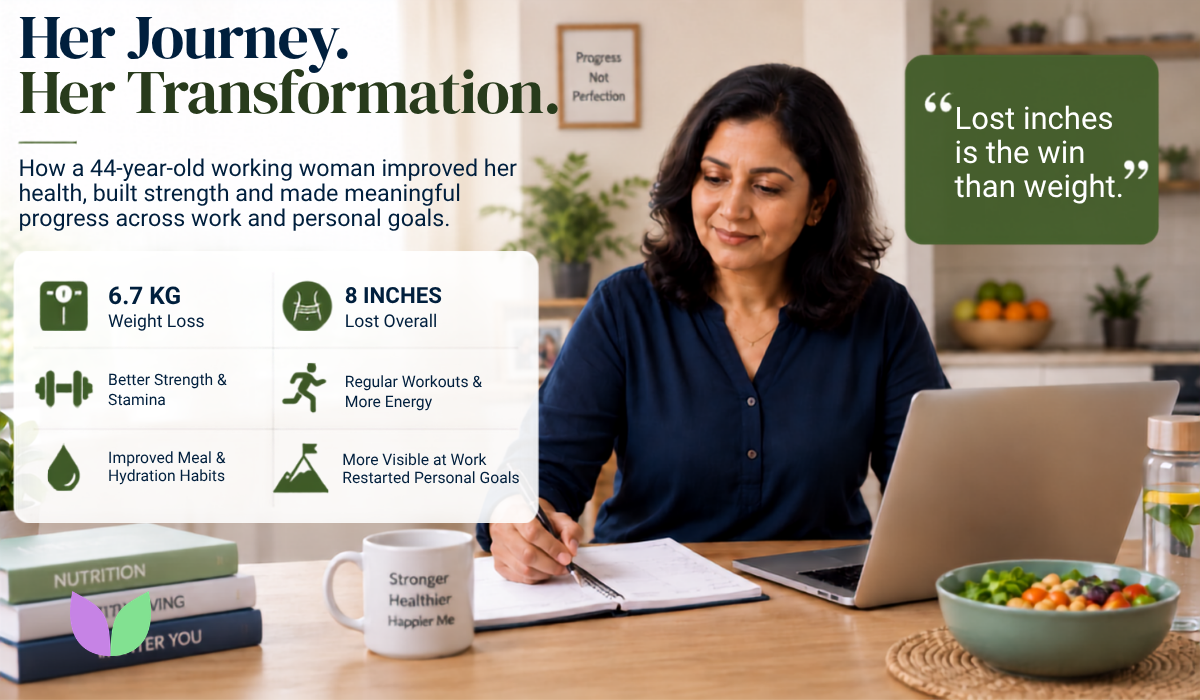
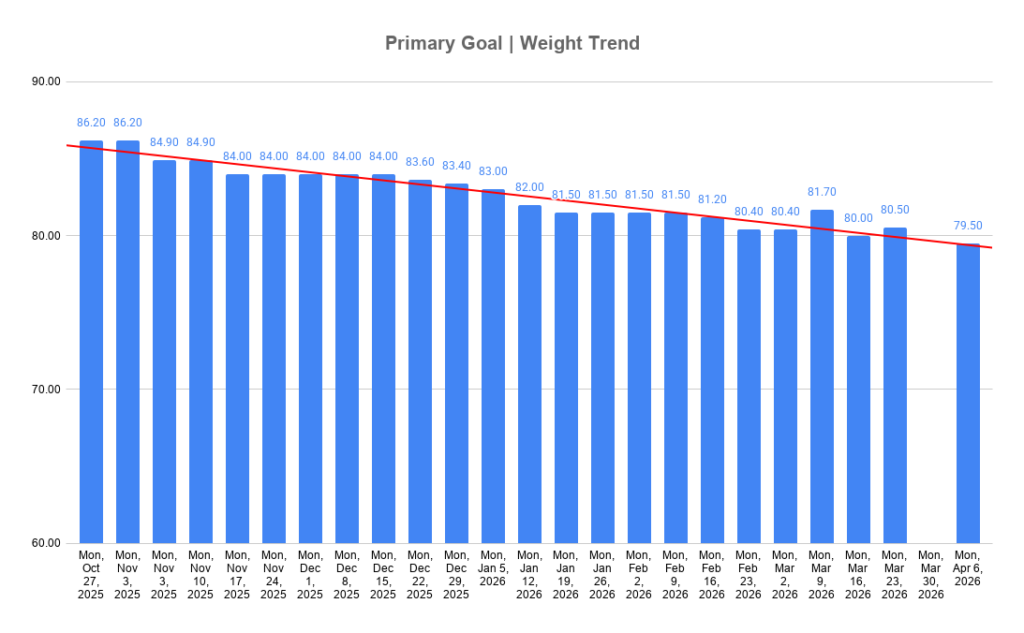
She began her journey at 86.2 kg.
Her initial goal was to lose 9 kg.
By the end of the program, she had reached 79.5 kg.
6.7 kg weight loss
But there was another number that mattered to her.
8-inch overall reduction across tracked measurements
And for her, that physical change wasn’t just about the numbers.
She noticed improvements in:
- Strength and stamina
- Energy during workouts
- Consistency with exercise
- Meal timings
- Water intake
- Blood markers
- Her overall sense of well-being
- Confidence and dressing sense
Her own progress feedback captured something important about how she viewed the transformation:
“Lost inches is the win than weight.”
Because sometimes, the way your body feels, moves and fits into your life tells a bigger story than the weighing scale alone.
The Biggest Win Was Consistency
One of the most striking parts of her journey wasn’t just the weight she lost.
It was how consistently she showed up.
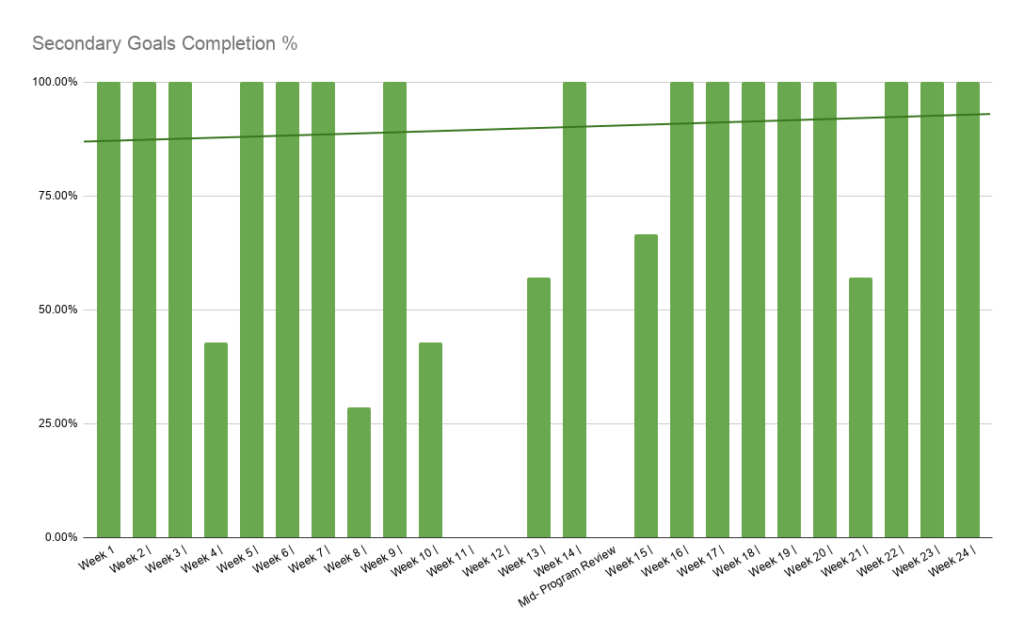
She completed the entire program without missing a scheduled session. In her feedback, she rated her progress 8/10, despite an eye problem temporarily interrupting some of her activities.
She reported following the plan consistently, with only a few meals here and there that didn’t go exactly according to plan.
Dinner remained one of the more challenging areas because of her packed schedule.
But even that became part of the learning process.
Because sustainable health isn’t about creating a life where nothing ever goes off-plan.
It’s about learning what makes you go off-track and knowing how to return.
From Following a Plan to Understanding Her Health
This is perhaps the most meaningful part of her story.
At the beginning, she wanted a solution to help her lose weight.
By the end, she had gained something more valuable:
a better understanding of how to continue.
Her experience wasn’t about becoming dependent on a perfect diet chart.
It was about learning:
- How to structure her meals
- How to make better food choices
- How to meet nutritional requirements within her preferences
- How to stay active
- How to listen to her body
- How to adapt when circumstances change
- And how to make health part of everyday life
That is what makes a wellness journey sustainable.
Her Story, In Her Own Words
Numbers can show weight loss.
Measurements can show physical change.
But her own words capture what the journey meant to her.
She described her IntuiWell experience as:
“Empowering self for sustainable journey. Educating on how to continue. Good relationships. Empathetic.”
She also rated her communication experience 10/10, the ease of following her plan 10/10, and her sessions 10/10 for making her feel heard and understood.
That feedback reflects something central to the IntuiWell approach:
The relationship matters.
A personalized plan isn’t only about personalization of food.
It is also about understanding the person following it.
See Her Story in Her Own Words
Want to hear about her experience directly from her?
Watch her share her IntuiWell journey, experience and transformation in her own words.
Hear Her Experience in Her Own Words.
Beyond Nutrition: Personal Growth Became Part of the Journey
As her health journey progressed, there were other areas of life she wanted to work on too.
In her first Personal Growth discussion, two areas stood out.
Professionally, she wanted to become more visible in front of leadership. She was doing good work, but felt she needed to communicate her contribution better, create clearer evidence of her impact and become more confident about showcasing what she was doing.
Personally, she wanted to manage her schedule better and make space for creative interests that often got pushed aside by work, home and everyday responsibilities.
The problem was not that she was doing too little. Her days were already full.
So instead of simply asking her to “manage time better” or “be more confident”, we started by making the challenges more specific.
Making Good Work More Visible
One of the first areas we worked on was professional visibility.
She was already doing the work. The challenge was to make sure important outcomes, decisions and contributions did not remain invisible simply because she completed them and moved on to the next thing.
Based on what she had shared, we created a personalized system called her Signal Stack. It included tools such as Finishline Lock, Default Filter, Impact Pulse and Mind Sweep.
Each had a specific purpose: help her focus on fewer meaningful outcomes, become more deliberate before taking on more, capture evidence of her contribution, and bring competing work and personal priorities into one clearer system.
The tools were not the goal. They were there to help her see what was happening and respond differently.
Over time, she started documenting her work more deliberately and communicating her contribution more consistently, creating clearer evidence of the work she was already doing rather than relying on good work to speak for itself.
That addressed one of the challenges she had originally brought into the sessions.
But the work also uncovered another pattern.
Three Unfinished Things Told Us Something
We looked at three things she had started but not completed.
The first was an online UX-design course.
She had started it because she wanted to upskill and enjoyed learning something new. Somewhere midway, however, the number of assignments and submissions started feeling overwhelming. She began questioning whether the effort she was putting in was worth it and eventually stopped.
The second was a DIY painting kit.
Creative activities genuinely mattered to her. But an eye infection interrupted the painting midway, and her focus naturally moved to recovering.
What stood out was what happened afterwards. Even after the immediate interruption had passed, she had not picked the painting up again. She would think about completing it over the weekend, but it continued to remain unfinished.
The third was dance classes, something she had wanted to pursue since childhood.
She finally started, but over time the commitment began to feel demanding. Long practice requirements added pressure, and parts of the experience with the teacher became uncomfortable. Gradually, her desire to continue reduced.
These were not activities that had simply stopped mattering to her.
She rated all three around 8/10 in importance.
That made lack of interest or importance an unlikely explanation.
The reasons for stopping were also different. One involved overwhelm. One involved a genuine interruption. Another involved pressure and discomfort.
But when we looked across the three experiences, a common pattern started to emerge:
Excitement → friction → overwhelm or discomfort → pause → difficulty restarting.
That was much more useful than simply labelling herself as inconsistent.
Starting Wasn’t Always the Hard Part. Returning Was.
This changed the focus of the work.
Instead of only asking:
“How do I become more disciplined?”
the more useful question became:
“What happens when my momentum breaks, and what would make it easier to return?”
We created another personalised tool around this pattern, her Pattern Breaker.
The idea was simple. Notice when something changes. Identify what is creating the friction. Reduce the size of the next step. And return without feeling that the only acceptable restart is a full comeback.
One of her tracker entries captured this well.
The trigger she noticed was:
“Resistance.”
Instead of waiting to feel motivated, she reduced the next step to:
“Do it for 5 mins.”
She showed up.
Her note afterwards was:
“Initial 2 mins push.”
It was a small experiment, but an important one. The resistance did not have to disappear before she acted. She could make the next step small enough to move through it.
And Then the Pattern Started to Change
Understanding the pattern was useful. But the real test was whether it changed what she did.
It did.
She went back and completed the UX-design course she had previously left unfinished.
She started painting again gradually, rather than continuing to wait for the right weekend or enough motivation to complete everything at once.
And professionally, she began creating documented evidence of her work and communicating her contribution more consistently, helping build greater visibility around work that previously could remain too quiet.
These were different areas of life, but the underlying shift was similar.
She was becoming better at noticing what was getting in the way and taking a practical next step before a pause stretched on for longer than she wanted.
The Personal Growth work had therefore moved from broad concerns around time management and professional visibility to something much more personal and useful:
understanding her own patterns well enough to respond differently.
What Her Journey Really Teaches Us
Her story isn’t about finding a magical diet.
It isn’t about perfect adherence.
And it isn’t about losing the maximum amount of weight in the shortest possible time.
It is about something much more practical:
The right approach has to fit the person, not the other way around.
For her, that meant:
- Working around a demanding lifestyle
- Respecting her vegetarian preferences
- Meeting her nutritional requirements without eggs
- Making food interesting and practical
- Understanding the science behind her recommendations
- Staying physically active
- Adapting when RA entered the picture
- Continuing to learn rather than simply following instructions
And through her Personal Growth work, it also meant:
- Becoming more deliberate about how she communicated her work and made her contribution visible
- Recognising a pattern in what happened when something meaningful became difficult or got interrupted
- Learning to make the restart smaller instead of waiting for the perfect time or motivation
- Returning to things that mattered to her, including completing a learning goal and gradually restarting a creative interest
And eventually, becoming more confident in managing her health and other areas of life that mattered to her.
That is the difference between simply following a plan and developing the understanding to continue independently.
At IntuiWell, we believe the goal isn’t to make you dependent on a nutritionist, coach or perfect plan forever.
The goal is to help you understand what works for you, recognise what gets in the way, and build the confidence to keep making informed choices long after the program ends.
That may mean learning how to manage your nutrition better. It may also mean working on another challenge that is relevant to your life.
The point is not to add more interventions.
It is to understand the person well enough to support what genuinely needs attention.
Who Is a Personalized Wellness Journey For?
Her story may resonate particularly with working women who:
- Have tried multiple diets but struggled to sustain them
- Know what they “should” be doing but find it difficult to fit into everyday life
- Are balancing work, home and personal responsibilities
- Want to lose weight without following an unnecessarily restrictive diet
- Have specific dietary preferences or requirements
- Want to improve strength and fitness alongside weight management
- Want to understand the science behind their nutrition
- Need a plan that can adapt when life or health circumstances change
You don’t necessarily need another diet chart.
Sometimes, you need someone to understand your life first and then build the health plan around it.
Blog Summary
A 44-year-old woman came to IntuiWell with a clear goal: weight loss.
At 44, she was balancing work, home responsibilities and her own health. She had tried other weight-loss platforms before, but the plans hadn’t felt practical enough for her lifestyle.
Her six-month IntuiWell journey took a different approach.
Her nutrition was personalized around her vegetarian preferences and nutritional requirements, without eggs. Recipes were designed to be practical and enjoyable. Weekly discussions focused not only on what she should eat, but on the science and logic behind every recommendation.
Exercise became another important part of her routine, with improvements in strength, stamina and workout energy.
When she was diagnosed with RA during the journey, the approach was adapted so she could continue her nutrition and exercise routine alongside appropriate medical care.
By the end, she had:
- Lost 6.7 kg
- Reduced 8 inches overall across tracked measurements
- Improved strength and stamina
- Maintained regular workouts
- Experienced more consistent energy during exercise
- Improved meal timings and hydration
- Reported improved blood markers
- Felt greater confidence in herself and her health journey
Alongside her health journey, she also chose to work on professional and personal challenges through Personal Growth sessions. She became more deliberate about documenting and communicating her contribution at work. By examining things she had started but left incomplete, she also recognised a pattern around what happened when overwhelm, discomfort or interruption broke her momentum. Learning to make the restart smaller helped her take action differently. She completed a UX-design course she had previously left unfinished and gradually returned to painting.
But perhaps the most meaningful transformation was not the number on the scale.
It was the shift from simply following a plan to understanding how to continue.
As she put it:
“Empowering self for a sustainable journey. Educating on how to continue.”
That is what sustainable wellness should ultimately create: not dependence on a plan, but greater understanding and confidence in your ability to continue.
Frequently Asked Questions
1. Can a personalized nutrition program work with a busy work and home schedule?
Yes. Her journey demonstrates why personalization matters. Her approach was designed around her work, home responsibilities, food preferences and daily routine, making it easier to integrate health into her existing lifestyle.
2. Can vegetarian nutrition provide adequate protein during a weight-loss journey?
Yes. She followed a vegetarian approach without eggs, while her nutritional and protein requirements were addressed through appropriate food choices and meal planning.
3. Does weight loss require following a very restrictive diet?
Not necessarily. Her approach focused on practical meals, mindful portions, consistency, movement and understanding the reasoning behind her nutrition rather than simply following a rigid diet.
4. What happens if a health condition develops during a wellness program?
A personalized approach needs to be adaptable. When she was diagnosed with RA during her journey, her nutrition and exercise approach was adapted so she could continue working toward her goals alongside appropriate medical care.
5. What did she achieve during her six-month journey?
She lost 6.7 kg and achieved an 8-inch overall reduction across tracked measurements. She also reported improvements in strength, stamina, workout energy, meal timings, hydration, blood markers and confidence.
6. Is the goal of a personalized nutrition program only weight loss?
Weight loss can be an important goal, but sustainable wellness involves much more. Her journey focused on helping her understand nutrition, build consistency, stay active and become more confident in managing her health independently.
7. How did Personal Growth fit into her wellness journey?
Personal Growth was not added because every nutrition client needs it. She chose to use these sessions because there were professional and personal challenges she also wanted to work on. In her case, the sessions focused on professional visibility, managing competing priorities and understanding what made it difficult to return to meaningful activities after interruptions. This led to practical changes, including completing an unfinished learning goal, gradually restarting a creative interest and communicating her work more deliberately.
Your Next Step
Your health journey doesn’t have to revolve around another rigid diet chart.
If you’re looking for an approach that considers your lifestyle, food preferences, nutritional requirements, health goals and changing circumstances, IntuiWell can help you build a more personalized path forward.
Explore IntuiWell Programs
Or, if you want to understand whether personalized guidance is right for you:
Book a Personalised Consultation
Because sustainable health isn’t about following a plan perfectly.
It’s about understanding your health, learning what works for you, and knowing how to continue.
Written by:
Shivani Jain
Co-founder & Clinical Lead Nutritionist, IntuiWell
Helping people simplify nutrition through science, tradition, and practical kitchen wisdom.
Personal Growth contribution by:
Vallabh Chitnis
Co-Founder & Mindset, Behavior, & Personal Growth, IntuiWell
Vallabh works with individuals on personal growth, emotional patterns, mindset shift, and behaviour change through founder-led programs.