Daily Life Movement Series Episode 2: How to Get In and Out of a Car Without Back or Knee Pain
About This Series
Daily Life Movement focuses on improving how you move during everyday activities — not just during workouts. Because most strain and stiffness don’t happen in the gym. They happen in daily life.
Today’s movement: Getting in and out of a car.
It sounds simple. It isn’t.
If you missed Episode 1, start there: Getting Up from the Floor Safely — a foundational movement that reveals more about your functional fitness than most workouts do.
Why This Movement Is Hard on the Body
Getting in and out of a car combines:
- Deep hip bending
- Spinal rotation
- Weight shifting
- Single-leg loading
- Limited space
When done incorrectly, the spine twists under load and the knees absorb unnecessary pressure. Research shows that combined flexion and axial rotation is a primary mechanism of lumbar disc injury — and biomechanical analysis of vehicle ingress and egress confirms significant lumbar and knee joint loading during these movements.
Over time, this creates:
- Lower back strain
- Knee discomfort
- Hip stiffness
- That “pull” feeling when you stand up
And since we repeat this movement daily, even small inefficiencies add up.
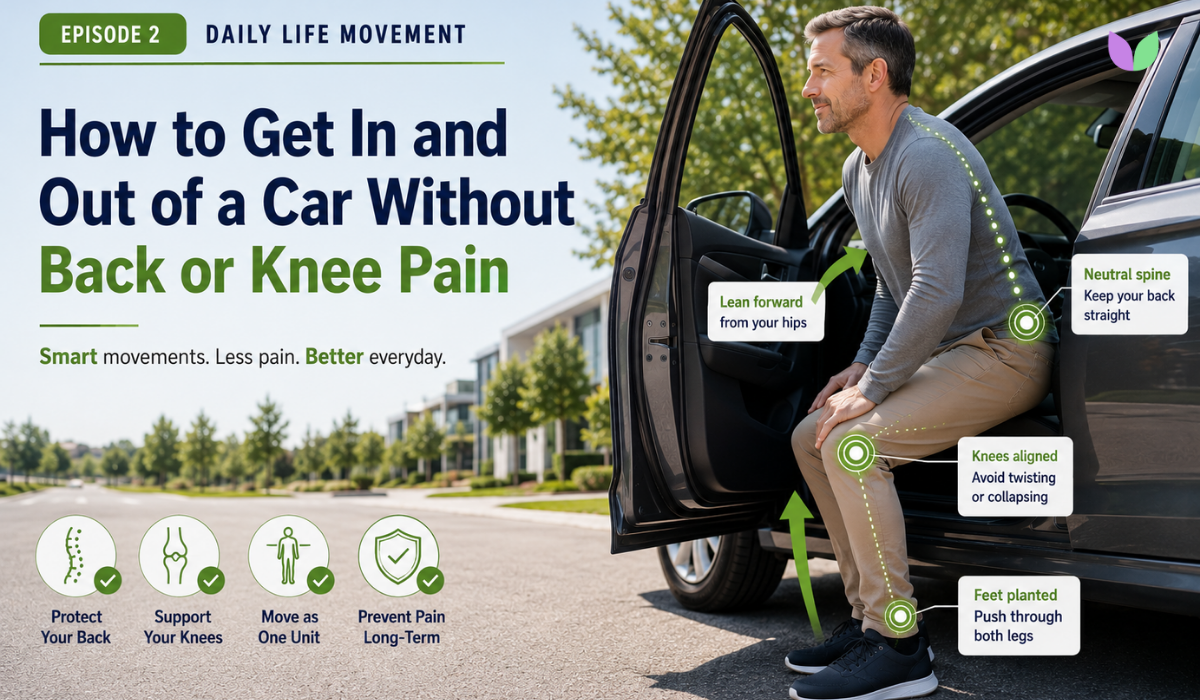
The goal is simple: Move as one unit. Avoid twisting under load.
How to Get Into a Car Safely
Step 1: Position Yourself First
Stand with your back to the seat, close enough that the back of your knees nearly touch it. Keep your feet together and your torso upright. Do not reach one leg in first.
Step 2: Sit First, Then Swing
✔️ Sit down fully, keeping your torso upright
✔️ Then lift both legs together and pivot into the car as one unit
This protects your lower back, knees, and hips — all at once.
How to Get Out of a Car Safely
Step 1: Turn Your Whole Body
Before standing, move both legs out together and plant both feet firmly on the ground. Do not let your spine rotate while your legs are still inside.
Step 2: Push Through Both Legs to Stand
✔️ Lean forward slightly from the hips — not the lower back
✔️ Push through both legs equally to rise
✔️ Use your leg strength — not your lower back — to lift yourself
Common Mistakes
❌ Twisting while standing up → Loads the spine unevenly
❌ Pushing off one leg only → Overloads the knee joint
❌ Leaning backward while exiting → Strains the lower back
❌ Holding your breath → Reduces core stability
If You Have Knee Pain
- Slide the seat slightly back before exiting to give yourself more room
- Keep feet slightly wider than hip-width for better base support
- Use a slow, controlled push — avoid sudden or jerky movements
If You Have Back Pain
- Gently engage your core before you begin to stand
- Lean forward slightly from the hips before pushing up
- Avoid any twisting while weight-bearing
Think: “Nose over toes” before standing.
Three Exercises That Make This Easier
You don’t need a gym.
- Sit-to-Stand Practice Strengthens the legs and hips — the same muscles doing the work in a car transfer. Research on sit-to-stand biomechanics shows that hip and knee extension are the primary drivers of safe, controlled rising. Sit on a firm chair, feet hip-width apart. Lean forward slightly, then push through both feet to stand. Lower slowly. Aim for 10 reps per session.
- Hip Hinge Drills Teaches your body to load the hips — not the lower back — when leaning forward. Stand with feet hip-width apart, hands on thighs. Push your hips back (not down) as you slide your hands toward your knees. Return to standing. Keep your spine long throughout.
- Seated Leg Swings Improves hip mobility so pivoting in and out of a car feels smooth rather than stiff. Adding targeted hip mobility and strength work has been shown to significantly improve sit-to-stand performance and reduce knee pain. Sit at the edge of a chair, hold the sides for support, and swing both legs gently side to side as a unit.
Practice these 3–4 times weekly.
The Bigger Picture
We repeat car transfers thousands of times over a lifetime. Being able to sit, rotate, stand, and balance with control reduces cumulative joint stress and supports long-term independence.
Fitness is not just workouts. It’s how you move during ordinary moments. Small daily corrections prevent big future problems — and this is one of the smallest corrections with some of the highest daily payoff.
Key Takeaway
Don’t twist under load.
Sit first, swing together. Turn your whole body. Use your legs — not your back.
That’s real-life movement intelligence.
Blog Summary
Getting in and out of a car is one of the most repeated movements in daily life — and one of the most overlooked sources of back and knee strain. This post breaks down exactly why the movement is harder on the body than it looks: it combines spinal rotation, deep hip bending, single-leg loading, and weight shifting in a confined space. Done incorrectly, day after day, those small inefficiencies accumulate into real pain.
The post covers the safe technique for both entry and exit — sit first, swing both legs together, turn your whole body before standing, and push through both legs rather than your lower back. It also addresses common mistakes, specific modifications for knee and back pain, and three simple exercises (sit-to-stand practice, hip hinge drills, and seated leg swings) that build the strength and mobility this movement actually requires.
The core principle throughout: move as one unit, avoid twisting under load. Master that, and one of your most frequent daily movements stops being a source of wear and starts being a moment of functional control.
FAQs
Q: How quickly will I notice a difference if I change how I get in and out of the car?
Most people notice reduced stiffness and that familiar “pull” feeling within a week of consistent practice. The technique itself takes seconds to learn — the challenge is remembering to use it every single time, especially when you’re in a hurry.
Q: Does the technique change for SUVs versus low sedans?
The principle stays the same — sit first, swing together, avoid twisting under load — but the entry height changes how much effort your legs need to provide. With a high SUV, use the grab handle above the door to support your descent. With a low sedan, widen your stance slightly before sitting to reduce the drop.
Q: My back pain only flares when I get out of the car in the morning. Why?
The intervertebral discs in your spine absorb fluid overnight and are slightly more pressurised in the morning, making them more vulnerable to rotational load. Combined with a cool, stiff body that hasn’t warmed up yet, morning car exits are genuinely higher-risk. Take an extra second before exiting — engage your core, move both legs out together, and lean forward from the hips before pushing up.
Q: Is it okay to use the car door or door frame for support?
Yes — and encouraged, especially if you have knee or hip pain. Use the door frame (not the door itself, which can swing) to take some load off your legs as you rise. The key is that it assists the push — it shouldn’t replace it. You still want your legs doing the primary work.
Q: I already have a knee replacement. Does anything change?
The core technique applies, and is actually especially important for post-replacement knees. Slide the seat as far back as it will go before exiting to reduce the bend angle at the knee. Rise slowly and avoid any lateral twist. If you’re in a formal post-op rehab programme, check with your physiotherapist before adding the exercises.
Q: How often should I practice the three supporting exercises?
Three to four times weekly is the recommendation in the post, but even two consistent sessions per week will build meaningful change over a month. Sit-to-stand practice can also be folded into daily life — every time you get up from a chair or sofa, do it with intention.
Q: Can these techniques help with hip pain, not just back and knee pain?
Yes. The “sit first, swing together” method significantly reduces the unilateral hip loading that happens when you step one leg in and drop your weight unevenly. People with hip impingement or early-stage hip arthritis often find the most immediate relief from this technique because it removes the asymmetric compression that twisting creates.
If getting in and out of your car causes pain, stiffness, or that nagging pull — your movement pattern is telling you something worth listening to.
Book a consultation call with IntuiWell to assess your movement patterns and get a personalised plan that builds real, functional strength in everyday life. Or request a call back and we’ll help you take the first step toward moving without pain — starting with the moments that happen before you even walk through the door.