
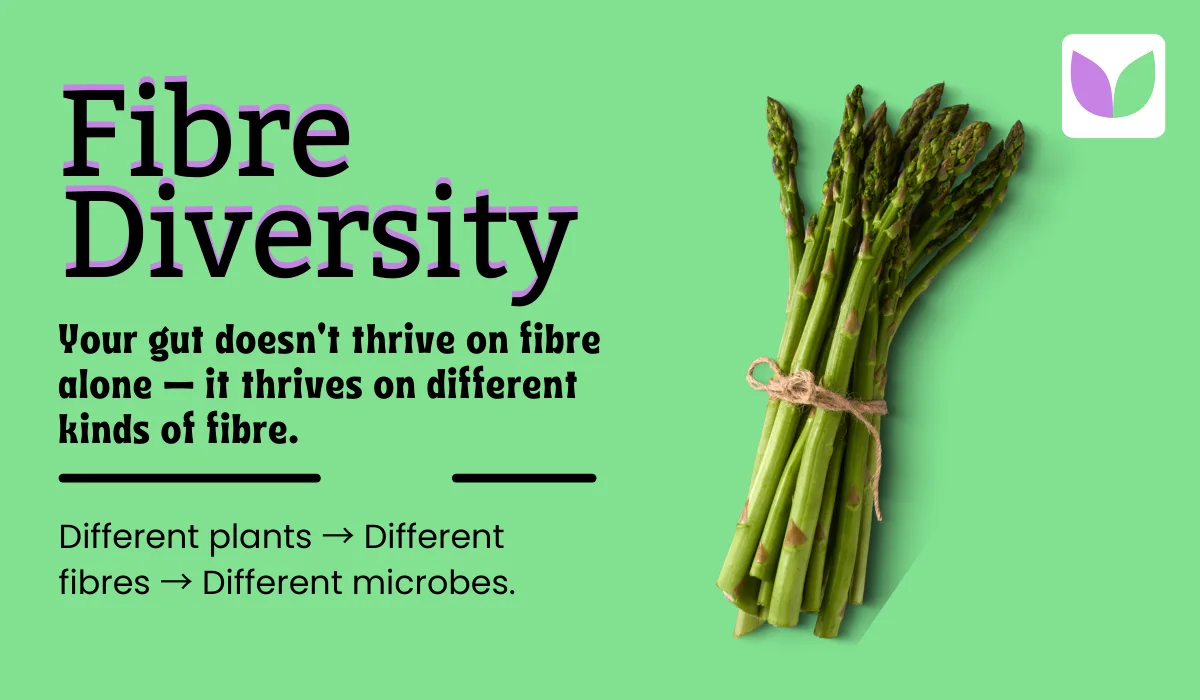
Most people try to “fix their gut” by adding more fibre, such as oats, psyllium, salads, and multigrain rotis.
But your gut doesn’t need more fibre.
It needs many types of fibre.
Just like your body needs different vitamins, your gut bacteria need different fibres to survive, grow, and do their job.
This is called fibre diversity, and it is one of the strongest predictors of gut resilience, metabolic health, immunity, and even mood balance.
The Science: Different Fibres Feed Different Microbes
Your gut is home to trillions of microbes, and each species eats a different type of plant fibre.
When you give your gut only one or two types (like oats + vegetables), you feed only a small part of your microbiome.
Over time, the rest of the microbes become weak or die out — reducing diversity.
Low microbial diversity is linked to:
- bloating
- constipation
- food intolerances
- weakened immunity
- chronic inflammation
- cravings and mood swings
Research from the American Gut Project shows:
People who ate the greatest variety of plant fibres (30+ plant types/week) had the healthiest, most diverse gut microbiomes.
This is the heart of fibre diversity.
Types of Fibre Your Gut Needs (and Why)
1. Soluble Fibre
Forms a gel and feeds beneficial microbes.
Benefits: digestion, blood sugar balance.
Examples: oats, chia, flax, apple, dal, beans.
2. Insoluble Fibre
Adds bulk and supports regular bowel movement.
Examples: whole grains, wheat bran, vegetable skins.
3. Resistant Starch
Feeds bacteria in the large intestine, improves insulin sensitivity.
Examples: cooked-cooled rice, potatoes, green bananas, millets.
4. Prebiotic Fibre
Directly feeds good bacteria like Bifidobacteria.
Examples: onions, garlic, banana, asparagus, rajma, chole.
Each of these fibres feeds different microbial families —
That’s why one type alone is never enough.
The Real Problem: Modern Diets Lack Fibre Variety
Most people rotate the same foods:
✔ oats
✔ wheat roti
✔ spinach
✔ dal
✔ apple
This is fibre, but not fibre diversity.
The gut gets bored.
Your microbes starve.
Symptoms begin.
How to Build Fibre Diversity
1. Eat 20–30 Different Plant Foods per Week
Plant foods include:
- fruits
- vegetables
- nuts
- seeds
- herbs
- spices
- whole grains
- legumes
Even a pinch of spice counts.
2. Rotate Your Grains
Instead of only wheat or rice:
- jowar
- ragi
- bajra
- barley
- red rice
- quinoa
Each grain feeds different bacteria.
3. Add 1–2 New Plant Foods Every Week
A new fruit, a new dal, a new sabzi — small changes → big shifts.
4. Go Back to Indian Food Patterns
Indian meals naturally include:
- 3–4 veggies
- 2 types of dals
- 2–3 spices
- a grain mix
- a fermented component
This is fibre diversity by design.
5. Think “Rainbow, Not ‘Healthy.”
A colourful plate = diverse polyphenols = diverse microbes.
Signs Your Gut Needs More Fibre Diversity
- You bloat easily
- You react to many foods
- Constipation or irregular stools
- You feel hungry soon after meals
- You rely heavily on one grain (wheat/rice)
- You have low energy or afternoon crashes
A Simple 7-Day Fibre Diversity Challenge
Daily goals:
✔ 5 plant foods per meal
✔ 1 colourful fruit
✔ 1 legume or dal
✔ 1 grain rotation
✔ 3 spices (jeera, haldi, dhaniya, ajwain count!)
By the end of 7 days, most people feel:
- lighter digestion
- better bowel movement
- stable energy
- fewer cravings
- less bloating
Why Fibre Diversity Works
- Feeds a broader microbial population
- Improves the gut barrier
- Supports detoxification
- Reduces inflammation
- Helps with hormonal balance
- Stabilises blood sugar
- Enhances mood and mental clarity
Your gut doesn’t need perfection.
It needs variety.
A Diverse Plate Builds a Diverse Gut
Healing the gut is not about adding supplements, powders, or extreme diets.
It’s about giving your microbes different foods so they can do their job.
Small additions.
Natural foods.
Weekly variety.
That’s the IntuiWell way.
Summary
Most people assume gut health improves by simply adding more fibre, but that’s a shallow fix. Your gut requires different types of fibre — soluble, insoluble, resistant starch, and prebiotic — because each feeds a different set of microbes. When you repeatedly eat the same limited foods (oats, dal, wheat, spinach, apple), you starve most of your gut bacteria, leading to bloating, inflammation, cravings, poor immunity, and unstable digestion.
Research proves that people who eat 30+ plant foods a week have the most resilient guts. The goal isn’t high fibre — it’s fibre diversity. Rotating grains, increasing plant variety, using spices, and following traditional Indian meal patterns naturally rebuild microbial diversity. A simple 7-day challenge (5 plant foods per meal, 1 fruit, 1 legume, grain rotation, and daily spices) already improves energy, bowel movement, and digestion. Gut healing is about consistent variety, not supplements or extreme diets.
FAQs
1. Isn’t “more fibre” enough?
No. A single fibre source feeds only a small fraction of your microbiome. Diversity is what strengthens gut function.
2. How many plant foods should I aim for weekly?
20–30 different plant foods. Small quantities count — even spices.
3. What qualifies as a plant food?
Fruits, vegetables, dals, legumes, nuts, seeds, herbs, spices, whole grains, millets.
4. Will fibre diversity reduce bloating?
In most cases, yes — because it restores missing microbes responsible for digestion and inflammation control.
5. How soon do results show?
Usually, within 7 days, lighter digestion, better stools, reduced cravings, and more stable energy.
6. Can traditional Indian meals help?
Yes. Indian thalis naturally include multiple vegetables, dals, spices, and fermented foods — all supporting microbial diversity.
7. Do I need supplements?
Not unless medically required. Food-based diversity works better and is sustainable.
Want a personalised plan to fix your gut with fibre diversity?
Book a consultation call or request a call back with IntuiWell — start your gut reset the right way.


