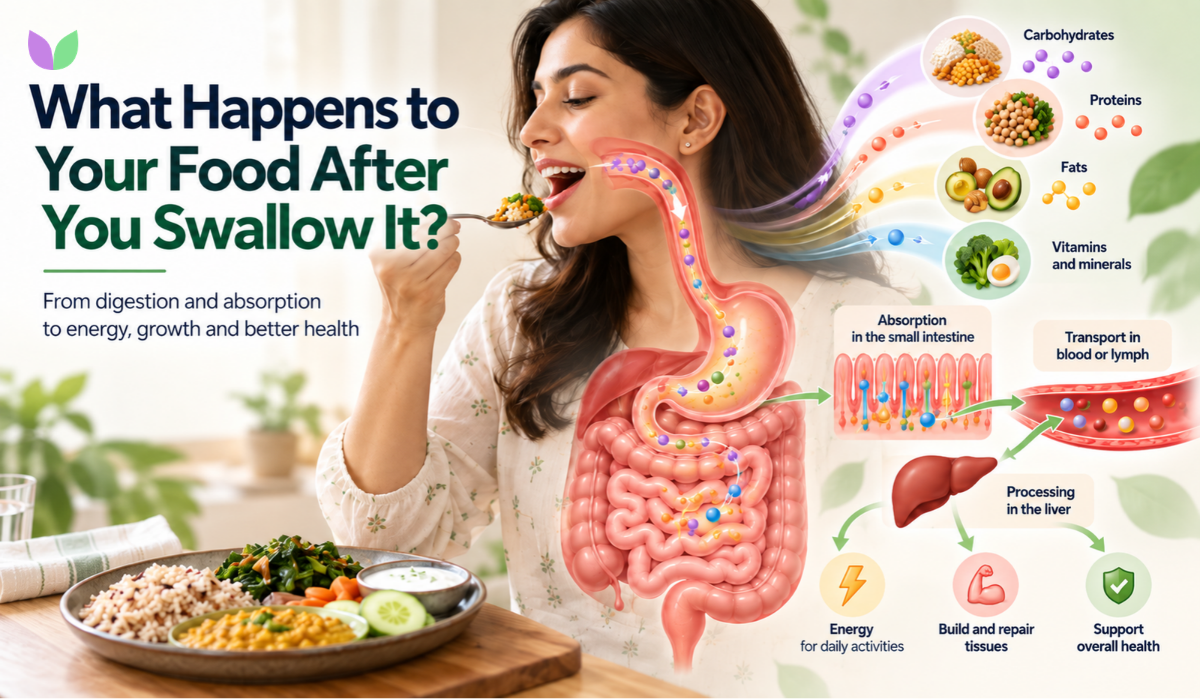
A Journey Through Digestion, Nutrient Absorption and How Your Body Uses Food
“You don’t simply eat food. Your body has to break it down, digest it, absorb it, transport it and finally decide what to use, store or eliminate.”
Quick Takeaways
- Digestion begins in your mouth, not your stomach. Chewing breaks food down mechanically, while saliva begins the digestion of starch.
- Your stomach mixes food with acid and digestive enzymes, begins protein digestion, and gradually releases the partially digested food into the small intestine.
- Your pancreas produces enzymes that digest carbohydrates, proteins and fats, while bile from the liver helps with the digestion and absorption of dietary fat.
- The small intestine is the major site of digestion and nutrient absorption. Its specialised surface, including villi and microvilli, provides a large area for absorption.
- Digestion and absorption are not the same thing. A nutrient must first be released from food and broken down appropriately before it can be absorbed.
- Different nutrients follow different absorption pathways. Many water-soluble nutrients enter the blood directly, while much of the absorbed long-chain dietary fat initially travels through the lymphatic system.
- Vitamin B12 has a particularly specialised absorption process involving intrinsic factor and the terminal ileum.
- The amount of a nutrient present in a food does not automatically tell you how much your body will absorb. Food form, meal composition, digestive function, nutrient status and individual physiology can all matter.
- Fibre that reaches the large intestine can be fermented by gut microorganisms, producing short-chain fatty acids. The extent of fermentation depends on the type and amount of fibre and the gut environment.
- Digestive symptoms are clues, not diagnoses. Persistent or significant symptoms may need proper clinical evaluation.
1. The Journey Starts Before You Swallow
Digestion begins in your mouth.
When you chew, your teeth mechanically break food into smaller pieces, increasing its surface area. At the same time, saliva moistens the food and contains enzymes that begin the digestion of starch.
Your tongue then helps form the food into a bolus, which can be swallowed.
So that first bite is already undergoing a series of digestive processes before it reaches your stomach.
2. The Oesophagus: Your Food’s Transport System
Once you swallow, the food bolus enters the oesophagus, the muscular tube connecting your mouth to your stomach.
Food does not simply “fall” into your stomach.
Instead, coordinated muscular contractions called peristalsis move the bolus downwards.
At the lower end of the oesophagus is the lower oesophageal sphincter (LES), which helps regulate the movement of stomach contents and helps prevent them from flowing back into the oesophagus.
When this barrier does not function effectively, stomach contents can move upwards and contribute to symptoms of reflux.
3. The Stomach: More Than a Storage Bag
The stomach temporarily stores food while mixing it with gastric secretions.
Hydrochloric acid creates a highly acidic environment that helps denature proteins and supports the activity of certain digestive enzymes.
Protein digestion begins here, particularly through the action of pepsin.
The stomach also mechanically churns food, gradually transforming it into a semi-liquid mixture called chyme.
But the stomach does not empty everything into the small intestine at once.
Gastric emptying is regulated, and the rate is influenced by factors such as meal volume and composition, including the amount of fat and energy in the meal.
This controlled delivery allows the small intestine to handle digestion and absorption efficiently.
4. The Small Intestine: Where Digestion Meets Absorption
This is where much of the major digestive work takes place.
The small intestine consists of three main sections:
- Duodenum
- Jejunum
- Ileum
As chyme enters the small intestine, it encounters pancreatic enzymes, bile and intestinal digestive processes.
Carbohydrates are broken down into smaller sugars.
Proteins are broken down into amino acids and small peptides.
Fats are broken down into smaller components that can be incorporated into micelles and eventually absorbed.
The inner surface of the small intestine is highly specialised for absorption.
It contains villi, tiny finger-like projections covered by epithelial cells. These cells have even smaller structures called microvilli, forming what is commonly called the brush border.
Together, these structures create a very large surface area through which nutrients can be absorbed.
5. Digestion and Absorption Are Not the Same Thing
This distinction is important.
Digestion means breaking food into smaller molecules that the body can process and absorb.
Absorption means moving those digested nutrients across the intestinal lining into the body’s transport systems.
For example, eating a protein-rich meal does not mean that intact dietary protein simply enters your bloodstream.
Proteins must first be digested into smaller units such as amino acids and small peptides. These can then be absorbed and transported for use by the body.
So when we talk about “getting nutrients from food”, we are actually talking about several stages:
Food → Digestion → Absorption → Transport → Use, storage or further metabolism
6. Not All Nutrients Travel the Same Way
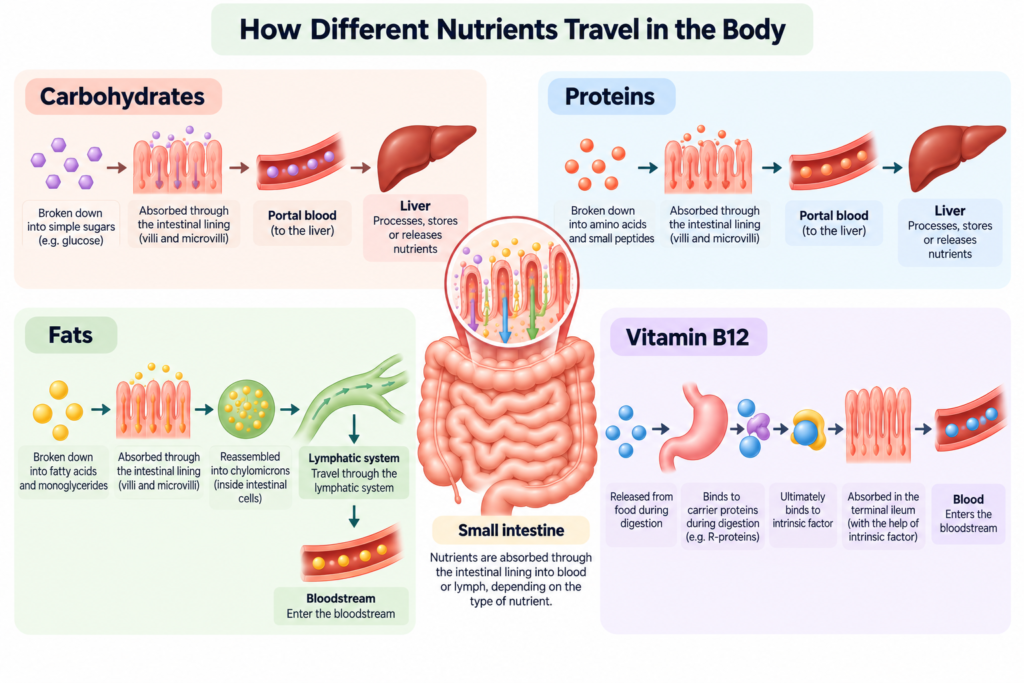
Once nutrients cross the intestinal lining, they do not all take the same route.
Many water-soluble nutrients and the products of carbohydrate and protein digestion enter the blood and are transported through the portal circulation, with much of this blood reaching the liver first.
Dietary fat follows a different pathway.
Long-chain fatty acids and other products of fat digestion are reassembled into triglyceride-rich particles called chylomicrons. These initially enter the lymphatic system before eventually reaching the bloodstream.
This is one reason why the digestive system is not simply a pipe carrying food from one end to another.
It is a highly organised system for processing and distributing nutrients.
7. Why Fat Matters for Fat-Soluble Vitamins
Vitamins A, D, E and K are commonly described as fat-soluble vitamins.
Their absorption is facilitated by normal fat digestion and absorption, although the relationship is not identical for every vitamin.
Dietary fat stimulates processes involved in fat digestion and helps form micelles, which can transport lipid-soluble compounds towards the intestinal surface.
This is one reason why extremely low-fat eating patterns can affect the absorption of some fat-soluble compounds.
However, this does not mean that every meal must contain a large amount of fat.
The key point is that normal fat digestion and absorption are part of the process by which these vitamins become available to the body.
8. Vitamin B12 Has Its Own Absorption Story
Vitamin B12 is an excellent example of why nutrient absorption is more complicated than simply “eating the nutrient”.
B12 in food is bound to proteins.
During digestion, stomach acid and enzymes help release it from food. B12 then undergoes several binding steps before ultimately forming a complex with intrinsic factor, a protein produced by the stomach.
The B12-intrinsic factor complex is recognised and absorbed primarily in the terminal ileum, the final part of the small intestine.
This means that adequate B12 intake alone does not guarantee adequate B12 absorption.
Problems involving stomach function, intrinsic factor production or the terminal ileum can interfere with B12 absorption.
9. Your Pancreas: The Digestive Enzyme Factory
Your pancreas has an important digestive role.
It releases digestive enzymes into the small intestine, including enzymes that help break down:
- Carbohydrates
- Proteins
- Fats
The pancreas also releases bicarbonate, which helps neutralise the acidic contents arriving from the stomach.
This creates a more suitable environment for pancreatic enzymes to function.
When pancreatic enzyme production or delivery is significantly impaired, digestion and nutrient absorption can be affected.
10. Your Liver and Gallbladder: The Fat-Digestion Team
The liver produces bile.
The gallbladder stores and concentrates bile and releases it into the small intestine when needed.
Bile does not enzymatically digest fat.
Instead, bile acids help disperse dietary fat into smaller droplets and support the formation of micelles. This makes it easier for digestive enzymes such as pancreatic lipase to act on fat and for the resulting products to be absorbed.
The liver also has a much broader role after absorption.
Many nutrients absorbed from the digestive tract reach the liver through portal circulation, where they can be processed, stored, transformed or released according to the body’s needs.
11. What Happens to the Food Your Small Intestine Does Not Absorb?
Not everything that enters your digestive tract is completely digested and absorbed in the small intestine.
Some carbohydrates, particularly certain types of dietary fibre, reach the large intestine.
The large intestine absorbs water and electrolytes and houses a complex community of microorganisms.
Some fibres are fermented by these microorganisms, producing short-chain fatty acids (SCFAs) such as acetate, propionate and butyrate.
The extent of fermentation depends on the type and amount of fibre as well as the composition and activity of the gut microbial community.
The remaining material gradually becomes more solid as water is absorbed and eventually passes into the rectum and out through the anus.
12. Your Gut Microbiota Gets Involved
Your digestive system does not work entirely on its own.
The microorganisms living in your gastrointestinal tract interact with dietary components that reach them, particularly certain fibres and resistant carbohydrates.
Through fermentation and other metabolic activities, they produce compounds that can influence the intestinal environment and interact with the host.
But the gut microbiota should not simply be reduced to the idea of “good bacteria” and “bad bacteria”.
It is a complex ecosystem whose composition and activity are influenced by diet, medications, gastrointestinal conditions and many other factors.
13. Why Increasing Fibre Can Sometimes Cause Bloating
Fibre is an important part of a healthy dietary pattern, but increasing it does not automatically improve symptoms for everyone.
A sudden increase in fibre can increase fermentation and intestinal contents, potentially producing more gas and bloating.
The response can depend on:
- Type of fibre
- Amount consumed
- Speed of increase
- Gut motility
- Constipation
- Individual tolerance
- Visceral sensitivity
- Underlying gastrointestinal conditions
This is why “just eat more fibre” is not always an adequate answer to digestive symptoms.
The goal is not simply to maximise fibre.
It is to find an amount and type that your digestive system can tolerate while meeting your nutritional needs.
14. When Digestion or Absorption Does Not Work Normally
Digestive problems can occur at several different stages.
A person may have difficulty:
- Breaking food down
- Producing or releasing digestive enzymes
- Digesting or absorbing particular nutrients
- Moving food through the gastrointestinal tract
- Tolerating particular carbohydrates or other food components
- Maintaining normal gastrointestinal function because of an underlying condition
For example, impaired pancreatic enzyme activity can interfere with digestion, while conditions affecting the small intestine can interfere with nutrient absorption.
This is why persistent digestive symptoms should not automatically be attributed to one food or one nutrient.
15. Why the Same Food Can Affect Two People Differently
Two people can eat the same meal and have very different digestive experiences.
Why?
Because digestion is influenced by much more than the food itself.
Individual differences can include:
- Digestive function
- Gut motility
- Meal size and composition
- Fibre intake
- Gut microbial composition and activity
- Food intolerances
- Existing gastrointestinal conditions
- Medication use
- Stress and sleep
- Overall dietary pattern
This does not mean that every digestive symptom has a psychological cause.
It means that nutrition needs to be understood in the context of the individual.
16. What Common Digestive Symptoms Can Tell You
Digestive symptoms can provide useful clues, but they do not identify a diagnosis by themselves.
Bloating
Bloating is not always simply “too much gas”.
It can involve intestinal contents, fermentation, motility, abdominal distension and how the nervous system perceives signals from the gut.
Heartburn
Heartburn is associated with the movement of stomach contents into the oesophagus and irritation of the oesophageal lining.
It is therefore too simplistic to assume that heartburn always means “too much stomach acid”.
Constipation
Constipation is not simply a fibre deficiency.
Fluid intake, fibre, physical activity, motility, medications, bowel habits and underlying conditions can all contribute.
Persistent greasy or oily stools
Repeated greasy, oily or difficult-to-flush stools can sometimes indicate problems with fat digestion or absorption and warrant appropriate medical evaluation, particularly when accompanied by weight loss or nutritional deficiencies.
17. Your Gut Is Connected to Your Nervous System
Your gastrointestinal tract and nervous system communicate continuously through neural, hormonal and immune signalling pathways.
This is one part of what is often called the gut-brain axis.
Stress can influence gastrointestinal motility, sensitivity and digestive symptoms in some people.
But this should not be interpreted as meaning that persistent digestive symptoms are “just stress”.
The relationship works in both directions, and ongoing gastrointestinal symptoms can themselves affect wellbeing.
18. After Absorption: Where Do the Nutrients Actually Go?
Once nutrients are absorbed, the journey is still not over.
The body has to decide what to do with them.
Depending on the nutrient and the body’s current requirements, nutrients may be:
- Used immediately for energy or cellular functions
- Used to build and repair tissues
- Converted into other compounds
- Stored for later use
- Transported to different tissues
- Excreted when present in excess
For example, glucose can be used by cells for energy, stored as glycogen or, depending on physiological conditions, converted into other forms.
Amino acids can be incorporated into proteins and other molecules.
Fatty acids can be oxidised for energy, incorporated into cell membranes or stored as triglycerides.
So the story of food does not end when a nutrient enters your bloodstream.
19. What You Eat Is Not Always What Your Body Absorbs
This is one of the most important concepts in nutrition.
What you eat is not necessarily the same as what your body absorbs.
And what your body absorbs is not necessarily the same as what your body ultimately uses.
For example, two foods may contain similar amounts of a mineral, but the amount absorbed can differ because of:
- Chemical form of the nutrient
- Food matrix
- Meal composition
- Compounds that enhance or inhibit absorption
- Digestive function
- Nutrient status
- Individual physiology
This is why nutrient analysis should go beyond simply looking at numbers on a food database.
20. What This Means for Your Everyday Meals
You do not need to think about your digestive system every time you eat.
But understanding the process can change how you think about nutrition.
Instead of asking only:
“Is this food healthy?”
you can also ask:
“How does this food fit into my overall diet?”
“How much of it do I tolerate?”
“What else am I eating with it?”
“Does the way I prepare it affect digestion?”
“Am I actually absorbing and tolerating the nutrients I am consuming?”
“Could my symptoms have another underlying explanation?”
These questions are much more useful than labelling individual foods as simply “good” or “bad”.
21. A Simple Way to Think About Your Digestive System
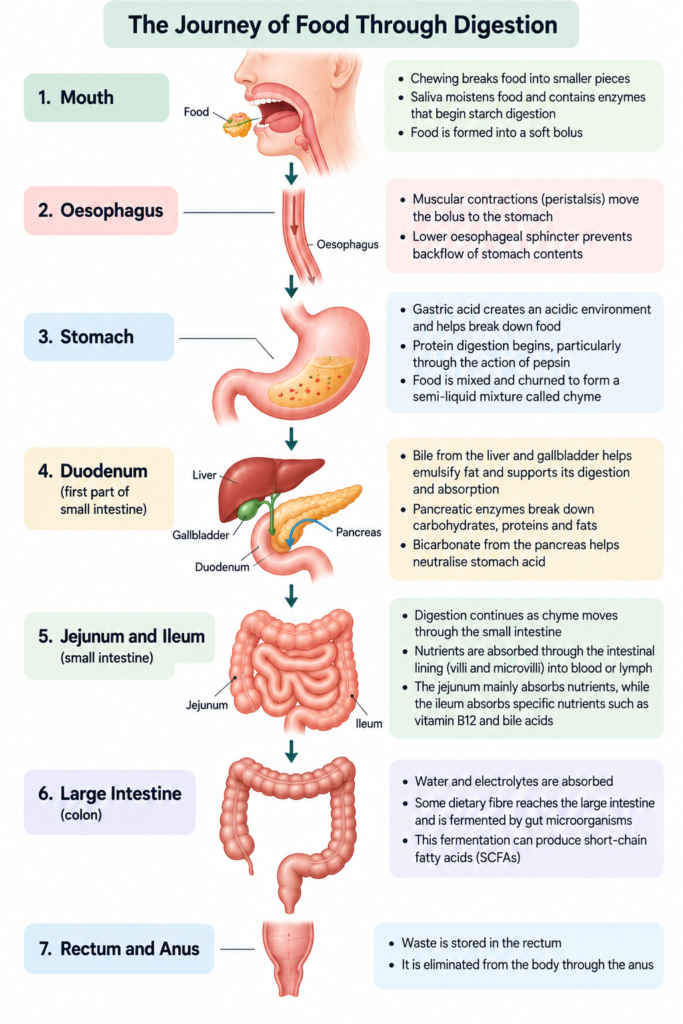
Think of your digestive system as a coordinated processing and distribution system:
Mouth
↓
Chewing + saliva
Oesophagus
↓
Peristaltic transport
Stomach
↓
Acid + enzymes + mixing
Liver + Gallbladder + Pancreas
↓
Bile + digestive enzymes + bicarbonate
Small Intestine
↓
Digestion + nutrient absorption
Blood + Lymphatic System
↓
Transport
Liver + Body Tissues
↓
Processing + use + storage
Large Intestine
↓
Water/electrolyte absorption + microbial fermentation
Rectum → Anus
↓
Elimination
The Big Takeaway
Every meal goes through a remarkable sequence of mechanical, chemical and biological processes before its nutrients become available to your body.
Your mouth begins the process.
Your stomach prepares and processes the food.
Your pancreas, liver and gallbladder help break it down.
Your small intestine performs most of the digestion and absorption.
Your blood and lymphatic system transport the absorbed nutrients.
Your liver and tissues then process, use or store them.
And your large intestine handles what remains, while your gut microorganisms interact with components that reach them.
So nutrition is not simply about what you eat.
It is also about what you digest, what you absorb, what you can use, and how your individual physiology responds.
How This Fits Into the IntuiWell Approach
At IntuiWell, nutrition is viewed in the context of the individual rather than as a one-size-fits-all food list.
Your food choices, nutritional requirements, lifestyle, health goals, symptoms and changing circumstances can all influence what an appropriate nutrition approach looks like.
That is why understanding your own response to food can be just as important as knowing the nutrient composition of the food itself.
Author
Written by: Shivani Jain
Co-founder & Clinical Lead Nutritionist, IntuiWell
Master’s in Foods & Nutrition
Helping people simplify nutrition through science, tradition, and practical kitchen wisdom.
Summary
Digestion is a coordinated process involving the gastrointestinal tract, pancreas, liver, gallbladder, nervous system and gut microbiota.
The process begins in the mouth and continues through the oesophagus, stomach, small intestine and large intestine.
The small intestine is the major site of nutrient absorption, but different nutrients follow different pathways. Vitamin B12, for example, requires a specialised absorption process involving intrinsic factor and the terminal ileum, while much of absorbed long-chain dietary fat initially travels through the lymphatic system.
The amount of a nutrient present in food does not automatically equal the amount absorbed or used by the body.
Understanding this distinction can help explain why nutrition needs to consider not only food composition, but also digestion, absorption, individual tolerance and physiological context.
Frequently Asked Questions
Does digestion begin in the stomach?
No. Digestion begins in the mouth. Chewing mechanically breaks food down and saliva begins the digestion of starch.
Where does most nutrient absorption occur?
Most nutrient absorption occurs in the small intestine, particularly through its highly specialised intestinal lining.
Does the stomach absorb nutrients?
The stomach has a limited role in absorption compared with the small intestine. Its major functions include storing, mixing and beginning the digestion of food.
Why is vitamin B12 different?
Vitamin B12 requires several steps for absorption, including binding to intrinsic factor and absorption in the terminal ileum.
Does eating fat help absorb vitamins?
Dietary fat facilitates the absorption of fat-soluble vitamins A, D, E and K by supporting normal fat digestion and absorption. This does not mean that large amounts of dietary fat are required.
Why does fibre sometimes cause bloating?
Increasing fibre rapidly can increase fermentation and intestinal contents. The effect depends on the type and amount of fibre, individual tolerance, gut motility and other factors.
Does a healthy food always get fully absorbed?
No. Nutrient absorption depends on the nutrient’s chemical form, food matrix, meal composition, digestive function, nutrient status and individual physiology.
Why can the same food cause different symptoms in different people?
People differ in digestive function, motility, gut microbial activity, food tolerance, existing gastrointestinal conditions and other physiological factors.
Need Help Applying This to Your Diet?
If you’d like to explore personalised nutrition and understand how your food, lifestyle and health goals can work together, you can learn more about the IntuiWell Programs.
For one-to-one guidance tailored to your individual needs, you can also Book a Personalised Consultation.
Have a question before booking? Send us a message on WhatsApp, and we’ll help you understand the next best step. Ask Us on WhatsApp.
Because understanding your health is the first step towards making changes that can actually fit into your life.
Key References
- Indian Council of Medical Research (ICMR), National Institute of Nutrition (NIN). Dietary Guidelines for Indians 2024. Hyderabad: ICMR-NIN; 2024.
- ICMR-NIN Expert Group. Nutrient Requirements for Indians: Recommended Dietary Allowances (RDA) and Estimated Average Requirements (EAR). Indian Council of Medical Research, National Institute of Nutrition; 2020.
- Longvah T, Ananthan R, Bhaskarachary K, Venkaiah K. Indian Food Composition Tables (IFCT 2017). Hyderabad: National Institute of Nutrition, Indian Council of Medical Research; 2017.
- Ghoshal UC, Sachdeva S, Pratap N, et al. Indian Consensus on Chronic Constipation in Adults: A Joint Position Statement of the Indian Motility and Functional Diseases Association and the Indian Society of Gastroenterology. Indian Journal of Gastroenterology. 2018;37(6):526–544.
- Kashyap S, Gowda P, Pasanna RM, et al. The Oral Bioavailability of Vitamin B12 at Different Doses in Healthy Indian Adults. Nutrients. 2024;16(23):4157.
- Kulkarni AS, Kumbhare SV, Dhotre DP, et al. Mining the Core Gut Microbiome from a Sample Indian Population. Indian Journal of Microbiology. 2019;59:90–95.
- Archana, Gupta AK, Noumani A, et al. Gut microbiota derived short-chain fatty acids in physiology and pathology: An update. Cell Biochemistry and Function. 2024;42(7):e4108.