Iron: The Mineral That Carries Oxygen, Powers Cells, and Supports Healthy Blood
Deep Dive Into m1: Iron (Fe) From The IntuiWell Nutrient Periodic Table™
“Iron does more than build haemoglobin. It helps carry oxygen to every tissue, supports cellular energy production, and plays an essential role in growth, brain function, and healthy red blood cells.”
Quick Takeaways
- Iron is an essential mineral required for haemoglobin, myoglobin, cellular energy production, DNA synthesis, growth, and neurological function.
- Iron exists mainly as haem iron and non-haem iron. Haem iron is found in animal foods, while non-haem iron is found in plant foods and fortified foods.
- The amount of iron in a food is not the same as the amount your body absorbs. Meal composition, iron status, inflammation, and hepcidin all influence absorption and utilisation.
- Vitamin C improves the absorption of non-haem iron. Pairing iron-rich plant foods with amla, guava, capsicum, tomato, citrus or other vitamin-C-rich foods can be useful.
- Phytates and certain polyphenols can reduce non-haem iron absorption. Soaking, sprouting and fermentation can help reduce phytate content in pulses and grains.
- Tea and coffee taken with iron-rich meals can reduce non-haem iron absorption. This becomes particularly relevant when iron stores are already low.
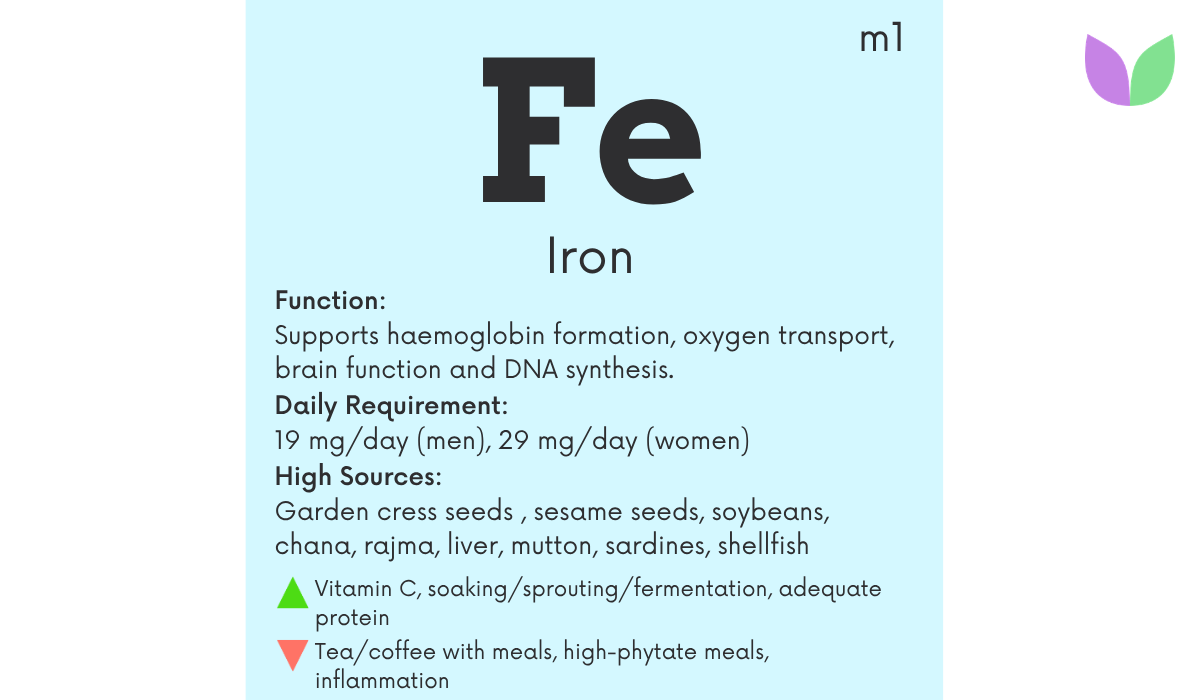
- Meaningful Indian dietary sources include masoor dal, chickpeas, rajma, soybeans and tofu, sesame seeds and garden cress seeds. Animal sources include organ meats, mutton/goat, sardines and shellfish.
- The ICMR-NIN 2020 RDA is 19 mg/day for adult men, 29 mg/day for adult women, 27 mg/day during pregnancy and 23 mg/day during lactation. These values reflect the lower bioavailability of iron in typical Indian diets.
- Low haemoglobin is not synonymous with iron deficiency. A CBC and ferritin provide a useful starting point, with additional iron studies and inflammatory markers when clinically appropriate.
- Iron supplementation should not be treated as a general energy booster. The cause of low iron should be identified before prolonged or high-dose supplementation.
1. What Iron Is and How Your Body Uses It
Iron is an essential trace mineral. Your body contains only a few grams of iron, but that relatively small amount is involved in several processes that are fundamental to life.
The largest proportion of body iron is incorporated into haemoglobin, the protein inside red blood cells that carries oxygen from the lungs to tissues. Iron is also present in myoglobin, which helps provide oxygen to working muscles.
Beyond oxygen transport, iron is required for numerous enzymes and proteins involved in cellular energy production, DNA synthesis, electron transport and other metabolic reactions. Iron is therefore not simply a “blood mineral”. Its functions extend into almost every metabolically active tissue.
Iron is obtained from food in two major forms:
Haem iron
Found mainly in animal foods such as meat, poultry, fish and shellfish.
Haem iron is generally absorbed more efficiently and is less affected by other components of the meal.
Non-haem iron
Found in plant foods, fortified foods and also in animal foods alongside haem iron.
Non-haem iron absorption is more sensitive to the composition of the meal. Vitamin C can enhance its absorption, while phytates and some polyphenols can inhibit it.
This distinction is particularly important when planning predominantly vegetarian Indian diets.
2. Primary Functions of Iron
Oxygen Transport
Iron is a structural component of haemoglobin.
Haemoglobin allows red blood cells to bind oxygen in the lungs and transport it throughout the body.
When iron availability becomes inadequate, haemoglobin production can eventually decline, resulting in iron-deficiency anaemia.
Oxygen Storage and Muscle Function
Iron is also present in myoglobin, the oxygen-binding protein found in skeletal and cardiac muscle.
This helps muscles access oxygen for energy production.
Cellular Energy Production
Iron is involved in several proteins and enzymes that participate in mitochondrial energy metabolism.
Therefore, iron deficiency can affect cellular function even before obvious anaemia develops.
Iron deficiency progresses through stages. Iron stores may become depleted first, followed by impaired iron availability for red blood-cell production, and eventually iron-deficiency anaemia if deficiency persists.
Brain and Neurological Function
Iron is required for normal neurological development and function.
This is particularly important during infancy, childhood and adolescence, when the brain is undergoing rapid development.
DNA Synthesis and Cell Growth
Iron-dependent enzymes participate in DNA synthesis and cell proliferation.
This helps explain why iron requirements increase during periods of rapid growth and physiological demand.
3. Iron Regulation: How the Body Maintains Balance
Iron regulation is unusual because the body has no major physiological pathway for actively excreting excess iron.
Instead, iron balance is controlled primarily by regulating how much iron is absorbed from the intestine and how iron is released from storage sites.
The central regulator is a hormone called hepcidin.
When iron stores are adequate or inflammation is present, hepcidin generally rises. It reduces the movement of iron into the circulation, limiting intestinal iron absorption and the release of stored iron.
When the body needs more iron, such as during iron deficiency or increased demand, hepcidin tends to fall. This allows greater iron absorption and mobilisation.
This is why iron metabolism cannot be understood simply as:
“Eat more iron → absorb more iron.”
The body’s regulatory system actively determines how much iron becomes available.
Inflammation adds another layer of complexity.
Inflammatory signals can increase hepcidin, trapping more iron within storage cells and reducing its availability for red blood-cell production. This contributes to the anaemia of inflammation or chronic disease.
4. Iron and Haemoglobin: More Than Just Oxygen Transport
The most familiar role of iron is its relationship with haemoglobin.
Haemoglobin contains haem groups, each incorporating an iron atom capable of reversibly binding oxygen.
When iron availability is insufficient for erythropoiesis, haemoglobin production can eventually fall.
However, this process does not happen immediately.
Iron deficiency can begin with depleted iron stores while haemoglobin remains within the reference range. As deficiency progresses, iron supply to developing red blood cells becomes inadequate and haemoglobin may eventually decline.
This distinction is clinically important:
Iron deficiency and iron-deficiency anaemia are not identical.
A person can have depleted iron stores before developing anaemia.
5. Iron Absorption: Why Your Meal Matters
Iron absorption is highly context-dependent.
The same amount of iron can be absorbed differently depending on:
- Whether it is haem or non-haem iron
- The person’s iron status
- Vitamin C intake
- Phytate content of the meal
- Polyphenols from tea and coffee
- Calcium and supplement timing
- Gastrointestinal conditions
- Certain medications
- Hepcidin and inflammation
Non-haem iron is particularly sensitive to these factors.
Vitamin C and Iron
Vitamin C improves absorption of non-haem iron.
This is why an iron-rich vegetarian meal can be strengthened by adding a vitamin-C-rich food.
Practical combinations include:
- Masoor dal + amla
- Chana + guava
- Rajma + capsicum
- Lentil preparation + tomato
- Tofu + capsicum or broccoli
- Iron-rich meal + citrus fruit
The objective is not to consume lemon with every iron-containing meal. The broader principle is to regularly combine plant sources of iron with vitamin-C-rich foods.
Phytates
Phytate is naturally present in foods such as pulses, whole grains, nuts and seeds.
It can bind minerals and reduce the absorption of non-haem iron.
This does not mean these foods should be avoided. They are nutritionally valuable foods.
Traditional food preparation methods such as soaking, sprouting and fermentation can reduce phytate content and may improve mineral bioavailability.
Tea and Coffee
Tea and coffee contain polyphenolic compounds that can inhibit non-haem iron absorption when consumed around an iron-rich meal.
This does not mean tea or coffee needs to be eliminated.
A more practical approach, particularly when iron stores are low, is to avoid having tea or coffee with the main iron-rich meal and instead consume them separately.
Calcium
Calcium can interfere with iron absorption under some circumstances, although its effect on overall iron status is more complex than simply saying that “calcium blocks iron”.
There is no need to eliminate dairy foods.
The more practical consideration is the timing of iron and calcium supplements when both are prescribed.
6. Daily Iron Requirements
Iron requirements vary substantially according to age, sex and physiological stage.
For Indian populations, the ICMR-NIN 2020 recommendations are particularly relevant because they account for the relatively low bioavailability of iron in predominantly cereal-pulse-based diets.
Adult men: 19 mg/day
Adult women: 29 mg/day
Pregnancy: 27 mg/day
Lactation: 23 mg/day
These are population-level dietary reference values, not therapeutic doses for treating iron deficiency.
An individual who has confirmed iron deficiency may require iron supplementation at doses substantially different from the dietary RDA, but that is a clinical decision based on laboratory findings and the underlying cause.
7. Where Your Iron Really Comes From
Rather than treating every food that contains a small amount of iron as an “iron-rich food”, it is more useful to focus on meaningful sources.
Strong Vegetarian Sources
Garden cress seeds (halim/aliv)
A concentrated traditional Indian seed source of iron. Because the usual serving size is small, it should be considered a concentrated addition rather than the sole strategy for meeting daily iron requirements.
Sesame seeds (til)
A useful source of iron and can be incorporated into chutneys, laddoos, seed mixes or meals.
Soybeans and tofu
Soybeans provide iron along with protein. Tofu can be a practical everyday source of both protein and iron.
Masoor dal
Masoor dal provides non-haem iron along with protein and can be used regularly in Indian meals.
Chickpeas (chana)
Chickpeas provide non-haem iron and can be used as chana, chole, roasted chana or in hummus-style preparations.
Rajma
Rajma provides non-haem iron along with protein and fibre.
The Indian Food Composition Tables maintained by ICMR-NIN provide food-specific composition data rather than treating all pulses or legumes as nutritionally identical.
Non-Vegetarian Sources
Liver and other organ meats
These are particularly concentrated sources of iron. However, liver should not be used casually during pregnancy because of its high preformed vitamin A content.
Mutton/goat meat
Provides haem iron, which is generally more bioavailable than non-haem iron.
Sardines
Provide haem iron along with protein and other nutrients.
Shellfish such as oysters
Some shellfish are particularly rich in iron. Oysters, for example, are a recognised high-iron food.
What About Spinach?
Spinach contains iron, but it should not be presented as the best strategy for correcting iron deficiency.
Its iron is non-haem and its absorption is affected by compounds such as polyphenols and other inhibitors.
Spinach can absolutely remain part of a healthy diet. It simply should not carry the burden of an “iron treatment” food.
What About Jaggery?
Jaggery can contain some iron, but its iron content is variable and the quantity typically consumed is not a reliable strategy for correcting iron deficiency.
“Eat jaggery for low haemoglobin” is therefore an oversimplification.
8. Timing and Practical Use
Iron does not require a complicated timing protocol.
The bigger priority is to improve the overall pattern of absorption.
A practical iron-focused meal can look like:
Iron source + vitamin-C-rich food + appropriate preparation + no tea/coffee with the meal
For example:
Masoor dal + vegetable preparation + amla
Chana + capsicum-based vegetable + guava later
Rajma + tomato-based preparation
Tofu + capsicum and broccoli
Sesame-based chutney + a vitamin-C-rich meal
For pulses and legumes, traditional preparation methods such as soaking, sprouting and fermentation can be useful ways of reducing phytate.
If someone is taking an iron supplement, timing may need to be individualised because iron can interact with medications and other supplements.
For example, iron can interfere with the absorption of levothyroxine, and calcium supplements may interfere with iron absorption. Proton pump inhibitors may also reduce absorption of non-haem iron in some people. Medication changes should always be discussed with the prescribing clinician rather than made independently.
9. Signs You May Be Low on Iron
Iron deficiency can develop gradually, so symptoms are not always obvious in the early stages.
Possible symptoms include:
- Fatigue or unusual tiredness
- Weakness
- Reduced exercise tolerance
- Breathlessness, particularly with exertion
- Headache or dizziness
- Difficulty concentrating
- Pale skin
- Reduced physical performance
- Brittle nails in some cases
However, these symptoms are not specific to iron deficiency.
Fatigue alone does not mean you need an iron supplement.
Iron status should be assessed when deficiency is suspected rather than diagnosing deficiency from symptoms alone.
10. When Iron Can Backfire
Iron is essential, but more is not automatically better.
Excessive iron intake, particularly from supplements, can cause gastrointestinal symptoms such as nausea, abdominal discomfort and constipation.
More importantly, excessive iron can be harmful in people with conditions that cause abnormal iron accumulation.
High-dose iron should therefore not be used simply because someone feels tired.
Iron supplements should be selected according to the person’s iron status, clinical situation, dose requirement and tolerance.
Iron-containing supplements should also be kept safely away from children because accidental iron overdose can be extremely dangerous.
The objective is not to maximise iron intake.
The objective is to maintain adequate iron availability without unnecessary excess.
11. Iron and Common Health Conditions
Iron-Deficiency Anaemia
This is the condition most commonly associated with inadequate iron.
It develops when iron stores and iron availability become insufficient to support normal red blood-cell production.
Dietary inadequacy is one possible contributor, but treatment should also investigate why iron became low.
Heavy Menstrual Bleeding
Menstruation increases iron losses.
Women with heavy or prolonged menstrual bleeding may therefore have substantially higher iron requirements and are at increased risk of iron deficiency.
Persistent low ferritin should not simply be managed with repeated supplements without considering menstrual blood loss and other possible causes.
Pregnancy
Iron requirements and the physiological demand for iron change substantially during pregnancy.
Iron status is particularly important because iron is required for maternal red-blood-cell production and fetal development.
Pregnancy is also a situation where supplementation decisions should be based on established antenatal care rather than self-prescribing high-dose iron.
Gastrointestinal Blood Loss
Chronic gastrointestinal blood loss can gradually deplete iron stores.
This is particularly important when iron deficiency is unexplained, recurrent or occurs in men or postmenopausal women.
Gastrointestinal Disorders and Malabsorption
Conditions affecting the gastrointestinal tract can interfere with iron absorption or cause blood loss.
If iron remains low despite adequate intake and appropriate supplementation, the question should shift from:
“Which iron food should I eat?”
to:
“Why is my iron remaining low?”
Anaemia of Inflammation
Inflammation can increase hepcidin and restrict the movement of iron into circulation.
As a result, a person may have adequate or even increased stored iron but reduced iron availability for red-blood-cell production.
This is one reason why ferritin cannot always be interpreted without considering inflammatory status.
12. Lab Markers Related to Iron
Iron status should not be judged using a single number in isolation.
CBC
A complete blood count can provide:
Haemoglobin (Hb)
Helps determine whether anaemia is present.
MCV
Indicates the average size of red blood cells and can provide clues about the type of anaemia.
MCH
Provides information about the haemoglobin content of red blood cells.
CBC findings are useful, but they do not independently establish iron deficiency.
Ferritin
Ferritin is one of the most useful markers of stored iron.
A low ferritin strongly supports depleted iron stores.
However, ferritin is also an acute-phase reactant and can rise during inflammation. Therefore, a person can have iron deficiency even when ferritin does not appear very low if significant inflammation is present.
Transferrin Saturation
Transferrin saturation, or TSAT, provides information about the amount of circulating iron available for tissues.
It becomes particularly useful when iron availability is uncertain.
Serum Iron
Serum iron measures circulating iron at a particular point in time.
It fluctuates and should not be interpreted as a stand-alone test for iron deficiency.
TIBC / Transferrin
Total iron-binding capacity and transferrin can provide additional information about iron transport and help interpret an iron profile.
CRP
C-reactive protein can help identify inflammation when ferritin interpretation is difficult.
A practical starting point
When iron deficiency is suspected:
CBC + Ferritin
may provide a useful initial assessment.
Depending on the findings and clinical context, additional testing such as:
TSAT + serum iron + TIBC/transferrin + CRP
may be appropriate.
The important distinction is:
Haemoglobin tells you about anaemia. Ferritin helps you assess iron stores. They are not interchangeable.
13. Iron in Different Life Stages
Infancy and Childhood
Iron is particularly important during periods of rapid growth and neurological development.
Infants transition from relying heavily on iron stores accumulated before birth to obtaining iron from complementary foods.
Adolescence
Iron requirements increase during rapid growth.
Adolescent girls have an additional consideration because menstruation introduces regular iron losses.
Reproductive-Age Women
Menstrual blood loss can substantially influence iron requirements.
Heavy menstrual bleeding is an important risk factor for iron deficiency.
Pregnancy
Pregnancy changes iron requirements and iron metabolism substantially.
Iron status should be monitored as part of appropriate antenatal care.
Lactation
Iron requirements change after delivery, partly because menstrual losses may be temporarily reduced or absent.
The ICMR-NIN 2020 RDA for lactating women is 23 mg/day.
Older Adults
Iron deficiency in older adults should not automatically be attributed to diet.
When deficiency is unexplained, gastrointestinal blood loss, malabsorption and other underlying causes may need evaluation.
In particular, unexplained iron-deficiency anaemia in men and postmenopausal women deserves medical investigation rather than repeated empirical supplementation.
14. Common Iron Myths
Myth 1: Spinach is the best source of iron.
Spinach contains iron, but its iron is non-haem and not particularly well absorbed.
It is a nutritious food, but it should not be presented as the primary food for correcting iron deficiency.
Myth 2: Jaggery can treat anaemia.
Jaggery may contain some iron, but its variable iron content and typical serving size make it an unreliable treatment for iron deficiency.
Myth 3: If a food contains iron, your body absorbs all of it.
The amount listed in a food composition table is not the amount absorbed by the body.
Iron absorption is affected by iron form, meal composition, iron status and physiological regulation.
Myth 4: Vitamin C makes every iron source highly absorbable.
Vitamin C improves non-haem iron absorption, but it does not completely override all other absorption factors.
Myth 5: If you are tired, you need an iron supplement.
Fatigue has many possible causes.
Iron supplementation should follow assessment rather than symptoms alone.
Myth 6: Tea and coffee must be completely avoided when iron is low.
The more useful strategy is to separate tea and coffee from iron-rich meals, particularly when iron stores are low.
Myth 7: Vegetarians cannot get enough iron.
Vegetarian diets can provide iron through pulses, soy foods, seeds and fortified foods.
The greater issue is that plant foods provide non-haem iron, whose absorption is more meal-sensitive.
Myth 8: A normal haemoglobin means your iron status is definitely normal.
Iron stores can become depleted before haemoglobin falls.
This is why ferritin can provide information that haemoglobin alone cannot.
15. Practical IntuiWell Iron Framework
1. Build the meal around a meaningful iron source.
Use specific foods such as masoor dal, chana, rajma, soybeans, tofu, sesame and garden cress seeds. For non-vegetarians, include appropriate haem-iron sources such as mutton, sardines or shellfish.
2. Add a vitamin-C-rich food.
Use amla, guava, capsicum, tomato or citrus foods to support non-haem iron absorption.
3. Improve preparation.
Soaking, sprouting and fermentation of pulses and grains can help reduce phytate.
4. Separate tea and coffee from iron-rich meals.
This is especially important when iron stores are already low.
5. Do not unnecessarily remove dairy.
Instead, consider the timing of calcium and iron supplements when both are being used.
6. Test before treating.
When deficiency is suspected, CBC and ferritin are useful starting points, followed by additional iron studies and inflammatory markers when indicated.
7. Look for the reason behind low iron.
Ask about:
- Menstrual blood loss
- Pregnancy
- Dietary intake
- Blood donation
- Gastrointestinal symptoms
- Possible blood loss
- Malabsorption
- Inflammation
- Medications
- Previous response to iron supplementation
8. Treat the cause, not just the number.
Repeatedly replacing iron without understanding why it keeps falling can miss an underlying problem.
16. Red Flags: When to See a Doctor
Seek medical evaluation when there is:
- Confirmed iron deficiency or iron-deficiency anaemia
- Persistent or unexplained fatigue or breathlessness
- Heavy or prolonged menstrual bleeding
- Black or bloody stools
- Unexplained gastrointestinal symptoms
- Recurrent iron deficiency despite adequate dietary intake
- Poor response to appropriately prescribed iron
- Iron deficiency in an adult man
- Iron deficiency in a postmenopausal woman
- A need for prolonged or high-dose iron supplementation
Iron deficiency is sometimes the visible result of an underlying problem rather than simply inadequate dietary intake.
The goal should therefore be to identify both the deficiency and its cause.
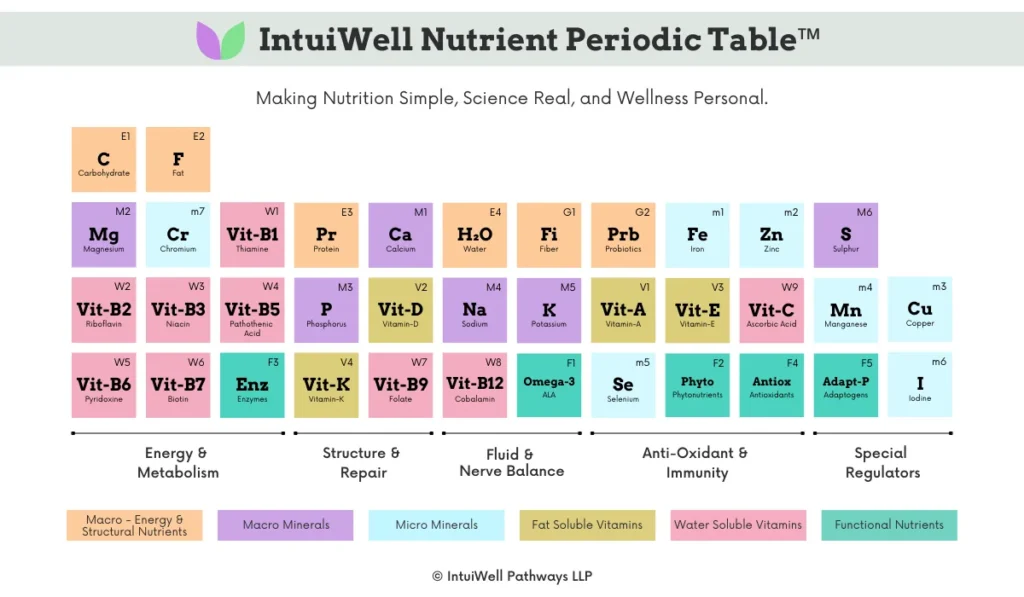
How This Fits Into the IntuiWell Nutrient Periodic Table™
Iron is m1 of the Micro Minerals in the IntuiWell Nutrient Periodic Table™.
It follows the six Macro Minerals and begins the Micro Minerals section.
Iron is a useful example of why nutrient adequacy is not determined simply by looking at intake.
The food may contain iron.
The meal may provide iron.
But the body still has to regulate absorption, transport, storage and utilisation.
This is why an IntuiWell approach looks beyond:
“How much iron is in the food?”
and asks:
“How much iron is available, how much can be absorbed, what is the person’s iron status, and why might the body need more?”
Next in sequence:
Learn how zinc supports immunity, wound healing, skin health, growth and normal cellular repair.
Author
Written by: Shivani Jain
Co-founder & Clinical Lead Nutritionist, IntuiWell
Master’s in Foods & Nutrition
Helping people simplify nutrition through science, tradition, and practical kitchen wisdom.
Summary
Iron is an essential mineral with roles extending far beyond haemoglobin.
It supports oxygen transport, muscle oxygen storage, cellular energy production, DNA synthesis, growth and neurological function.
For Indian diets, understanding bioavailability is particularly important.
A well-designed iron strategy therefore involves more than simply adding iron-rich foods.
It means choosing meaningful sources of iron, improving non-haem iron absorption with vitamin C, using appropriate food preparation methods, avoiding tea and coffee with iron-rich meals when iron status is low, and investigating the reason for deficiency when laboratory values remain low.
Most importantly, iron deficiency should be assessed rather than assumed.
Food first when appropriate. Testing when needed. Supplementation when indicated. And always, identify the reason behind the deficiency.
FAQs
Is iron deficiency the same as anaemia?
No.
Iron deficiency refers to inadequate iron stores or availability. Iron-deficiency anaemia occurs when iron deficiency becomes severe enough to impair red-blood-cell production and lower haemoglobin.
Can I get enough iron from a vegetarian diet?
Yes, but plant-based iron is non-haem iron and is more sensitive to absorption factors.
Regularly including pulses, soy foods, seeds and other meaningful sources, while improving meal composition, can help.
Should I take iron supplements if I feel tired?
Not automatically.
Fatigue can have many causes. Iron status should ideally be assessed before starting prolonged or high-dose iron supplementation.
Is ferritin more important than haemoglobin?
They answer different questions.
Haemoglobin helps determine whether anaemia is present, while ferritin provides information about iron stores.
Both may be useful depending on the clinical situation.
Should tea and coffee be stopped if iron is low?
Usually, complete avoidance is unnecessary.
A practical approach is to avoid consuming tea or coffee with the main iron-rich meal, especially when iron stores are low.
Is lemon necessary with an iron-rich meal?
No.
Lemon is one possible source of vitamin C, but it is not essential. Amla, guava, capsicum, tomato, citrus fruits and other vitamin-C-rich foods can also support non-haem iron absorption.
Is jaggery a good treatment for low haemoglobin?
No.
Jaggery can contain iron, but its iron content is variable and it should not be relied upon to correct iron deficiency.
Can spinach correct iron deficiency?
Spinach contributes nutrients, including some iron, but its iron is not particularly well absorbed.
It should be part of a varied diet rather than treated as an iron-deficiency remedy.
Why can iron remain low even when I eat iron-rich foods?
Possible reasons include low intake, poor absorption, heavy menstrual losses, gastrointestinal blood loss, inflammation, increased physiological requirements or certain medications.
Persistent deficiency deserves investigation rather than simply adding more iron-rich foods.
Need Help Applying This to Your Diet?
If your diet contains iron-rich foods but your ferritin or haemoglobin remains low, the answer may not simply be “eat more iron.”
The more useful approach is to look at:
Food source → meal composition → absorption → iron status → blood loss → inflammation → underlying cause
That is where personalised nutrition becomes more useful than a generic list of “iron-rich foods”.
At IntuiWell, we help you assess your overall dietary pattern, identify nutritional gaps, interpret relevant laboratory findings, and develop practical nutrition strategies that fit your health goals and lifestyle.
Option 1: Book a Paid Nutrition Consultation
Receive personalised nutrition guidance based on your dietary pattern, health goals, relevant laboratory reports, and overall nutritional needs.
Book a Paid Nutrition Consultation
Option 2: Ask Us on WhatsApp
Have a question before booking? Send us a message on WhatsApp, and we’ll help you understand the next best step.
No unnecessary supplements.
No nutrition myths.
Just practical, evidence-based nutrition designed for real life.
Key References
ICMR-NIN: Nutrient Requirements for Indians
ICMR-NIN: Indian Food Composition Tables
NIH Office of Dietary Supplements: Iron Fact Sheet
NIH Office of Dietary Supplements: Iron Consumer Fact Sheet
NIH Office of Dietary Supplements: Vitamin C Fact Sheet
Nutrients: Anaemia in India and Its Prevalence and Multifactorial Aetiology