Republic Day 2026: Where Is Your Personal Constitution?
On Republic Day morning, most homes look the same.
The TV runs the parade.
Stand up for the anthem.
Then the day begins.
And for many people, the day follows a familiar pattern.
You listen to patriotic songs.
You relax.
You scroll longer than planned.
You postpone the one task you fear.
You snap at someone and regret it later.
You promise yourself you’ll do better “from tomorrow.”
This happens because most people run life without clear rules.
India didn’t. That is the real point of Republic Day.
What we celebrate on Republic Day
15 August 1947 gave India freedom from British rule.
26 January 1950 gave India a rulebook to use that freedom well.
That rulebook is the Constitution of India.
Freedom is powerful.
But freedom without rules can become chaos.
Rules don’t reduce freedom.
Rules protect freedom.
Why 26 January?
During the freedom movement, 26 January 1930 was observed as the day of Purna Swaraj (complete self-rule).
India later chose the same date to bring the Constitution into effect.
So Republic Day is not only a celebration.
It is a reminder of a decision:
India will not run on one person’s mood.
India will run on a shared rulebook.
What is a Constitution?
A Constitution is the highest rulebook of a country.
It answers practical questions:
- What does the country believe in?
- What rights do citizens have?
- How is power given to leaders?
- How is power limited?
- What happens when rules are broken?
Think of it like rules in a school.
Without rules:
- the loudest dominate
- the quiet suffer
- fights increase
- people feel unsafe
With rules:
- people know what is allowed
- people know what is not
- power stays controlled
- trust increases
That’s why a Constitution matters.
The 4 pillars that hold the country steady
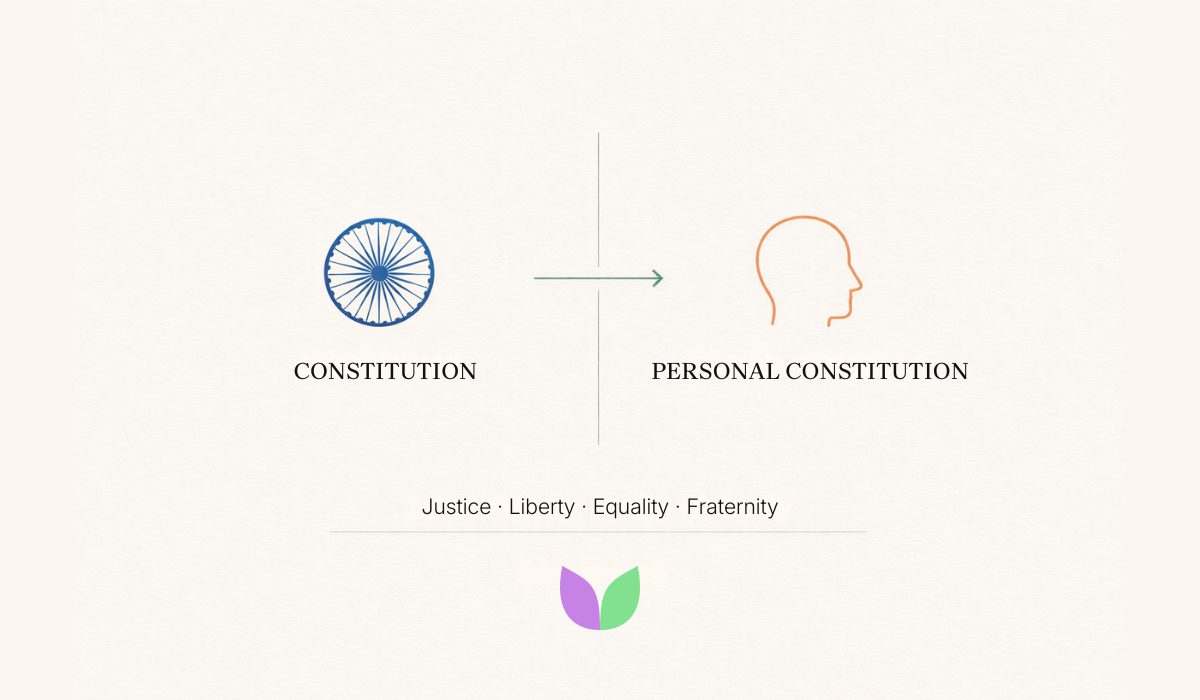
The Preamble highlights four core ideals.
These are like the foundation beams of the nation.
1) Justice: Be fair
Justice means fairness in treatment and decisions.
Not based on money, power, or connections.
Example: If two people do the same wrong thing, the rule should apply to both.
2) Liberty: Be free, but responsible
Liberty means freedom to think, speak, and live your life.
But you cannot harm others with that freedom.
Example: You can disagree. But you cannot bully.
3) Equality: No one is above the law
Equality means rules apply to everyone.
Even to powerful people.
Example: The class captain also follows the rules.
4) Fraternity: Stay united
Fraternity means we respect differences and still stay one team.
Example: Different languages in one classroom. Still one class.
These pillars keep a nation stable.
Now comes the mirror question.
Where is your personal constitution?
India has a Constitution.
India has pillars.
India has rules.
Most people don’t have the same clarity for their own life.
So what runs their day instead?
- Mood.
- Anger.
- Fear.
- Comfort.
- Phone.
- People’s opinions.
That is not self-governance.
That is reaction.
If you feel stressed, distracted, or inconsistent, this is often the real reason.
You may not lack motivation.
You lack a simple rulebook you actually follow.
Personal growth begins when you write that rulebook.
The Personal Constitution: Same pillars, personal use
I’ve seen this across founders, teams, and individuals under pressure.
Motivation changes daily.
Energy changes daily.
Mood changes hourly.
Rules stay steady.
So here is a simple mapping of the same four pillars to your mindset.
No vague advice. Only concrete actions.
1) Justice → Be fair to yourself (Fact–Cost–Fix)
Most people do one of these:
- Excuse everything: “It’s fine. I was tired.”
- Attack themselves: “I’m useless.”
Both waste time.
Use this fairness rule instead:
Fact → Cost → Fix
- Fact: What did I do? (no drama, no story)
- Cost: What did it spoil? (sleep, health, work, relationship)
- Fix: What one change will I do next time?
Example:
Fact: “I scrolled for 90 minutes.”
Cost: “I slept late and woke up tired.”
Fix: “Phone stays outside the bedroom tonight.”
This is justice to yourself.
You don’t lie. You don’t punish. You correct.
2) Liberty → Protect your freedom (Control one distraction)
Real freedom is not “I can do anything.”
Real freedom is “I can choose even when it’s hard.”
If you don’t control your attention, something else will.
So don’t try to fix your whole life in one day.
Control one distraction.
Pick one boundary:
- No phone for the first 20 minutes after waking
OR - One 25-minute focus block daily with no multitasking
OR - No social media until your top task is done
One rule.
Follow it daily.
That is personal liberty.
3) Equality → Balance the basics (Minimum standards)
Many people overfeed one area and starve the rest:
- marks but no sleep
- work but no health
- money but no peace
- fitness but no relationships
Then life feels heavy.
Because the system is unbalanced.
Equality in personal growth means you protect the basics.
Set minimum standards:
- Sleep minimum: ___ hours
- Move minimum: ___ minutes
- Focus minimum: ___ minutes
Example: 7 hours | 20 minutes | 60 minutes
You can do more when life allows.
But you don’t go below minimum.
4) Fraternity → Support your future self (One small nightly support)
Most people are polite to others.
But they sabotage their future self daily.
They waste tonight.
Tomorrow arrives. Then panic starts.
Fraternity inside you means teamwork between:
- Present You
- Future You
Each night, do one “tomorrow support” action:
- pack your bag
- set clothes
- write the top 1 task
- keep the phone away from bed
- keep water bottle ready
Small support builds self-trust.
Self-trust builds confidence.
Write Your Personal Constitution
A Constitution is long-term.
So your personal constitution is also long-term.
But every real constitution starts as a draft.
Then it improves through amendments.
Write yours in four lines:
- Justice: When I slip, I will write Fact–Cost–Fix and move on.
- Liberty: My one distraction rule is: ______________________.
- Equality: My minimums are: Sleep ___ hrs | Move ___ mins | Focus ___ mins.
- Fraternity: Every night, I support tomorrow-me by: ______________________.
Test it for 7 days. Then amend it for life.
This is not a “7-day motivation challenge.”
It is a 7-day test.
After 7 days, take 5 minutes:
- What worked? Keep it.
- What was too hard? Reduce it, don’t quit.
- What was useless? Replace it.
Same constitution. Better version.
That is exactly how stable systems survive.
Stable principles. Small updates.
Republic Day celebrates a nation choosing principles over chaos.
A country stays stable when it follows its Constitution.
A person stays stable when they follow theirs.
So on 26 January 2026, ask one question:
Where is my personal constitution?
- Then write it.
- Follow it.
- Amend it.
- Grow.