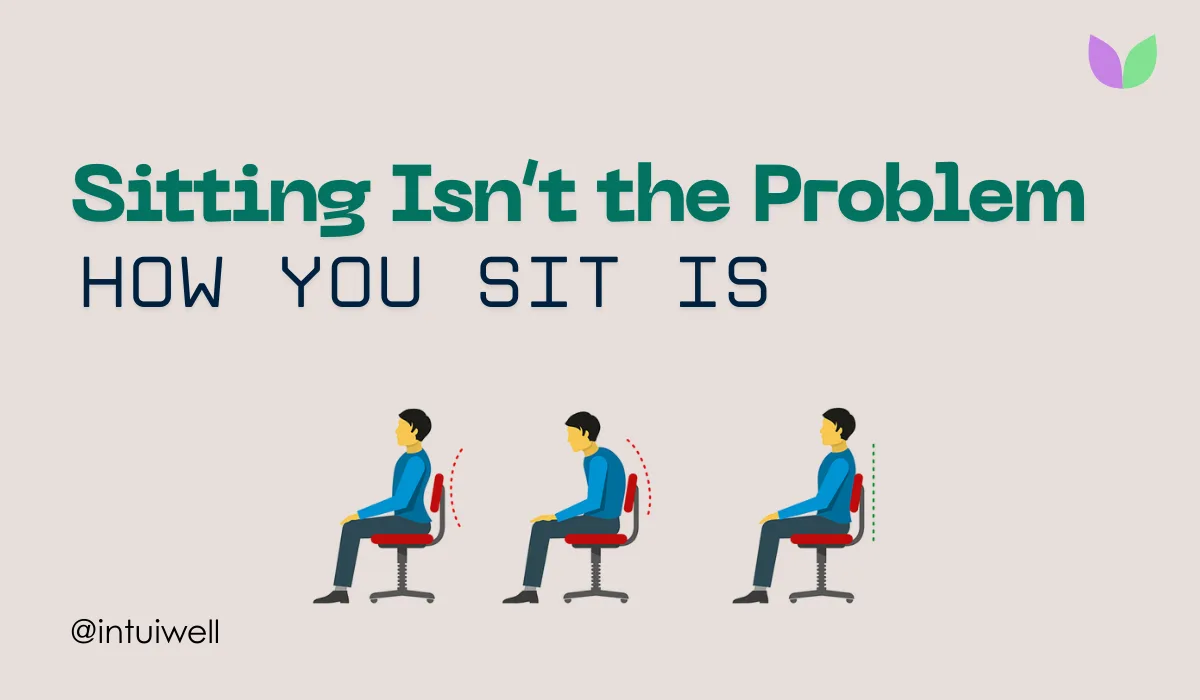
We blame sitting for everything: back pain, stiffness, fatigue.
But the truth is simpler:
Your body isn’t angry because you sit.
Your body is angry because you sit without support, without breaks, and without awareness.
You don’t need perfect posture.
You don’t need to sit up “straight” all day.
You just need to know how to sit in a way that allows your spine to understand.
Let’s break it down practically.
1. Neutral Pelvis vs. Slumped Pelvis (Why It Matters MUCH More Than Posture)
Slumped Pelvis
This is the posture most people fall into when tired:
- Pelvis tucked under
- Lower back rounded
- Shoulders collapsing
- Ribs pushed forward or sinking
- Belly squeezed unintentionally
This position increases pressure on the lumbar discs and overstretches the lower-back muscles, making them ache over time.
It also steals the work from your core, making your back do everything.
Neutral Pelvis
Think of your pelvis like a bowl of water:
- Not spilling forward
- Not spilling backward
Signs you’re in neutral:
- Slight natural curve in your lower back
- Chest relaxed, not lifted
- Ribs stacked over the pelvis
- Weight on your sit bones, not your tailbone
HOW TO FIND IT (10-second reset)
- Sit on the edge of your chair.
- Rock your pelvis ALL the way forward → exaggerate it.
- Rock it ALL the way back → slump fully.
- Now stop in the middle → that’s neutral.
- Scoot back and keep that pelvic angle while supported.
You don’t need to hold this forever — just return to it a few times per day.
2. Microbreaks: The REAL Fix for Sitting Pain
The problem is not the duration of sitting…
It’s the lack of movement while sitting.
Your back loves movement.
Your discs love movement.
Your joints love movement.
The Rule: Every 20–30 minutes, change something.
Not stand.
Not walk.
Just change SOMETHING.
Here are microbreak ideas (10 seconds each):
- Roll your shoulders backward 5 times
- Look left/right slowly
- Stand and sit back down
- Extend legs out once
- Arch and round your lower back
- Ribcage circles
- Inhale deeply → long slow exhale
That’s it.
These tiny resets lubricate the spine, relax the nervous system, and reduce stiffness.
Microbreaks > Long breaks for back health.
3. Three Posture Resets You Can Use Anytime
RESET 1: “Sit Bones + Breath” Reset
- Find neutral pelvis (as above).
- Place one hand on your belly.
- Inhale gently → belly softens.
- Exhale → ribs drop naturally.
You’ve just activated the deep core without trying.
RESET 2: “Shoulders in Your Back Pockets”
- Lift your shoulders.
- Roll them back.
- Let them softly drop.
- Imagine sliding them into your back pockets.
This opens the chest without a stiff military posture.
RESET 3: “Ribcage Stack”
- Sit normally
- Imagine a string gently pulling your sternum up 1 cm.
(not chest up, just un-slumping) - Drop ribs softly into place.
- Keep breathing normally.
This reduces upper-back strain dramatically.
4. Ergonomics Simplified (No Fancy Chair Needed)
Ergonomics doesn’t mean buying an expensive chair.
It means adjusting angles, support, and habits.
FEET
- Feet flat on the ground
- Knees slightly lower than hips
(If not: use books under feet or a cushion under hips)
HIPS
- hips slightly above knee level (reduces hip flexor strain)
LUMBAR SUPPORT
Use:
- Rolled towel
- Sweater
- Small cushion
Place at the curve of your lower back prevents slumping.
SCREEN HEIGHT
Top of the screen = eye level.
If not:
Raise the laptop by books or a stand.
KEYBOARD / MOUSE
Elbows near your ribs → relax shoulders.
Pull the keyboard closer if you find yourself reaching.
MOST IMPORTANT
Your setup should allow you to breathe easily.
If you can’t breathe comfortably → posture will collapse.
THE INTUIWELL TAKEAWAY
Your back doesn’t need perfection.
It needs movement, neutral support, and kindness.
When you sit well, breathe well, and break the stillness,
Your spine can finally relax, not fight you.
You don’t need perfect posture.
You need a flexible posture.
Your body thrives on variety, not rigidity.
Blog Summary
Most people blame sitting for back pain, stiffness, and fatigue—but sitting itself isn’t the enemy. The real problem is how you sit, how long you stay still, and how little support and awareness you give your body.
This blog breaks down sitting pain in practical terms: why a slumped pelvis strains your spine more than “bad posture,” how finding a neutral pelvis takes just 10 seconds, and why microbreaks every 20–30 minutes matter more than standing desks or expensive chairs.
Instead of chasing “perfect posture,” it introduces the idea of flexible posture—small, repeatable resets for your pelvis, ribs, shoulders, and breath that reduce spinal stress in real time. The guide also simplifies ergonomics, showing how basic adjustments (feet position, lumbar support, screen height, breathing ease) can dramatically improve comfort without fancy equipment.
The core message is simple:
Your spine doesn’t need discipline.
It needs movement, support, and variety.
FAQs
1. Is sitting really bad for your back?
No. Prolonged static sitting is the problem—not sitting itself. Your spine is designed to tolerate sitting if you change positions, support your pelvis, and move regularly.
2. Do I need perfect posture all day?
Absolutely not. Trying to “sit straight” all day usually increases tension. What your body needs is frequent posture changes, not rigid alignment.
3. What is the neutral pelvis, and why does it matter?
A neutral pelvis keeps your spine’s natural curve intact. When you slump, pressure shifts to spinal discs and overstretches back muscles, leading to pain and fatigue.
4. How often should I take breaks while sitting?
Every 20–30 minutes. Even 10 seconds is enough—as long as you move or change something. Microbreaks beat long breaks for spinal health.
5. Do I need an ergonomic chair or a standing desk?
No. Basic support (rolled towel, correct screen height, feet placement) plus movement does more than expensive furniture without habit change.
6. Why does breathing matter for posture?
If you can’t breathe comfortably, your posture will collapse. Breath and posture are inseparable—poor breathing locks the ribcage and overloads the spine.
Still dealing with daily back pain, stiffness, or fatigue—even after “fixing” your posture?
At IntuiWell, we don’t prescribe generic posture rules. We assess how your body actually sits, breathes, and moves—and rebuild support from there.
👉 Book a consultation call to understand your personal sitting pattern
👉 Or request a call back, and we’ll guide you through your next steps
Your spine doesn’t need more discipline.
It needs smarter support.
REFERENCES
Sitting, posture, and back pain research
- Cleveland Clinic — Posture & Spine Health
https://my.clevelandclinic.org/health/articles/4485-back-health-and-posture - Mayo Clinic — Office Ergonomics Guide https://www.mayoclinic.org/healthy-lifestyle/adult-health/in-depth/office-ergonomics/art-20046169
- NIH / PubMed — Microbreaks and musculoskeletal relief
https://pubmed.ncbi.nlm.nih.gov/31569438/ - Canadian Centre for Occupational Health — Neutral Sitting Position
https://www.ccohs.ca/oshanswers/ergonomics/sitting/sitting_basic.html