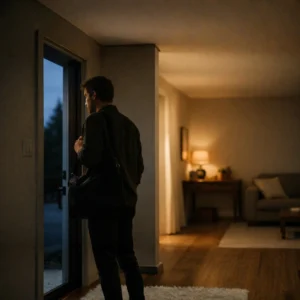
It’s 7:14 PM. You walk through the door.
Your daughter runs up. “Papa, come see what I made!”
You’re mid-thought about the client message you didn’t reply to.
“Not now. Give me a minute.”
She goes quiet. You didn’t mean it like that. But the tone was already there.
Twenty minutes later, your partner mentions the weekend plans.
“Can we figure this out later? I’ve had a really long day.”
It comes out sharper than intended. You see the look on their face. You recognise it.
Later, when the house is quiet, you lie there. Not replaying the client problem. This. The look on your daughter’s face. The silence from your partner.
“I did it again.”
This is not a bad mood. This is not who you are.
This is what happens when your system is still at work, while your body is already home.
In One Minute, Here Is What Is Happening
What this is: Your body may be home, but your system is still in work mode.
Why it happens: Pressure does not switch off just because your location changes. Without a transition, your stress state follows you through the door.
What helps: A short, repeatable reset between work mode and home mode. Not guilt. Not willpower. A transition.
The Pattern Has a Name. And It Is Not “Bad Parenting.”
If you have snapped at someone you love after a hard day, you already know the cycle:
Stressful day → arrive home activated → small trigger → sharp response → guilt → lie awake → wake up tired → stressful day.
Repeat.
The guilt is what hurts most. Because you know better. You want to be present. You love these people. And yet the same thing keeps happening.
In my work with high-load professionals, I see this every week. The jobs are different. The families are different. The triggers are different. But the structure is almost always the same.
The person who walks through the door is not the person their family needed. Not because they stopped caring. Because they never properly left work.
There is a name for this: work-to-family spillover. A closely related concept is psychological detachment from work. Sonnentag and Bayer (2005) studied this directly. Their research found that failing to mentally detach from work during off-job time leads to negative mood, elevated fatigue, and poor recovery. These effects show up most clearly at home, with the people closest to you.
It is not about how much work you have. It is about whether you gave yourself a transition — between who you had to be at work and who you want to be at home.
Most people don’t. There is no transition. There is only a commute. And for many people now, there isn’t even that.
Why Your Brain Treats Your Child’s Question Like a Threat
Your workday asks you to stay alert. Deadlines. Difficult conversations. Unread messages. Political dynamics. These keep you running at a high level all day.
Your body is running stress chemistry to hold that alertness. That is useful at 2 PM. It is harmful at 7 PM.
The problem is simple. Your body does not switch off automatically. There is no signal that says: you are home now, stand down. You need a deliberate cue to move from work mode into connection mode.
Without that cue, you walk through the door still running as if you were in the office. Small triggers — a request, a question, a noise — get processed by a system that is already strained.
That is why the snap happens. Not because the trigger was big. Because your threshold was already gone.
Why “Just Leave Work at Work” Fails Every Time
You have probably heard this advice. You may have tried it.
It fails because it treats this as a decision problem. It is actually a role transition problem.
You cannot think your way out of a body that has been running hot all day. You cannot choose to switch off a system that spent eight hours in alert mode. Willpower is not the tool for this.
Think of it like a laptop with too many tabs open. You cannot close the lid and expect it to run cool. You need to close the tabs first.
Your mind works the same way. You need a deliberate pattern — a set of signals that tells your brain: this context is different. You can stand down now. Without that pattern, it stays in the last mode it was running.
What Keeps Happening to Your Family When You Never Switch Off
I want to say this plainly. It is easy to minimise.
When you carry work mode home repeatedly, it does not stay contained to one sharp comment. Over time, your children start reading your arrivals. They learn to check your mood before they approach you. Some stop approaching altogether.
Your partner absorbs the weight of managing around you. Small things go unsaid because the timing never feels right. And you — despite being physically present every evening — slowly feel disconnected from the people you are working this hard for.
The guilt builds. The thought gets louder. “I’m a good person at work. Why can’t I be that at home?”
Because you are not the problem. Your transition is.
If You’re Reading This Because Someone Else Brings This Home
Not everyone reading this is the one snapping.
Some of you are the partner. You are the one absorbing the sharp tone. You have learned to read the mood at the door before you speak. You choose your timing carefully. You carry the emotional weight of the household on evenings like these.
That is real work. And it is exhausting.
You are not imagining it. The pattern is real. It has a mechanism. And it is not about love — the person bringing it home loves you. They are stuck in a stress state, they haven’t learned to exit yet.
Sharing this post is a starting point — not as a confrontation, but as a frame that names what is actually happening. What follows is a reset your partner can do in under 10 minutes, before they come through the door. The ones who find their way back to each other are the ones who work on this together.
Before You Start: If You Work From Home
If your commute is a flight of stairs, you face a different challenge. There is no threshold to cross. No car to sit in. No walk to take.
You need to create one.
Do the reset at your desk before you leave your workspace. Close the laptop fully. Put the phone face-down. Sit still for two minutes. Or step outside the front door and walk around the block before you “arrive” home.
The location matters less than the intention. What you are doing is building a mental gap between two roles. Even five minutes of deliberate separation changes what the rest of the evening feels like.

The Threshold Reset Method: 3 Steps. Under 10 Minutes.
This is not about becoming calmer. It is about giving yourself a clear signal that the context has changed — something your commute, your phone, and your willpower cannot reliably do on their own.
You do not need to be calm before you start. You need to start in order to become calm.
Step 1 — The Discharge (3 minutes)
Before you enter your home — in your car, on the last stretch of your walk, or at your desk before you close up — write down three things:
- What is still running in my head from today? Name it. Don’t try to solve it.
- What was hard today? Write it. Don’t dismiss it.
- What am I leaving here? Write it out: “I am leaving the status call here. I will handle it tomorrow.”
Why writing? Because your mind holds unfinished tasks open like background apps. Masicampo and Baumeister’s research on making a specific plan showed that writing a concrete next step for an unfinished task eliminates its intrusive mental pull. When you write “I will deal with this tomorrow,” your brain registers it as a commitment. It stops actively holding the task.
This is not journaling. It is a deliberate mental unload with a specific mechanism behind it.
Three bullets. Three minutes. That is all.
If you are driving, say these out loud instead. Writing is more effective — the act of writing registers as a stronger commitment — but speaking works when writing is not possible.
If you work from home: do this at your desk with the laptop closed before you leave the room.
If the discharge doesn’t fully clear it:
Sometimes you finish Step 1 and still feel the hum of something unresolved.
That usually means one item is still unnamed. It is sitting in the background — too uncomfortable to face directly, so the mind keeps circling it without landing.
Go back. Be more specific. Not “the meeting” — but “the thing my manager said that I didn’t respond to.” Not “the project” — but “the email I sent that I’m not sure landed right.”
Name the specific thing, not the general category.
Vague burdens stay open. Named ones can be set down.
Step 2 — The Physical Reset (3 minutes)
Writing addresses the mental layer. This step addresses the physical one.
Your body is still carrying the tension of the day. You need to help it shift.
Choose one of the following:
Option A — Extended exhale breathing
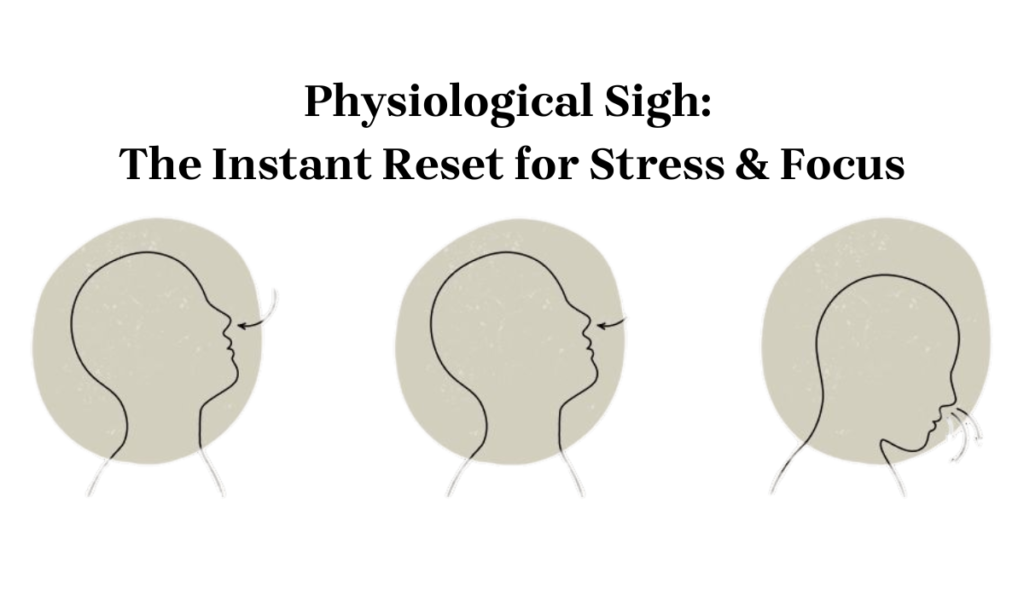
Take three slow breath cycles. Inhale gently for 4 counts through your nose. Hold briefly. Exhale slowly for 6 to 8 counts through your mouth.
The extended exhale is the mechanism that matters. Zaccaro et al.’s systematic review on slow breathing found that breathing with a longer exhale promotes a measurable shift toward parasympathetic nervous system dominance — directly countering the stress arousal that built up during your day. This is not relaxation theatre. It is physiology.
Option B — Cold water
Splash cold water on your face and wrists for 30 seconds.
Cold water contact on the face is associated with the mammalian dive reflex — an autonomic response that slows the heart rate via the vagus nerve. It is fast and requires nothing except a tap. Many people find it the most immediate of the three options.
Option C — Walk
Park two minutes from home and walk. Or, if you work from home, take a short walk outside before you “arrive.” Physical movement helps the body clear the day’s stress chemistry. Sitting still does not.
You only need one option. Pick the one you will actually do today — not the one that sounds most impressive.
Step 3 — The Intention Set (2 minutes)
Before you open the door, say one sentence to yourself. Out loud, if you can.
“Work is done. For the next two hours, I am [your name]. I am home.”
Then decide one specific thing you will do in the first five minutes inside. Not a task. A connection.
- “I will sit with her and look at what she made.”
- “I will ask him one question and actually listen to the answer.”
- “I will help with dinner without my phone on the counter.”
Small and specific is better than big and vague. Your mind needs a destination — somewhere to move toward, not just away from the stress you just discharged.
Track This for 7 Nights
Every night before bed, answer one honest question:
“Did I say something in the first 30 minutes at home that I wouldn’t have said if I’d had a calm hour first?”
- No — Clean transition. The reset worked.
- Once — You slipped, but caught it. Note what was still running.
- More than once — The day got through. Note what kind of day it was.
Examples of what to note: Conflict-heavy day. Deadline pressure. Difficult manager conversation. Unfinished task still open. Client escalation. Back-to-back meetings. Low sleep.
You are not tracking to judge yourself. You are tracking to find your pattern.
Most people discover a specific trigger they had never consciously named. A certain type of meeting. An unresolved confrontation. A message left on read. Once you can name it, you can prepare for it.
That insight is not a small thing. It is the difference between managing your mood and understanding your system.
Here is what the seven days usually look like:
Day 1–2: High awareness. You catch yourself mid-snap and pull back. The reset feels effortful. But it works.
Day 3: First natural day. The reset becomes faster. Home feels different.
Day 4–5: The hard days. Work pressure returns. You skip the reset once, and the old pattern comes back strongly. This is normal. It is the habit testing whether you are still committed.
Day 6–7: The reset starts to feel automatic. Evenings feel lighter. You notice, for the first time, what you were carrying.
Days 4 and 5 are the hinge point.
If you skip the reset on a hard day, you are not failing. You are encountering the exact condition the reset was built for. Do it the following evening. The pattern does not collapse from one miss. It collapses from giving up after one miss.
What Changes When This Starts Working
Usually, the first sign is small.
The tone softens slightly. You pause once before reacting. You feel less defensive walking in.
Then other things follow.
People at home approach you more freely. Conversations happen at the door instead of being carefully timed. Evenings stop feeling like recovery from damage.
You begin to notice how much of your day you were carrying in without realising it.
This does not require becoming a different person. It requires building a better bridge between two roles. That is the real shift.
Where the Personal Growth Program Comes In
The Threshold Reset Method works. I have seen it change the texture of people’s evenings within a week.
Same families. Same workloads. Just a 10-minute gap between worlds — and everything after it changes.
I hear versions of the same thing: “I didn’t realise how much I was carrying until I stopped.” Or: “My kids started coming to me at the door again.” Or simply: “I feel like I came home for the first time in months.”
But here is what also happens. Work gets harder. A difficult project arrives. A performance season begins. A period of sustained pressure sets in. And the reset gets skipped — because there is no one checking, no one holding the thread, and the old pattern is always waiting.
This is what the IntuiWell Personal Growth Program is built for.
Not to give you a method and leave you with it. But to work alongside you weekly — tracking which types of days are bypassing your reset, adjusting the approach to what your specific work demands, and providing the structured accountability that turns one good week into a permanent shift.
The people who benefit most from this program are not the ones falling apart. They are the ones performing well at work, holding it together, managing the pressure — and quietly paying for it at home every evening, in small ways that accumulate.
If that sounds familiar, a Personal Plan Call takes 30 minutes. I will tell you directly whether the program fits your situation. If it does not, I will tell you that too.
No upselling. Just clarity.
→ Book a Personal Plan Call or message on WhatsApp
Related: If your mind keeps replaying work after you have come home, read [Work Is Over, But Your Mind Isn’t — the 7-Minute Switch-Off Method for Better Sleep]. If your phone keeps pulling you back into work mode during the evening, read [Why You Keep Checking Your Phone — and the 4-Window Reset That Stops It].
A Note From the Author
I spent over 20 years in product and operations leadership. The kind of work that follows you out the door, whether you invite it or not.
I know what it feels like to walk into your home carrying a day that has not ended. To look at your family. And to want to be better than what you are showing up as.
The work-to-home transition was one of the first things I built a system around. Not because I read about it. Because I needed it.
What I help people build now is what I wish someone had handed me earlier. A practical, repeatable method that does not require you to become a different person. Just a 10-minute bridge between who you have to be and who you want to be.
Vallabh Chitnis, Co-Founder, IntuiWell Mindshift Strategist | 20+ years in tech product and operations leadership | Helping high-load professionals build practical systems for clarity, emotional resilience, and follow-through
A Safety Note
If snapping, shutting down, or persistent guilt is happening most days — and meaningfully affecting your relationships — please speak to a clinical mental health professional. This can be connected to burnout, anxiety, or other conditions that need proper clinical support.
This post is educational. It is not therapy or medical advice.
Get the 1-Page Tool
Download the Threshold Reset Sheet — a printable, fillable one-pager you can keep in your car, your bag, or at your desk. It walks you through all three steps in under 10 minutes and includes the 7-night tracking log.
Frequently Asked Questions
- Why do I take my work frustration out on my family?
Your system does not switch off when your location changes. The stress you built up at work carries directly into your home. Small things at home — a question, a request, a noise — get processed by a system that is already strained. The reaction feels disproportionate because it is. Not because of the trigger. Because of what was already there. This is not a character flaw. It is what happens without a transition. - Why am I so irritable when I get home from work?
Irritability after work is a sign you are still running in work mode. Your threshold for frustration has been worn down by sustained pressure all day. What feels like impatience is your stress response reacting to small frictions as if they were large ones. The answer is not to try harder to be patient. The answer is to restore the buffer before you walk in the door. - How do I stop bringing work stress home?
Build a deliberate transition before you enter your home — or before you leave your workspace if you work from home. Think of it as learning how to move from work mode to home mode: the Threshold Reset Method — discharge, physical reset, intention set — gives you that shift in under 10 minutes. The key is doing it on hard days, not just easy ones. Hard days are when it matters most and when it is hardest to remember. - How do I decompress after work?
Start with the discharge step. Write down what is still running in your head — specifically, not generally. Name the exact thing, not the general category. Then do one physical reset: slow breathing, cold water, or a short walk. These are not comfort rituals. They are practical tools that help your system come down from the alert state it held all day. Ten minutes done consistently changes what your evenings feel like within a week. - Why do I feel guilty after snapping at my family?
Because the snap is not who you are. It is what happens when your resource tank is empty and there is no transition between contexts. The guilt is real and valid. But guilt alone does not break the cycle — it deepens it. Guilt adds to your load, which makes the next evening harder. A systematic transition replaces the snap-guilt-snap cycle with something that addresses the actual cause. - When does work-to-home emotional spillover get worse?
After high-conflict meetings, performance reviews, missed deadlines, difficult conversations with your manager, client escalations, and periods of sustained pressure. These are the exact days when the reset feels hardest to do. They are also the exact days when it matters most. - How long does it take to stop carrying work home?
Many people notice a shift within a few days of using the reset consistently. A deeper pattern — the automatic tension that sets in at the door — usually takes longer to change. The 7-night tracking helps you see progress as it happens and identify which specific days need the most attention. - Is this about work-life balance?
Not in the way that phrase is usually used. This is not about working fewer hours or being less ambitious. It is about creating a clean break between two roles you carry — your work self and your home self — so neither one bleeds into the other in ways that cost you. You can be fully committed to your work and still do this. The two are not in conflict. - What if the reset doesn’t stick after a few days?
That is common. The pattern of carrying work home is deeply ingrained — and it gets reinforced every time pressure spikes, which is exactly when the reset is hardest to maintain. If it is not holding after Day 7, structured weekly support usually makes the difference between a method that fades and one that becomes permanent. That is what the IntuiWell Personal Growth Program is specifically designed for.