Episode 4: How to Stand for Long Hours Without Back Pain – A Practical Guide for Better Posture and Everyday Comfort
Important Note
This article is for general movement education. It is not a diagnosis or a replacement for medical advice.
If you have severe or persistent back pain, pain that radiates into your legs, numbness, tingling, weakness, loss of bladder or bowel control, pain after a fall or injury, or pain that continues to worsen despite self-care, consult a qualified doctor or physiotherapist before trying new exercises or movement strategies.
About This Series
Daily Life Movement focuses on improving how you move during everyday activities, not just during workouts.
Most aches and pains do not develop because of one dramatic movement. They often build gradually from small daily habits repeated over weeks, months, and years. Standing, sitting, climbing stairs, walking, lifting groceries, or getting in and out of a car may seem ordinary, but these everyday movements reveal a lot about your strength, balance, mobility, and overall movement quality.
If you missed the earlier articles, start with Episode 1: Getting Up from the Floor Safely, where we explored why getting up from the floor is a simple yet powerful indicator of real-life fitness.
Then read Episode 2: How to Get In and Out of a Car Without Back or Knee Pain, where we explained how twisting under load and poor movement control can quietly strain your back, hips, and knees.
Finally, read Episode 3: How to Use Stairs Without Knee Pain, where we showed how simple changes in movement can reduce knee stress and make one of life’s most common activities feel easier.
Today’s movement is standing.
Standing may seem effortless, but many people spend hours every day standing while cooking, teaching, working at a standing desk, working in retail, healthcare, factories, salons, restaurants, or simply waiting in long queues.
The way you stand can either help your body feel supported or gradually contribute to fatigue, stiffness, and back pain.
The goal is not to avoid standing.
The goal is to understand how to stand in a way that works with your body instead of against it.
How to Stand for Long Hours Without Back Pain
Most people don’t think standing could be the reason for their back pain.
After all, standing feels natural. It’s something we’ve done since childhood without giving it much thought.
Yet after spending an hour cooking, working behind a counter, teaching a class, or standing through a long event, many people begin to notice:
- Lower back pain
- Tired legs
- Hip stiffness
- Aching feet
- The constant urge to shift weight or sit down
It’s easy to blame standing itself.
But that’s usually not the real problem.
Standing is not the problem. Standing still is.
Your body is designed to move continuously.
When you stay in one position for long periods, the same muscles keep working without a chance to recover. Blood circulation slows, your joints remain under constant load, and your body naturally begins looking for a more comfortable position.
That’s why you may notice yourself:
- Leaning onto one hip
- Locking one knee
- Resting against a wall or countertop
- Shifting your weight repeatedly
- Looking for the nearest chair
These aren’t bad habits.
They’re often your body’s way of asking for movement.
The real problem begins when one side of your body keeps doing more work than the other or when you remain in exactly the same position for a long time.
The goal isn’t to stand perfectly.
The goal is to stand comfortably, stay active, and allow your body to keep moving throughout the day.
Why Standing for Long Hours Can Cause Back Pain
Standing may look like a passive activity, but your body is constantly working to keep you upright.
Every second you stand, several muscle groups work together to maintain your balance and support your spine.
These include your:
- Core muscles
- Glute muscles
- Hip muscles
- Thigh muscles
- Calf muscles
- Feet and ankles
Together, they help distribute your body weight and keep your spine stable.
When you stand for long periods without moving, these muscles gradually become tired.
As they fatigue, your body naturally begins to compensate.
You may find yourself:
- Leaning more onto one leg
- Arching your lower back
- Slumping forward
- Locking your knees
- Resting more weight on one hip
These changes usually happen without you even realizing it.
While they may feel comfortable for a few minutes, they can gradually increase stress on your lower back, hips, knees, and feet.
Standing still for too long can also make your legs feel heavy or tired because your muscles aren’t changing position enough to help blood circulate efficiently.
This is one reason people often notice:
- Heavy legs
- Tired feet
- Calf tightness
- General fatigue after prolonged standing
Many people believe that standing perfectly straight all day protects the back.
In reality, any posture becomes uncomfortable if you hold it for too long.
Your spine is designed for movement, not stillness.
That’s why the goal isn’t to find one “perfect” standing posture.
The goal is to keep changing your position throughout the day.
In simple words:
Your back usually isn’t complaining because you’re standing.
It’s complaining because you’ve stopped moving.
How to Stand Correctly
Many people believe the solution to standing comfortably is to “fix” their posture.
So they pull their shoulders back, tighten their stomach, push their chest out, and try to stand perfectly straight.
Ironically, this often creates even more tension and fatigue.
Good standing posture is not about holding yourself rigidly.
It is about allowing your body to stay balanced, relaxed, and ready to move.
Think:
“Stand tall, but stay relaxed.”
Your body should feel supported, not stiff.
Step 1: Distribute Your Weight Evenly
The first thing to notice is how you’re standing.
Many people unknowingly place most of their body weight on one leg. It may feel comfortable at first, but over time it places extra stress on one side of your hips, pelvis, and lower back.
Instead:
✔ Keep your weight balanced between both feet.
✔ Let both legs share the workload.
Think:
“Stand evenly.”
This doesn’t mean you have to stay perfectly symmetrical all the time. Small shifts are natural. The important thing is to avoid leaning onto the same leg for several minutes at a time.
Balanced weight distribution allows your muscles to work together more efficiently and reduces unnecessary strain on your joints.
Step 2: Keep Your Knees Soft
A very common habit during prolonged standing is locking the knees.
When the knees are pushed completely straight, the joints begin supporting more of your body weight while your muscles do less work.
Although this may feel easier initially, it often increases joint stress and may contribute to stiffness or discomfort over time.
Instead:
✔ Keep a slight natural bend in your knees.
✔ Allow your legs to stay relaxed rather than rigid.
Think:
“Soft knees. Relaxed legs.”
Your knees should never feel like they’re locked in place.
This small adjustment keeps your muscles gently active and allows your body to adapt more comfortably while standing.
Step 3: Keep Your Pelvis Neutral
Many people try too hard to maintain “good posture.”
Some tuck their hips underneath.
Others exaggerate the arch in their lower back.
Neither extreme is helpful.
Instead, allow your pelvis to stay in its natural position.
Think:
“Tall, balanced, and relaxed.”
You shouldn’t feel like you’re forcing yourself into position.
Your spine naturally has gentle curves that help absorb forces during daily movement. Trying to flatten these curves or exaggerate them usually creates more tension rather than better posture.
A comfortable, natural posture is much easier to maintain throughout the day.
Step 4: Use Gentle Core Support
Your core muscles provide important support for your spine.
But many people misunderstand what engaging the core actually means.
It doesn’t mean sucking your stomach in.
It doesn’t mean tightening your abdominal muscles as hard as possible.
Instead:
✔ Gently activate your abdominal muscles.
✔ Continue breathing normally.
Think:
“Support, not stiffness.”
Imagine someone is about to gently tap your stomach.
That light level of muscle engagement is usually enough to help support your spine while still allowing you to breathe and move comfortably.
The Most Important Rule
If you remember only one thing from this article, remember this:
Don’t stand still for too long.
Your body is designed to move.
Even the best standing posture becomes uncomfortable if you hold it long enough.
There is no single “perfect” position that you should maintain all day.
Instead, think of standing as a dynamic activity.
Small movements help different muscles share the workload, improve circulation, and prevent one area of the body from becoming overloaded.
Movement is often more important than perfect posture.
Use the “Shift Rule”
One of the simplest ways to reduce back pain from prolonged standing is to follow what we call the Shift Rule.
Every 2 to 5 minutes, make a small adjustment.
You can:
- Shift your weight from one foot to the other.
- Move one foot slightly forward.
- Take a small step.
- Relax your shoulders.
- Reset your posture.
These movements may seem small, but they allow different muscles to work while giving others a chance to recover.
Over several hours, these tiny adjustments can make a surprisingly big difference.
Remember:
Your muscles like variety more than stillness.
Smart Standing Strategies
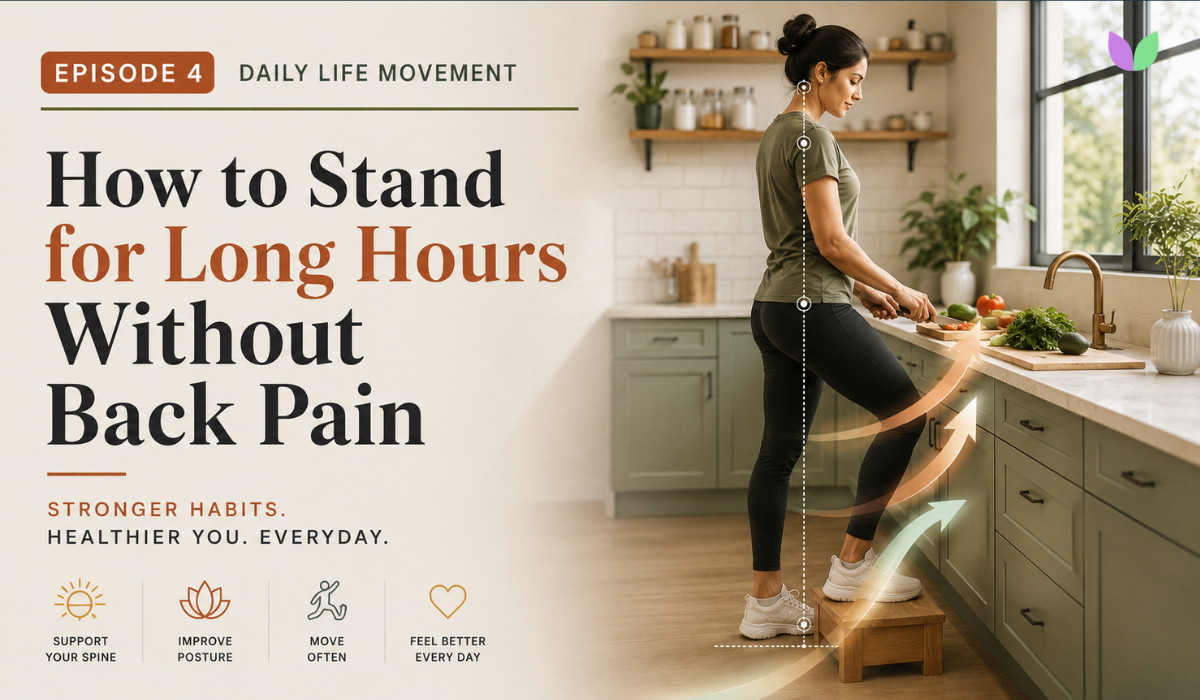
1. Use a Foot Support
This is one of the easiest and most effective ways to reduce lower back strain.
If you spend time:
- Cooking
- Washing dishes
- Ironing clothes
- Working at a counter
- Standing at a reception desk
place one foot on a small stool, low ledge, or footrest.
After a few minutes, switch to the other foot.
Changing the position of your legs slightly changes the position of your pelvis and reduces continuous stress on your lower back.
It also encourages gentle movement instead of rigid standing.
2. Change Your Stance Regularly
Avoid standing with your feet in exactly the same position for long periods.
Instead, alternate between comfortable positions such as:
- Feet hip-width apart
- One foot slightly in front of the other
- One foot resting on a footrest
- Small side-to-side weight shifts
These small posture changes spread the workload across different muscles and reduce fatigue.
3. Break Up Static Standing
Even excellent posture cannot replace movement.
If your work requires prolonged standing, try to move whenever you have the opportunity.
Every 20–30 minutes:
✔ Walk for 30–60 seconds.
✔ Stretch gently.
✔ Roll your shoulders.
✔ Take a few comfortable steps.
These short movement breaks improve circulation, reduce muscle fatigue, and give your joints a chance to recover before discomfort builds up.
Remember:
The best standing posture is the one that changes regularly.
If You Stand at Work
Many jobs require prolonged standing.
This includes:
- Teachers
- Retail staff
- Healthcare professionals
- Chefs and kitchen staff
- Hairdressers
- Factory workers
- Security personnel
- Pharmacists
If you spend most of your working day on your feet:
- Change your position regularly.
- Use a footrest whenever possible.
- Wear comfortable, supportive footwear.
- Avoid locking your knees.
- Take short walking breaks during quieter moments.
- Stretch gently between tasks.
Even a minute of movement every half hour can reduce fatigue by the end of the day.
Common Mistakes While Standing
Mistake 1: Locking Your Knees
Locked knees reduce muscle activity and place more stress on your joints.
Keep your knees relaxed rather than rigid.
Mistake 2: Leaning on One Hip
Standing with most of your weight on one leg may feel comfortable at first, but over time it can overload one side of your hips, pelvis, and lower back.
Try to let both legs share the workload.
Mistake 3: Trying Too Hard to Stand Perfectly
Good posture should feel natural.
Standing with your chest pushed out, your stomach pulled in, and your body held rigidly often creates more fatigue than comfort.
Relax.
Your goal is good movement, not perfect posture.
Mistake 4: Standing Completely Still
This is the biggest mistake of all.
Your body is designed to move.
Small posture changes, gentle weight shifts, and regular movement breaks help keep your muscles active and your joints comfortable.
Standing comfortably isn’t about finding one perfect position.
It’s about giving your body permission to keep moving.
If You Already Have Back Pain
If standing already causes discomfort, don’t assume you need to avoid standing altogether.
In many cases, the solution is not less standing. It is better standing.
The goal is to reduce prolonged static loading while allowing your body to keep moving comfortably throughout the day.
Use a Safer Approach
If you already experience back pain while standing:
✔ Shift your weight regularly.
✔ Follow the Shift Rule every 2–5 minutes.
✔ Use a small footrest while cooking or working at a counter.
✔ Wear comfortable, supportive footwear if you spend long hours on your feet.
✔ Take short movement breaks every 20–30 minutes.
✔ Avoid locking your knees.
✔ Change your stance frequently instead of standing in one position.
These simple adjustments often reduce strain on your muscles before discomfort builds up.
Remember, back pain during prolonged standing is often your body’s way of asking for movement, not complete rest.
If standing becomes increasingly painful despite making these changes, don’t simply push through it. Listen to your body and seek professional guidance if needed.
When to Get Professional Help
Occasional tiredness or mild stiffness after standing for long periods is common.
However, prolonged standing should not cause severe or persistent pain.
Seek professional assessment if you experience:
- Back pain that lasts for several weeks despite self-care.
- Pain that travels into one or both legs.
- Numbness, tingling, or weakness.
- Pain following a fall or injury.
- Difficulty standing or walking because of pain.
- Pain that wakes you at night.
- Loss of bladder or bowel control (seek urgent medical attention).
These symptoms may suggest that something more than simple muscle fatigue is contributing to your discomfort.
A qualified doctor or physiotherapist can determine whether your symptoms are related to muscle weakness, posture, spinal joints, nerve irritation, disc problems, or another underlying condition.
Early assessment often prevents a small problem from becoming a long-term one.
Exercises That Make Standing Easier
Standing comfortably requires more than good posture.
It also requires strength, endurance, balance, and movement control.
The good news is that you don’t need complicated workouts.
A few simple exercises performed consistently can help your body tolerate prolonged standing much more comfortably.
Always perform these exercises slowly and with control.
Stop immediately if you experience sharp pain.
1. Glute Bridges
Glute bridges strengthen the muscles that support your pelvis and lower back.
Lie on your back with your knees bent and feet flat on the floor.
Slowly lift your hips until your shoulders, hips, and knees form a straight line.
Pause briefly, then lower yourself with control.
Focus on squeezing your glutes rather than arching your lower back.
Strong glute muscles help reduce unnecessary stress on the spine during prolonged standing.
2. Core Stability Exercises
Examples include:
- Dead Bug
- Marching
- Heel Slides
These exercises teach your core muscles to support your spine while allowing your arms and legs to move naturally.
Remember:
Your core should provide support, not stiffness.
Quality is far more important than speed.
A few slow, controlled repetitions are more beneficial than rushing through many.
3. Calf Raises
Your calf muscles play an important role in helping blood circulate through your legs.
Strengthening them can reduce the feeling of heavy or tired legs after prolonged standing.
Stand near a wall or countertop for support.
Slowly rise onto your toes.
Pause briefly.
Lower yourself with control.
Repeat at a comfortable pace.
Over time, this simple exercise improves both endurance and circulation.
4. Sit-to-Stand Practice
This is one of the most practical functional exercises you can do.
Sit on a sturdy chair with your feet hip-width apart.
Stand up slowly without using your hands if possible.
Then sit back down with control.
This movement strengthens your hips, thighs, and core together.
Improving these muscles makes prolonged standing feel much less demanding.
The Bigger Picture
People often think:
Sitting is bad. Standing is good.
The reality is much simpler.
Neither sitting nor standing is harmful on its own.
The real problem is staying in any one position for too long.
Your body is designed to alternate between sitting, standing, walking, bending, reaching, stretching, and changing positions throughout the day.
Movement keeps your muscles active.
Movement improves circulation.
Movement helps distribute load across different joints instead of overloading the same structures continuously.
This is the same principle behind the entire Daily Life Movement Series.
In Episode 1, getting up from the floor showed us how strength, mobility, balance, and confidence work together.
In Episode 2, getting in and out of a car demonstrated how twisting under load can quietly strain the back, hips, and knees.
In Episode 3, stairs taught us that repeated daily movements can either overload the knees or become an opportunity to build strength.
This episode reminds us that standing follows the same principle.
Your posture doesn’t need to be perfect.
Your body simply needs opportunities to keep moving.
Small adjustments repeated throughout the day often have a greater impact than trying to maintain one “ideal” posture for hours.
When you stand with better awareness, your muscles share the workload more efficiently, your spine feels better supported, and everyday activities become more comfortable.
Standing then becomes less tiring.
It becomes another opportunity to build strength through everyday movement.
Key Takeaway
Stand tall.
Stand relaxed.
Keep moving.
Distribute your weight evenly.
Keep your knees soft.
Support your spine with gentle core engagement.
Change your position often.
Take movement breaks throughout the day.
Remember:
It’s not about standing perfectly.
It’s about not standing still.
Real fitness isn’t only about what you do during exercise.
It’s about how comfortably and confidently you move through everyday life.
Blog Summary
Standing for long hours can lead to lower back pain, tired legs, hip stiffness, and muscle fatigue, not because standing is harmful, but because staying in the same position for too long places continuous stress on your muscles and joints. Your body is designed for regular movement, and prolonged static standing can reduce circulation, fatigue the supporting muscles, and increase strain on the lower back.
To stand more comfortably, distribute your weight evenly between both feet, keep your knees slightly relaxed, maintain a natural posture, and gently engage your core without becoming stiff. Following the Shift Rule by changing your position every 2–5 minutes and taking short walking breaks every 20–30 minutes can significantly reduce fatigue and improve comfort.
Simple strategies such as using a small footrest while cooking, changing your stance regularly, wearing supportive footwear, and performing strengthening exercises like glute bridges, core stability exercises, calf raises, and sit-to-stand can improve endurance and reduce back strain over time.
However, if your back pain is severe, radiates into your legs, is associated with numbness or weakness, follows an injury, or continues to worsen despite self-care, seek professional medical assessment rather than ignoring the symptoms.
Frequently Asked Questions (FAQs)
1. Why does my lower back hurt after standing for a long time?
Standing for prolonged periods can fatigue the muscles that support your spine. As these muscles become tired, your body begins compensating by leaning, arching the lower back, or shifting weight unevenly, increasing stress on your back and surrounding joints.
2. Is standing better than sitting?
Neither standing nor sitting is inherently better. Both positions become problematic when maintained for long periods without movement. The healthiest approach is to alternate between sitting, standing, and walking throughout the day.
3. What is the correct way to stand for long periods?
Stand with your weight evenly distributed on both feet, keep your knees slightly relaxed, maintain a natural spinal posture, gently engage your core, and change your position frequently instead of remaining completely still.
4. Should I lock my knees while standing?
No. Locking your knees reduces muscle activity, places more stress on your joints, and may contribute to stiffness or discomfort. Keeping your knees slightly relaxed allows your muscles to support your body more efficiently.
5. How often should I move if my job requires prolonged standing?
Try to make small posture changes every 2–5 minutes and take a short walking or stretching break every 20–30 minutes whenever possible. Even small movements can reduce fatigue over the course of the day.
6. Can standing all day cause back pain?
Yes. Standing for long hours without movement may contribute to muscle fatigue, joint loading, and lower back discomfort, particularly if you frequently lean onto one side, lock your knees, or maintain the same posture for hours.
7. What exercises help reduce back pain from prolonged standing?
Exercises such as glute bridges, core stability exercises (like Dead Bug), calf raises, and sit-to-stand help improve strength, endurance, and postural support for prolonged standing. Focus on slow, controlled movements rather than high repetitions.
8. When should I see a doctor or physiotherapist?
Seek professional help if your back pain follows an injury, radiates into your legs, is associated with numbness or weakness, causes difficulty walking or standing, wakes you at night, or continues to worsen despite self-care.
Related Posts in This Series
- Episode 1: Getting Up from the Floor Safely – A Simple Skill That Shows Real Fitness
- Episode 2: How to Get In and Out of a Car Without Back or Knee Pain
- Episode 3: How to Use Stairs Without Knee Pain
How This Article Was Created
This article was created by IntuiWell as part of the Daily Life Movement Series.
The goal of this series is to simplify everyday movement education so people can better understand how daily habits influence strength, posture, mobility, balance, joint comfort, and long-term independence.
This article is based on:
- Practical movement education used in physiotherapy and functional rehabilitation.
- Common movement patterns associated with prolonged standing and lower back discomfort.
- General principles of posture, core stability, muscle endurance, weight distribution, and safe movement.
- Publicly available guidance from trusted healthcare and research organizations.
The content is educational and is not intended to diagnose or replace professional medical care.
References
- NHS Inform — Exercises for Back Pain
- Harvard Health Publishing — Posture & Back Health
- Harvard Health Publishing – Stretching and Strengthening Exercises to Relieve and Prevent Lower Back Pain
- Mayo Clinic — Back Pain: Symptoms and Causes
- Mayo Clinic – Back Pain: Diagnosis and Treatment
- CDC/NIOSH – Ergonomics and Musculoskeletal Disorders
Pain during prolonged standing is often your body’s way of asking for more movement, better support, and healthier daily habits, not necessarily less activity.
At IntuiWell, we help you understand how everyday movement, nutrition, strength, recovery, and lifestyle work together so your body feels more supported in real life.
If you’re struggling with back pain, stiffness, fatigue, weight management, digestion, hormonal health, or building sustainable healthy habits, explore IntuiWell’s personalized wellness guidance.
Start with a simple conversation.