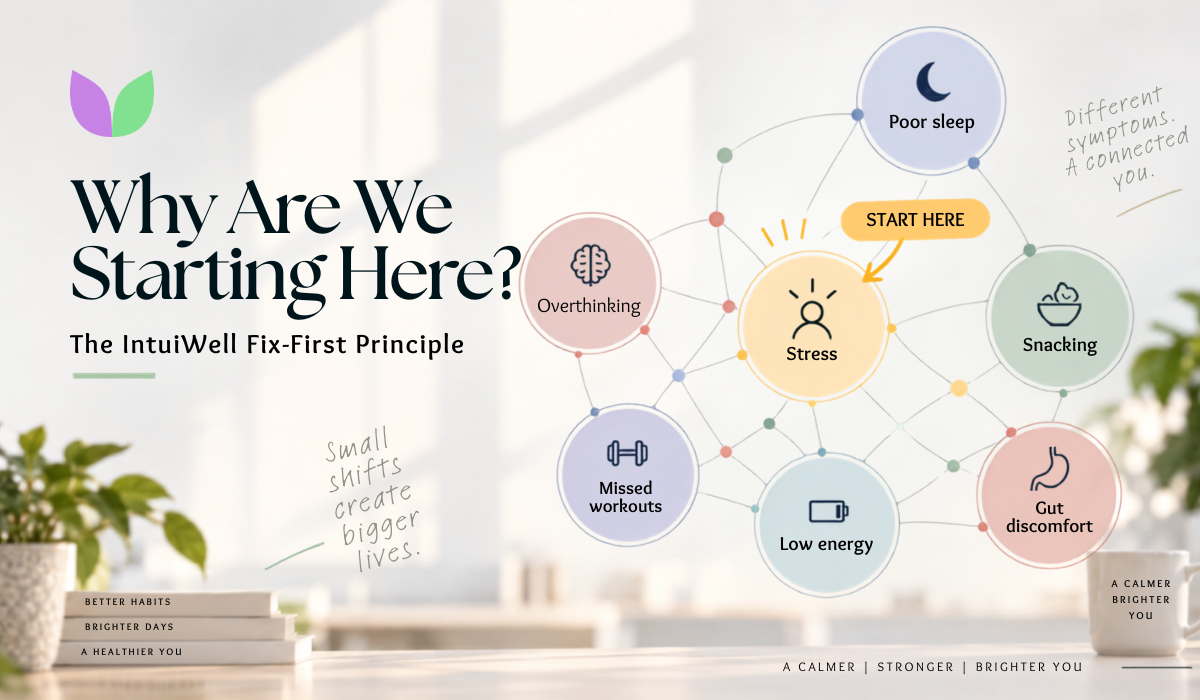
The IntuiWell Fix-First Principle: Understand the pattern before committing to the program
You have probably tried something already.
Maybe it was a diet plan, an exercise routine, meditation, supplements, therapy, coaching, a wellness program, or simply a lot of advice from doctors, friends, family, YouTube and social media.
Some of it may have genuinely helped. Some things worked for a while and then slowly disappeared from your life. Others made complete sense when someone explained them, but became difficult to follow once work got hectic, the family needed you, travel happened, stress increased or your motivation dropped.
Then someone suggests another program.
And perhaps the first thought in your mind is not, “When can I start?”
It is:
“Before I spend more time and money, why do you think this will be any different?”
We think that is a fair question.
At IntuiWell, we believe you should understand where we want to start and why before you are asked to commit to working with us.
That belief sits behind what we call the Fix-First Principle.
The idea is simple: do not begin with the program. Begin by understanding the problem, the pattern around it, and the most useful place to intervene.
The situations used in this article are illustrative composites based on recurring real-life patterns, not individual client case histories.
What Is the IntuiWell Fix-First Principle?
We look at three things:
Problem: What are you actually experiencing?
Pattern: What tends to happen around it, before it and after it?
Fix Point: Where could a practical change create the most useful shift?
Sometimes that starting point is nutrition. Sometimes it is mindset or behaviour. It may involve routine, sleep, movement, recovery, or something happening in the person’s work or family environment.
Sometimes several things are interacting.
And sometimes the right conclusion is that IntuiWell is not where the person should start.
The important point is this:
The problem you notice first is not always the place where useful change should begin.
You May Not Need Another Plan
Suppose you say:
“I know what I should eat. I just cannot stay consistent.”
The obvious response is another diet plan.
But imagine your week more closely.
Monday to Thursday goes reasonably well. Friday brings a difficult client meeting. You finish work mentally exhausted, dinner gets delayed, snacking starts, and by Saturday you are thinking, “This week is already ruined. I will restart on Monday.”
Monday comes, and the cycle begins again.
You may still need nutritional guidance. But if you already know broadly what to eat, another beautifully designed plan may not address the point where things actually break.
The more useful question becomes:
What repeatedly happens at the moment consistency disappears?
If that pattern is never understood, we can keep improving the plan while the same mechanism keeps disrupting it.
The Same Goal Can Hide Very Different Problems
Take something as common as:
“I want to lose weight.”
For one person, better nutritional guidance may genuinely be the right starting point. Another may understand nutrition well but repeatedly eat differently under stress. Someone else may work such unpredictable hours that the “perfect plan” is unrealistic before it even begins. Another person may have medical or metabolic concerns that need appropriate clinical evaluation alongside lifestyle support.
All four may walk in asking for weight loss.
They do not necessarily need the same starting point.
The same is true when someone says:
“My gut gets worse whenever I am stressed.”
Food may matter. Meal timing may matter. Sleep and routine may matter. Stress may matter. The way the person interprets and responds to symptoms may matter. And some symptoms need proper medical assessment rather than assumptions about either food or stress.
So rather than jumping immediately to:
“What should we remove from your diet?”
we first want to understand:
“What pattern surrounds what you are experiencing?”
The same thinking applies to Personal Growth.
Imagine someone saying:
“I overthink every important decision.”
You can help them solve today’s decision. Take the job. Do not take it. Have the conversation. Wait another month.
That may provide immediate relief.
But what happens when the next difficult decision arrives?
If the recurring pattern is to seek reassurance from several people, reopen decisions whenever someone disagrees, worry about disappointing family, or treat normal uncertainty as evidence that the choice must be wrong, then solving today’s decision may do very little for tomorrow’s.
The useful work may instead be helping the person recognise how they respond when a decision feels uncertain.
The goal changes from:
“Help me make this decision.”
to:
“Help me understand the pattern that makes these decisions so difficult for me.”
That is something the person can carry into the next situation.
A Simple Lens You Can Use Yourself: Problem → Pattern → Fix Point
You do not need to become an IntuiWell client to use this way of thinking.
Pick one problem that keeps returning and look at it through three lenses.
1. Problem: What exactly keeps happening?
Avoid broad labels if you can.
“I need to become healthier” gives you very little to work with.
“I follow my routine for four or five days and then stop” is more useful.
“I replay difficult conversations long after they are over” is more useful.
“My gut symptoms become much harder for me to handle during stressful weeks” is more useful.
Specific problems reveal more than labels.
2. Pattern: What happens around the problem?
Look at the sequence rather than only the final symptom.
What usually happens before it? What do you think, feel or do next? What gives temporary relief? What makes the situation worse? What have you already tried? At what point does the old behaviour normally return?
You are not trying to diagnose yourself.
You are looking for the repeat.
3. Fix Point: Where is the first useful place to intervene?
Instead of asking:
“How do I fix all of this?”
ask:
“Where is the first useful point at which I could change the pattern?”
For one person, that may genuinely be breakfast. For another, it may be a conversation they have avoided for three months. For someone else, it could be creating a better transition between work and home, changing how they respond to uncertainty, rebuilding a disrupted routine, or seeking the appropriate medical or psychological support.
The fix point is not necessarily the complete solution.
It is simply the place where it makes sense to begin.
Clarity Before Commitment
This is how the same thinking enters our first conversation with someone.
We are trying to understand what is happening, what appears to keep repeating, where a useful starting point may be, and whether IntuiWell is actually equipped to help.
If we recommend working together, you should broadly understand:
- what we believe needs attention,
- where we would begin,
- why we want to begin there,
- and what kind of work that direction may involve.
Then you decide whether it makes sense to you.
You should understand our thinking before being asked to trust our program.
This does not mean we can fully assess or solve a complex problem in one conversation. It does not mean receiving a complete personalised program before enrolment, and it certainly does not mean promising an outcome before the work begins.
It means having enough clarity to make a more informed decision.
This principle is consistent with the broader idea of shared decision-making. For example, NICE guidance on shared decision-making emphasises that people should understand their options and participate in decisions while bringing their own preferences, priorities and circumstances into the conversation.
IntuiWell’s work is not a substitute for clinical care, and a wellness or Personal Growth conversation is not the same as a medical consultation. But we strongly agree with the underlying principle:
The person should understand and participate in decisions that affect them.
Why Would a Business Do This Before You Pay?
Because enrolling the wrong person helps nobody.
The client spends money and may lose trust. The practitioner spends weeks working on the wrong problem. Expectations are mismatched from the beginning, and when progress does not happen as expected, everyone starts wondering whether the client lacked discipline or whether the program failed.
Sometimes neither conclusion is fair.
The starting point may have been wrong.
That is why the objective of an initial conversation cannot simply be:
“How many people enrolled?”
A better question for us is:
“Did the right person enrol for the right reason, with a reasonable understanding of what we intend to work on?”
We would rather have better-fit enrolment than maximum enrolment.
From a purely short-term commercial point of view, that may seem unusual. But IntuiWell was not designed around selling every person the largest available program.
If the conversation suggests that a simple next step may be enough, we may recommend that rather than a longer program. If structured support makes sense, we explain why. And if we are not the right fit, we should be willing to say that too.
Capability Before Dependence
Fix-First should not end once somebody enrols.
Suppose we correctly identify your pattern, but then spend the next six months telling you exactly what to do every time it appears.
You may improve while the support is there. But eventually, we will not be sitting beside you.
Work will become hectic again. Travel may disrupt your routine. Family pressure may return. Someone may question your decision. Symptoms may fluctuate. Your motivation may fall. A new challenge may appear.
If every recurrence still requires somebody else to tell you what to do, something important is missing.
We are not trying to make you good at following our plan.
We are trying to make you better at understanding yourself.
Over time, we want something to change in your awareness.
At first:
“This happened again.”
Then:
“I can see what usually triggers it.”
Then:
“I know what tends to make it worse.”
And eventually:
“I know what I can try next, and I also know when I need help.”
That is what we mean by Capability Before Dependence.
It does not mean you should never need professional help again. Life changes. Bodies change. Careers and relationships change. New situations genuinely require new expertise, and some people appropriately need continuing medical or psychological care.
The goal is more specific:
You should not remain unnecessarily dependent on us for the same recurring pattern simply because nobody helped you understand how that pattern works.
There is a substantial research base around self-management support in long-term health conditions. The PRISMS evidence synthesis on self-management support drew on 102 systematic reviews covering 969 randomised trials and found that effective self-management support is generally multifaceted, tailored to the individual and supported by a collaborative relationship rather than one universally effective component.
That research does not clinically validate IntuiWell’s specific Fix-First framework, and we do not claim that it does.
The connection is more modest: support becomes more meaningful when people increasingly understand and participate in managing what is happening to them rather than remaining passive recipients of instructions.
Three Principles Behind the Way IntuiWell Works
When we strip the philosophy down, three ideas sit underneath much of our work.
1. Clarity Before Commitment
Understand why a direction is being recommended before deciding whether to join.
We recommend. You decide.
2. Patterns Before Plans
A surface problem does not automatically reveal the best intervention. We look at what is happening around the problem before deciding what support makes sense.
3. Capability Before Dependence
Support should gradually increase your ability to recognise and respond to your own patterns rather than create unnecessary reliance on continued guidance.
These principles apply whether the starting concern is nutrition, stress, behaviour, consistency, decision-making, recovery, or several areas interacting together.
What This Looks Like in Everyday Life
| You may arrive saying… | The obvious response may be… | Fix-First asks… | The longer-term goal |
| “I know what to eat but cannot stay consistent.” | Give another stricter plan | Where and why does consistency break? | Recognise and manage the situations that derail you |
| “My gut gets worse when I am stressed.” | Assume it is only food or only stress | What pattern exists across symptoms, food, routine, stress and medical context where relevant? | Respond more appropriately without reacting to every fluctuation |
| “Tell me what decision to make.” | Solve today’s decision | What makes uncertainty so difficult for you? | Make sound decisions with less reassurance-seeking |
| “I need someone to keep me accountable.” | Create permanent external accountability | What helps you start, continue, notice drift and restart? | Build greater self-awareness and internal accountability |
This is why personalisation, to us, means more than changing a meal plan or selecting a different worksheet.
It means understanding where this particular person gets stuck.
Sometimes the Right Fix Is Not IntuiWell
A Fix-First philosophy only means something if we are also willing to recognise where our role ends.
Not every challenge belongs inside a wellness or Personal Growth Program.
Persistent or unexplained physical symptoms may need medical assessment. Significant anxiety, depression, obsessive symptoms, trauma-related difficulties, severe sleep disturbance or major impairment in daily functioning may require a qualified mental-health or medical professional.
Nutrition, behaviour and lifestyle support should complement appropriate healthcare, not replace it.
So there will be situations where the useful conclusion from a first conversation is:
“We are not the right first step for this.”
That is not a failed consultation.
It is the consultation doing what it was meant to do.
Before You Join Your Next Program, Ask These Five Questions
Whether you are considering IntuiWell or somebody else, take one recurring challenge and ask:
- What exactly keeps happening?
Try to describe the problem specifically instead of using a broad label such as “stress,” “motivation” or “health.” - What pattern surrounds it?
What usually happens before it, during it and afterwards? Where does the same sequence keep returning? - What have I already tried?
More importantly, what happened when that approach stopped working? - Where might the first useful intervention be?
Not the entire solution. Just the place where it makes sense to begin. - Can the person recommending the program explain why they want to start there?
That final question matters.
Before you commit your time, money and effort, you deserve more than:
“This is our program. Trust the process.”
You should understand the logic.
Perhaps You Already Know the Problem. The Harder Question Is Where to Start.
Most people who speak with us already know something about what is bothering them.
“I overthink.”
“I am exhausted.”
“I keep falling off the plan.”
“My gut becomes unpredictable.”
“I cannot say no.”
“I am constantly stressed.”
“I know what to do, but I don’t do it consistently.”
What they often do not know is:
Why does this keep happening, and where should I begin changing it?
That is what an IntuiWell Clarity Call is designed to explore.
We look at what you are experiencing, what you have already tried, what seems to keep repeating, and where we believe a useful starting point may be.
If the pattern you are struggling with is around stress, overthinking, difficult decisions, boundaries, consistency, self-trust or another Personal Growth challenge, our Personal Growth Clarity Call can help us explore whether IntuiWell is the right fit and where the work might begin.
If the conversation points elsewhere, we will tell you that too.
We recommend. You decide.
Book a Personal Growth Clarity Call
Come with the problem. You do not need to arrive knowing the solution.
That is what we explore together.
Frequently Asked Questions
1. What is the IntuiWell Fix-First Principle?
The Fix-First Principle means looking beyond the surface problem to understand the recurring pattern and identify a useful starting point before recommending a longer program. The aim is to help you understand why a particular direction is being suggested before you decide whether to enrol.
2. What happens during an IntuiWell Clarity Call?
The conversation focuses on what you are experiencing, what you have already tried, what appears to keep repeating and where a useful starting point may be. It is not a complete assessment, diagnosis or personalised program delivered during one call.
3. What if IntuiWell is not the right support for my problem?
Then that should become part of the recommendation. IntuiWell’s wellness, nutrition and Personal Growth work does not replace appropriate medical or mental-health care. If another qualified professional should be involved first or alongside us, we should say so.
About the Author
Vallabh Chitnis, Co-Founder – IntuiWell
Vallabh brings more than 20 years of experience across product strategy, operations and leadership into IntuiWell’s Personal Growth work. He works with individuals on recurring patterns around decision-making, stress, behaviour, consistency, boundaries, self-trust and personal growth using practical tools designed for real-life situations.
Educational note: This article explains IntuiWell’s philosophy and approach to wellness and Personal Growth. It is not medical advice, diagnosis, psychotherapy or a substitute for care from a qualified healthcare professional.