Deep Dive Into E3 – Healthy Fats From The IntuiWell Nutrient Periodic Table™
Educational only. Not a substitute for medical advice. Please work with your doctor or nutritionist for personalised plans.
Quick Takeaways
- Fat gives you 9 kcal per gram, more than double carbs or protein.
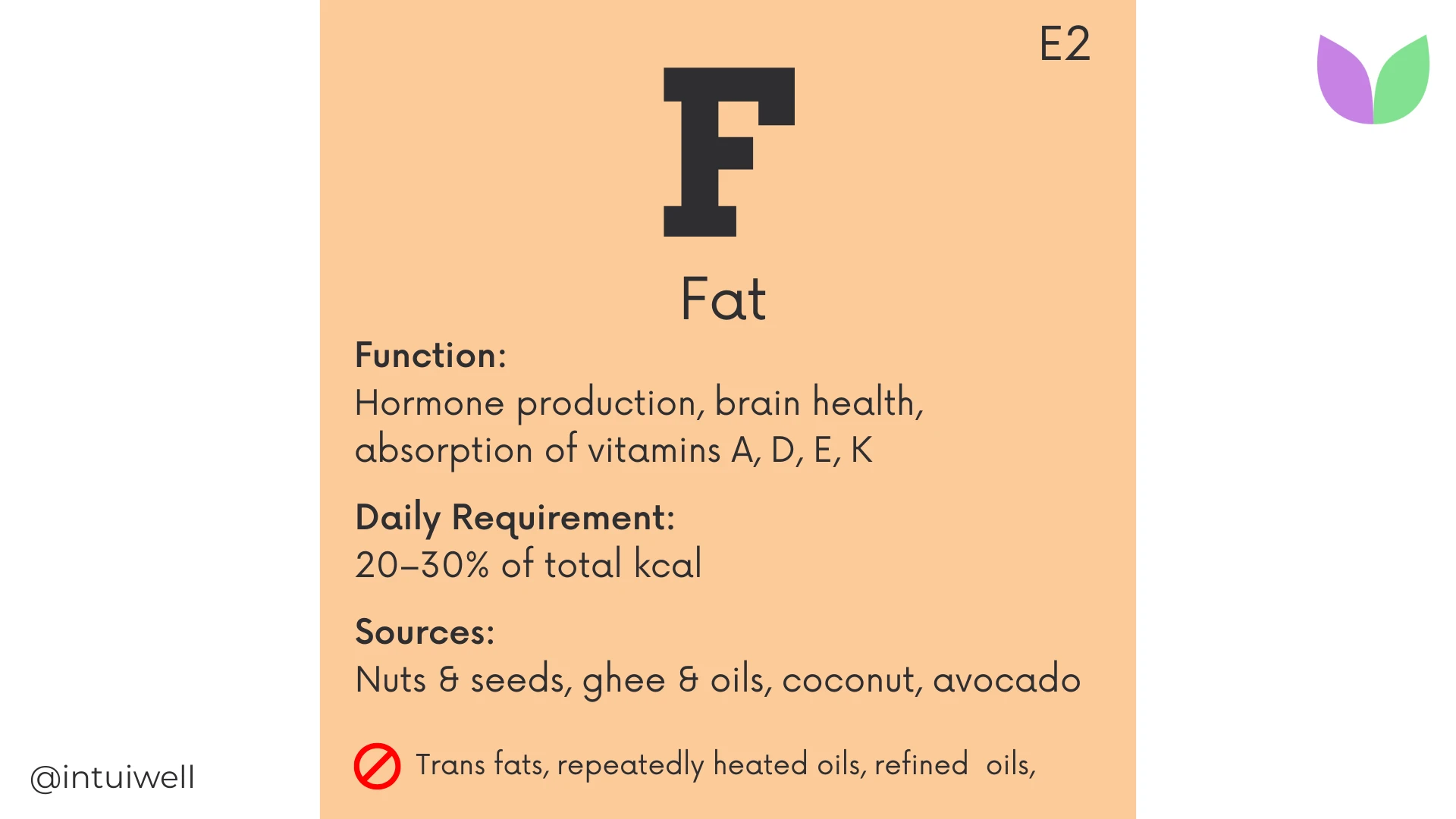
- Most adults do well when 20–35% of daily calories come from fat, with less than 10% from saturated fat and as little trans fat as possible. Exact ranges differ slightly by guideline, but this is a practical average.
- Quality matters more than grams: natural, minimally processed fats beat refined, repeatedly heated oils and trans fats.
- Fats are crucial for hormones, brain, nerves, cell membranes, and fat-soluble vitamins (A, D, E, K).
- Very low-fat diets can disturb hormones, mood, and satiety in many people.
- The real problem is usually refined carbs + poor-quality fats + low movement + chronic stress, not “a spoon of oil” in home-cooked food.
1. What Are Fats, Really?
Fats (lipids) are a family of molecules that include:
- Triglycerides – three fatty acids attached to glycerol; main storage and transport form.
- Phospholipids – a key part of every cell membrane.
- Sterols – like cholesterol, used to make hormones and vitamin D.
Fat is a macronutrient. It gives 9 kcal per gram, compared with 4 kcal/g from carbs and protein.
How your body digests fat
- In the stomach, fat slows gastric emptying.
- In the small intestine, bile from the liver (stored in the gallbladder) emulsifies fat into tiny droplets.
- Pancreatic lipase breaks triglycerides into fatty acids and monoglycerides.
- These form micelles, enter the intestinal cells, and get packaged into chylomicrons.
- Chylomers travel through the lymph and then blood, delivering fat to tissues.
- The liver later processes lipids, builds lipoproteins, and helps regulate cholesterol and triglycerides.
Dietary fat vs body fat
- Dietary fat is the fat you eat.
- Body fat is stored energy in your fat cells (adipose tissue).
- You gain body fat mainly when total calories exceed your needs over time, not just because fat grams are “bad.”
2. What Do Fats Do In The Body?
Fats act like infrastructure and long-term fuel:
- Provide long-term energy at rest and during low-intensity activity.
- Build cell membranes (phospholipid bilayers) so every cell stays stable yet flexible.
- Produce hormones – including sex hormones (estrogen, progesterone, testosterone) and hormone-like eicosanoids that regulate inflammation and blood flow.
- Absorb vitamins A, D, E, and K from your meals.
- Protect nerves through fat-rich myelin sheaths.
- Satiety signal – fats help you feel full and delay hunger.
When fat intake or fat quality is poor, you often see changes in hormones, skin, mood, and energy before you see anything on the scale.
3. Types Of Fats You Need To Understand
Saturated fats
- Structure: carbon atoms fully “saturated” with hydrogen.
- Usually solid at room temperature.
- Examples: ghee, butter, coconut oil, palm oil, visible fat on meat, full-fat dairy.
- Stable at heat, but in excess can raise LDL cholesterol and cardiovascular risk, especially when coming from processed foods and low-fibre diets.
Monounsaturated fats (MUFA)
- Structure: one double bond.
- Main fatty acid: oleic acid.
- Sources: groundnut oil, mustard oil, sesame oil, olive oil, avocados, and many nuts.
- Linked with better heart health when they replace saturated fat and refined carbs.
Polyunsaturated fats (PUFA)
- Structure: more than one double bond.
- Two key families:
- Omega-6 (linoleic acid) – in many vegetable oils and nuts.
- Omega-3 (ALA, EPA, DHA) – in flax, chia, walnuts, fatty fish, algae oil.
- Critical for brain, eyes, immunity, and inflammation regulation.
Trans fats
- Industrial trans fats (vanaspati, some bakery fats, re-used frying oil) are strongly linked to heart disease.
- Even small intakes raise LDL and lower HDL, increasing risk.
- WHO recommends less than 1% of energy from all trans fats; many countries are banning them.
There are tiny natural trans fats in some dairy and meat. Those are usually not the main problem; the big issue is industrial trans fats and deep-fried, ultra-processed foods.
Essential fatty acids
Your body cannot make:
- Omega-3 ALA (alpha-linolenic acid).
- Omega-6 LA (linoleic acid).
You must get them from food. EPA and DHA (long-chain omega-3s) are not formally “essential,” but low levels are tied with higher heart risk, and many people do not convert ALA efficiently.
Medium-chain vs long-chain fats
- MCTs (medium-chain triglycerides) are found in coconut and MCT oil. They absorb faster and go straight to the liver for quick energy.
- LCTs (long-chain) are most of the fat we eat. They travel via chylomicrons and are more likely to be stored.
MCTs can help in some gut or absorption issues, but they are not magic and still add calories.
4. Where Do Fats Come From In An Indian Plate?
Plant sources
- Nuts: almonds, walnuts, cashews, pistachios, peanuts.
- Seeds: flax, chia, sunflower, pumpkin, sesame (til).
- Oils: mustard, groundnut, sesame, rice bran, sunflower, safflower, soybean, olive, coconut.
- Other: avocado (less common but growing), olives.
Animal sources
- Ghee, butter, cream.
- Milk, curd, paneer, cheese.
- Egg yolks.
- Fatty fish (rohu, mackerel, salmon, sardines).
Hidden fats
- Bakery items: biscuits, cakes, puffs, breads.
- Deep-fried snacks: samosa, kachori, pakoda, bhajiya, chips, namkeen.
- Fast food: burgers, pizza, fries.
- “Health” snacks coated in oil, cheese, or mayonnaise.
These often combine refined carbs + poor-quality fats + salt – the worst mix for long-term metabolic and heart health.
5. Why Fat Quality Matters More Than Grams
Natural vs refined oils
- Less processed oils (cold-pressed mustard, groundnut, sesame, extra-virgin olive) keep more antioxidants and minor compounds.
- Highly refined oils are deodorised, bleached and can have more oxidation products.
Both types give 9 kcal/g. The main difference is what else is in the bottle (or what has been stripped away).
Oxidation and rancidity
- Light, heat, and air damage fats, especially PUFA-rich oils.
- Rancid oils increase oxidative stress and should be discarded (odd smell, bitter or “old” taste).
Smoke point vs reality
People over-focus on the smoke point. In real kitchens:
- Use stable oils for deep frying and high heat.
- Avoid reusing oil many times. That is where many harmful compounds form.
6. Essential Fatty Acids & Inflammation
Omega-3
- ALA – flax, chia, walnuts, mustard seeds, canola.
- EPA/DHA – fatty fish, fish oil, algae oil.
Benefits:
- Lower triglycerides.
- Support heart and brain health.
- Help regulate inflammation.
Many Indian vegetarians get very little EPA/DHA and modest ALA. In such cases, algae-based omega-3 supplements can help after medical advice.
Supplements can help, but they should come after diet changes and with medical guidance, especially if you take blood thinners or have a chronic illness.
Omega-6
- Abundant in sunflower, safflower, soybean, corn, and many seed oils.
- Necessary in moderate amounts for normal function.
The problem is not omega-6 alone. It is too much omega-6 + too little omega-3 + ultra-processed food.
7. Fats & Hormones
Fats are a raw material for many hormones.
- Sex hormones (estrogen, progesterone, testosterone) are made from cholesterol.
- Adrenal hormones like cortisol also depend on cholesterol and healthy fat metabolism.
- Very low-fat diets can disturb: Menstrual cycles. Fertility. Libido. Recovery from stress
From practice, most women who come with cycle issues or PCOS fall into one of two buckets:
- “Diet food” all the time, almost no visible fat, fear of oil.
- Frequent fried, packaged food as the main fat source.
Simply moving them to measured ghee, nuts, seeds, and better oils often improves energy, mood, and cycle regularity over a few months.
Thyroid hormones interact with lipids, too. Poor fat quality and chronic inflammation worsen insulin resistance and lipid markers, which then complicate thyroid management.
8. Fat Digestion & Absorption Problems
Fat digestion uses a lot of machinery:
- The liver makes bile.
- The gallbladder stores and releases bile.
- The pancreas releases lipase.
- The small intestine absorbs the products.
Signs of poor fat digestion
- Bloating or nausea after greasy food.
- Pale, floating, or foul-smelling stools.
- Greasy film in the toilet bowl.
- Pain or heaviness in the right upper abdomen.
Possible causes:
- Gallstones or reduced bile flow.
- Pancreatic enzyme issues.
- Gut inflammation or IBS.
In these cases, doctors may advise a temporarily lower fat intake, use specific fats (like MCTs), and add digestive support.
9. Fats & Cardiometabolic Health
This is where debates get loud. Keep to what we know well.
- Saturated fat tends to raise LDL cholesterol, especially in some people.
- What you replace it with matters: Replace sat fat with refined carbs → risk often does not improve much. Replace sat fat with unsaturated fats → risk usually drops.
Markers that respond to fat quality:
- Triglycerides
- HDL and LDL cholesterol
- LDL particle pattern – pattern B means smaller, denser LDL particles that are more harmful than larger, “fluffier” pattern A.
Most heart-health guidelines agree:
- Keep saturated fat modest.
- Avoid trans fat completely.
- Shift towards unsaturated fats plus whole, minimally processed foods.
10. Fats & Blood Sugar Control
Fat itself does not raise blood sugar. But it changes how carbs behave.
- Fat slows gastric emptying. This can smooth the glucose rise after a mixed meal.
- A little fat with carbs can help with satiety and steadier energy.
Where it goes wrong:
- Refined carbs + refined fats + low fibre
Example: fries, chips, samosa, pastry, burger with sugary drink. This combination pushes insulin, triglycerides, and inflammation up over time.
For diabetes and PCOS:
- Use fats strategically:
Add a small amount of nuts, seeds, or good oil to slow carb absorption. Avoid high-fat, high-sugar meals. Keep overall calories and weight in check.
11. How Much Fat Do You Need?
For most healthy adults:
- Total fat: about 20–35% of daily calories.
- Saturated fat: generally under 10% of calories, and ideally lower in high-risk people.
- Trans fat: as close to zero as possible.
Very low-fat diets (for example, under ~15% of calories) can:
- Reduce essential fatty acid intake.
- Harm hormone balance and mood in some people.
In daily life, that often looks like:
- Very little visible oil plus almost no nuts, seeds, or full-fat dairy.
Higher fat intakes can work when:
- Carbs are carefully managed (e.g., some low-carb or Mediterranean-style plans).
- Fats come mainly from nuts, seeds, fish, and high-quality oils.
Lower fats may be needed short-term in:
- Gallbladder disease.
- Some gut conditions with fat malabsorption.
12. Cooking With Fats (What To Actually Do In The Kitchen)
Better choices for high-heat cooking
- Groundnut oil.
- Mustard oil.
- Rice bran oil.
- Sesame oil.
- Traditional ghee in small amounts.
These are relatively stable when used correctly and not overheated repeatedly.
Fats to use gently
- Extra-virgin olive oil.
- Flaxseed oil (no heating).
- Cold-pressed seed and nut oils.
Use them for:
- Finishing cooked dishes.
- Salads, chutneys, dips.
Fats to limit or avoid
- Vanaspati, margarine, “bakery fats.”
- Reused deep-frying oil.
- Mixed unnamed “vegetable oil” in street food or low-quality packaged foods.
Oil rotation principle
- Use 2–3 oils over a month, not 7–8.
- Combine one MUFA-rich oil (groundnut, mustard, olive) with one PUFA-rich (sunflower, safflower, rice bran) and traditional ghee in small amounts.
And remember: even healthy fats are calorie-dense. A few extra spoons of oil or handfuls of nuts every day can quietly block fat loss.
The teaspoon is your best tool. Do not pour directly from the bottle into the pan.
13. Fats In Common Health Conditions
Diabetes/insulin resistance
- Reduce deep-fried foods and trans fats.
- Use nuts, seeds, and good oils to replace part of the refined carbs and support better blood sugar patterns.
PCOS & fertility
- Prioritise omega-3, nuts, seeds, olive/mustard oil, and small amounts of ghee.
- Avoid frequent fried and ultra-processed foods.
Thyroid disorders
- Focus on balanced fat intake, good quality, and weight management.
- Extreme low-fat or extreme high-fat diets both need medical supervision.
Fatty liver (NAFLD)
- High refined carb + high fat + obesity drives many cases.
- Cut sugar and deep-fried foods. Use measured, high-quality fats instead.
In real life, almost every NAFLD client who walks in has the same trio: soft drinks or sweetened tea, frequent fried food, and almost no movement. The problem is rarely homemade dal with a spoon of ghee.
Weight loss
- You don’t need zero fat.
- You need calorie deficit + movement + better fat choices:
Less deep-fried food. More nuts, seeds, and oils in teaspoons, not free pours.
Menopause and ageing
- Healthy fats support hormones, brain, and joint health.
- Many older adults feel better with good fats + higher protein + fewer refined carbs.
14. Symptoms Of Fat Imbalance
Too little fat
- Dry skin and hair.
- Hair fall.
- Brittle nails.
- Hormonal issues (irregular cycles, low libido).
- Constant hunger and poor satiety.
- Low energy and mood swings.
Poor fat quality
- Joint pain and stiffness.
- Acne or skin inflammation.
- High LDL and triglycerides.
- Central weight gain with a processed-food-heavy diet.
Possible omega-3 deficiency
- Dry, scaly skin.
- Mood issues, low resilience to stress.
- High triglycerides.
- Very low omega-3 index on testing.
These are signals to review your fats, not to start heavy supplements.
15. Lab Markers Related To Fat Metabolism
Always interpret results with your doctor. Ranges can vary by lab and risk profile.
- Triglycerides
Often flagged high at ≥150 mg/dL. Lower levels are generally better.
- HDL cholesterol (“good”)
Higher HDL usually means lower risk, especially when combined with low triglycerides.
- LDL cholesterol (“bad”)
Key risk marker for heart disease; lower is usually better, especially in high-risk people.
- Total cholesterol / non-HDL cholesterol
Useful context when combined with HDL, triglycerides, and other factors.
- Omega-3 index (if tested)
Rough guide:
- <4% of red blood cell fatty acids → higher CHD risk.
- 4–8% → intermediate.
- 8% → lower risk.
Most routine labs don’t offer this yet, but where available, it gives a deeper view of long-term omega-3 status, not just what you ate last week.
- Liver enzymes (ALT, AST, GGT)
Elevated values with central obesity can suggest fatty liver or liver stress.
- hs-CRP (high-sensitivity C-reactive protein)
Marker of low-grade inflammation:
- <1 mg/L → low CVD risk
- 1–3 mg/L → average
- 3 mg/L → higher risk (if no acute infection).
Fat quality, weight, smoking, sleep, stress, and movement all affect these markers.
16. Common Myths About Fats
“Fat makes you fat.”
Excess calories make you gain fat. Those calories can come from fat, sugar, or even “healthy” foods.
“All saturated fat is poison.”
Context matters. Total diet quality, fibre, and what replaces saturated fat are key. Still, major bodies recommend limiting saturated fat and replacing some of it with unsaturated fat.
“Vegetable oils are always heart-healthy.”
Not always. Some are fine in moderation. Others are heavily refined and used in deep frying and ultra-processed food, which raises risk.
“Ghee clogs arteries.”
Ghee is mostly saturated fat. Small amounts in an otherwise balanced, active lifestyle are usually fine for many people. Heavy ghee plus sedentary life and other risk factors is a problem.
“Low-fat diets are best for everyone.”
Some people feel worse on very low-fat diets. Hormones, mood, and satiety often suffer.
17. Practical Fat-Selection Frameworks
Daily fat inclusion checklist
In a typical day, aim for:
- A small handful of nuts or seeds.
- 2–3 teaspoons of cooking oil per main meal, per person, at most.
- 1–2 small visible servings of fat (like ghee on roti or seeds on salad).
- Minimal fried food and almost no industrial trans fat.
As a simple target for an average adult, think:
- 1 small handful of nuts or seeds.
- 2–3 teaspoons of visible oil per main meal, adjusted up or down for size, hunger, activity, and goals.
Even healthy fats are calorie-dense, so a few extra spoons of oil or handfuls of nuts every day can quietly block fat loss.
How to choose cooking oils
Ask:
- Is this oil authentic and not repeatedly heated?
- Does it fit my cuisine (mustard/groundnut for Indian, olive for Mediterranean)?
- Does my monthly pattern include:
- One MUFA-rich oil?
- One PUFA-rich oil?
- Optional ghee in small amounts?
If yes, you are usually on the right track.
Portion size visual guide
- 1 teaspoon oil = tip of thumb.
- 1 tablespoon nut butter = whole thumb.
- 1 small handful of nuts = about 20–30 g.
Ideal fat combinations with meals
- Breakfast – poha/upma with peanuts; eggs with a bit of ghee; oats with nuts and seeds.
- Lunch – dal with tadka, sabzi cooked in measured oil, plus curd.
- Dinner – lighter: sabzi, roti or millet, paneer/dal, minimum fried items.
Eating out strategies
- Avoid “double fat”: deep-fried + creamy sauce.
- Pick grilled, steamed, or tandoori options.
- Ask for sauces and dressings on the side.
- Share desserts instead of solo portions.
18. Red Flags That Your Fat Intake Needs Fixing
Watch for:
- Feeling hungry again within 1–2 hours of meals despite “healthy” food.
- Removing fats and noticing your hair, skin, and cycles suffer.
- Lipid profile showing high triglycerides or low HDL.
- Feeling heavy and bloated after a restaurant or having greasy food.
- Intense cravings in the evening or at night.
These are signals to review both the type and amount of fat with a professional.
19. Summary & Takeaway Principles
- Fats are essential, not optional.
- Focus on quality, balance, and cooking method, not fear of oil.
- Keep total fat in a sensible range, limit saturated fat, and avoid trans fat.
- Prioritise nuts, seeds, good oils, fish, and small amounts of ghee, while cutting deep-fried and ultra-processed foods.
- Watch your hormones, energy, skin, and lab markers – they tell you whether your fat strategy is working.
Author
Written by: Shivani Jain, Co-founder & Clinical Lead Nutritionist, IntuiWell
- Certified nutritionist based in India (Master’s in Foods & Nutrition)
- Combines scientific diet planning, superfoods, ancient wisdom, and simple kitchen remedies
- Works with clients to attack the root cause of issues like fatigue, weight gain, gut problems, and hormonal imbalances
Key References
World Health Organization (2023). Saturated fatty acid and trans-fatty acid intake for adults and children: WHO guideline.
WHO, Geneva.
https://www.who.int/publications/i/item/9789240073630
FAO/WHO (2010). Fats and fatty acids in human nutrition: Report of an expert consultation.
FAO Food and Nutrition Paper 91.
PDF: https://www.fao.org/fileadmin/user_upload/nutrition/docs/requirements/fatsandfattacidsreport.pdf
Sacks FM, et al. (2017). Dietary Fats and Cardiovascular Disease: A Presidential Advisory From the American Heart Association.
Circulation 136(3):e1–e23.
PubMed: https://pubmed.ncbi.nlm.nih.gov/28620111/
American Heart Association (2024). Saturated Fats.
Patient guidance page, updated 23 August 2024.
https://www.heart.org/en/healthy-living/healthy-eating/eat-smart/fats/saturated-fats
Harris WS (2008). The omega-3 index as a risk factor for coronary heart disease.
American Journal of Clinical Nutrition 87(6):1997S–2002S.
PubMed: https://pubmed.ncbi.nlm.nih.gov/18541601/
Pressler M, et al. (2022). Dietary Transitions and Health Outcomes in Four Populations – Systematic Review. Frontiers in Nutrition 9:748305.Full text: https://www.frontiersin.org/articles/10.3389/fnut.2022.748305/full