Deep Dive Into M4: Sodium From The IntuiWell Nutrient Periodic Table™
Quick Takeaways
Sodium is an essential electrolyte required for fluid balance, nerve signalling, muscle contraction, blood pressure regulation, and maintaining normal cellular function.
- Sodium works closely with potassium, chloride, and water to regulate fluid distribution inside and outside cells.
- Contrary to popular belief, sodium is not harmful by itself. Both excessive and inadequate sodium intake can affect health.
- Most people consume excess sodium not from the salt added during home cooking, but from processed foods, packaged snacks, restaurant meals, and hidden sodium additives.
- Sodium requirements vary depending on climate, physical activity, sweating, illness, medications, and certain medical conditions.
- Excess sodium intake may contribute to high blood pressure in salt-sensitive individuals, but overall dietary quality and potassium intake also play an important role.
- Extremely low sodium levels (hyponatremia) and very high sodium levels (hypernatremia) are medical conditions that require proper evaluation and should not be self-managed.
- Maintaining a healthy sodium-to-potassium balance is often more important than focusing on sodium alone.
1. What Sodium Is and How Your Body Uses It
Sodium is an essential mineral and one of the body’s primary electrolytes.
Unlike structural minerals such as calcium and phosphorus, sodium is mainly responsible for regulating fluid movement and electrical activity throughout the body.
Nearly all of the body’s sodium is found in the fluid outside cells, where it helps maintain normal blood volume, blood pressure, and cellular hydration.
Your body uses sodium to:
- Maintain fluid balance inside and outside cells
- Support nerve impulse transmission
- Enable muscle contraction
- Help regulate blood pressure
- Maintain acid-base balance
- Support nutrient transport across cell membranes
- Help maintain normal cellular function
Sodium is tightly regulated because even small changes in blood sodium concentration can significantly affect normal body function.
2. Primary Functions of Sodium
Sodium supports multiple physiological systems that keep the body functioning normally.
Fluid Balance
- Maintains the balance of fluids inside and outside cells
- Helps regulate blood volume
- Supports normal hydration
Nervous System
- Enables electrical signals to travel between nerves
- Supports communication between the brain and the rest of the body
Muscle Function
- Required for normal muscle contraction
- Works with potassium and calcium during muscle activity
Cardiovascular Function
- Helps maintain circulating blood volume
- Supports normal blood pressure regulation
Nutrient Transport
- Helps transport glucose and certain amino acids into cells
- Supports absorption of nutrients in the small intestine
Acid-Base Balance
- Helps maintain normal pH within body fluids
Sodium is not simply a “blood pressure mineral.” It is essential for nearly every cell to function properly.
3. Sodium Regulation: How the Body Maintains Balance
The body maintains sodium balance within a very narrow range. Unlike many nutrients, sodium is continuously regulated throughout the day.
Several organs and hormones work together to maintain this balance.
The body regulates sodium through:
- Kidneys
- Adrenal hormones (especially aldosterone)
- Antidiuretic hormone (ADH or vasopressin)
- Thirst mechanism
The kidneys continuously adjust how much sodium is retained or excreted depending on the body’s needs.
When sodium intake increases, healthy kidneys usually remove the excess through urine. When intake decreases or sodium losses increase through sweating, vomiting, or diarrhoea, the kidneys conserve sodium to help maintain normal fluid balance.
Sodium also works closely with:
- Potassium
- Chloride
- Water
Several factors may influence sodium balance, including:
- Heavy sweating
- Prolonged vomiting or diarrhoea
- Kidney disease
- Heart failure
- Liver disease
- Certain medications such as diuretics
- Very high intake of processed foods
Maintaining sodium balance is not only about intake. It also depends on how effectively the body regulates water and electrolytes.
4. Sodium and Fluid Balance: The Core Connection
One of sodium’s most important roles is maintaining fluid balance.
Water naturally follows sodium.
When sodium levels change, water moves between different compartments of the body to maintain equilibrium.
This process helps regulate:
- Blood volume
- Blood pressure
- Cellular hydration
- Circulation
- Normal organ function
Too little sodium may contribute to abnormal fluid movement into cells.
Too much sodium, particularly when combined with inadequate potassium intake and excess processed foods, may contribute to increased blood pressure in susceptible individuals.
However, sodium is only one part of the equation.
Blood pressure is influenced by many factors, including:
- Potassium intake
- Kidney function
- Physical activity
- Body weight
- Overall dietary quality
- Stress
- Sleep
For most healthy people, the goal is not eliminating sodium.
The goal is maintaining an appropriate balance between sodium, potassium, water, and overall dietary quality.
Sodium works best as part of a balanced dietary pattern rather than in isolation.
5. Sodium and Nerve & Muscle Function: The Electrical Mineral
Sodium plays a fundamental role in the body’s electrical signalling system.
Every nerve impulse and muscle contraction depends on the controlled movement of sodium across cell membranes.
This movement is largely maintained by the sodium-potassium pump, one of the body’s most important cellular transport mechanisms. It continuously moves sodium out of cells and potassium into cells, helping maintain normal electrical activity and cellular function.
Without adequate sodium, nerves cannot transmit signals efficiently, and muscles cannot contract and relax normally.
Sodium supports:
Nerve Function
- Helps generate and transmit nerve impulses
- Supports communication between the brain, spinal cord, and peripheral nerves
Muscle Function
- Initiates muscle contraction
- Works together with potassium and calcium to regulate muscle activity
Heart Function
- Helps maintain normal cardiac electrical conduction and rhythm
- Supports coordinated contraction of the heart muscle
Because sodium, potassium, and calcium work together, an imbalance in one electrolyte may influence the function of the others.
Maintaining overall electrolyte balance is more important than focusing on sodium alone.
6. Sodium and Electrolyte Balance: The Real Story
Sodium does not function independently. It works continuously with several electrolytes to maintain normal physiological function.
These include:
- Potassium
- Chloride
- Calcium
- Magnesium
Together, these electrolytes help regulate:
- Fluid movement
- Blood pressure
- Nerve signalling
- Muscle contraction
- Cellular hydration
One of the most important concepts in modern nutrition is the sodium-to-potassium balance, rather than sodium intake alone.
Many people consume excessive sodium from ultra-processed foods while consuming insufficient potassium-rich foods such as fruits, vegetables, legumes, and coconut water. This imbalance may have a greater impact on cardiovascular health than sodium intake alone.
Another important distinction is between naturally occurring sodium in foods and sodium added during food processing.
Packaged foods, processed meats, instant noodles, sauces, bakery products, chips, ready-to-eat meals, processed soups, seasoning mixes, and fast foods often contain large amounts of hidden sodium.
Natural home-cooked meals usually contribute far less sodium than commercially processed foods.
Electrolyte balance—not sodium alone—is what supports healthy physiological function. Both sodium deficiency and sodium excess can disrupt this balance.
7. Daily Sodium Requirements
Sodium is essential every day, but individual requirements vary depending on age, climate, physical activity, sweating, illness, medications, and underlying health conditions.
For Indian adults, use the latest ICMR-NIN recommendations as the primary reference.
As a practical public health recommendation, the World Health Organization (WHO) advises that adults consume less than 2,000 mg of sodium per day, which is approximately equivalent to 5 grams of salt (about one teaspoon) from all dietary sources combined.
This recommendation is intended to reduce the risk of hypertension and cardiovascular disease at the population level.
However, sodium needs are not identical for everyone.
Requirements may increase during:
- Heavy sweating
- Endurance sports
- Hot and humid climates
- Prolonged vomiting or diarrhoea
- Certain medical conditions under professional supervision
People taking diuretics or those with certain endocrine, heart, liver, or kidney disorders should follow medical advice rather than general sodium recommendations.
Most people do not need additional sodium supplements.
Instead, the priority should be reducing excess sodium from processed foods while maintaining adequate intake through a balanced diet.
Use public health recommendations as a guide rather than a rigid target. Individual needs should always be interpreted within the context of overall health, lifestyle, climate, and medical conditions.
8. Where Your Sodium Really Comes From
Many people believe the salt they add during cooking is their biggest source of sodium.
In reality, a substantial proportion of sodium intake often comes from processed and packaged foods.
Foods Naturally Containing Sodium
These foods naturally contain modest amounts of sodium:
- Milk
- Curd
- Eggs
- Meat
- Fish
Added Salt
The most common source of sodium is:
- Table salt (sodium chloride) used during cooking and at the table.
Hidden Sources
Large amounts of sodium are commonly found in:
- Packaged snacks
- Instant noodles
- Pickles
- Papad
- Bakery products
- Processed meats
- Fast foods
- Processed cheese
- Sauces and ketchup
- Processed soups
- Seasoning mixes
- Ready-to-eat meals
- Restaurant foods
The goal is not to eliminate salt.
The goal is to reduce hidden sodium from highly processed foods while maintaining an overall balanced dietary pattern.
For most people, improving dietary quality is likely to have a greater impact than simply removing the salt shaker from the dining table.
9. Timing and Practical Use
Sodium is naturally present in many foods and is commonly consumed through salt added during cooking and food preparation. Most healthy individuals do not need to focus on specific timing of sodium intake.
Instead, maintaining an appropriate overall sodium intake throughout the day is more important than consuming large amounts at a single meal.
Simple habits help maintain better sodium balance:
- Prefer freshly prepared home-cooked meals over highly processed foods.
- Taste food before adding extra salt.
- Include potassium-rich foods such as fruits, vegetables, legumes, and coconut water as part of a balanced diet.
- Stay adequately hydrated, especially during hot weather and physical activity.
- Replace sodium losses appropriately during prolonged sweating, endurance exercise, vomiting, or diarrhoea under professional guidance.
- Read nutrition labels and choose lower-sodium packaged foods whenever possible.
For most people, sodium works best as part of an overall balanced dietary pattern rather than through deliberate restriction or excessive intake.
10. Signs You May Be Low on Sodium
Mild sodium depletion may occur when sodium losses exceed intake, particularly during prolonged sweating, vomiting, diarrhoea, excessive water intake without electrolyte replacement, or certain medical conditions.
Possible signs may include:
- Fatigue or weakness
- Muscle cramps
- Headache
- Nausea
- Dizziness
- Difficulty concentrating
- Confusion in more severe cases
Severe sodium deficiency (hyponatremia) is a medical condition that requires prompt medical evaluation and should never be self-treated with excessive salt intake.
Many of these symptoms are non-specific and can also occur due to dehydration, infections, hormonal disorders, medication use, or other nutritional deficiencies.
Do not self-diagnose sodium deficiency based on symptoms alone.
11. When Sodium Can Backfire
More sodium is not always better.
Excess sodium intake may become a concern when it is consistently consumed through processed foods, packaged snacks, restaurant meals, and hidden sodium additives.
High sodium intake may contribute to elevated blood pressure in salt-sensitive individuals, particularly when accompanied by low potassium intake, obesity, physical inactivity, or chronic kidney disease.
At the same time, excessive sodium restriction without a medical indication may also be inappropriate for some individuals, especially those experiencing significant sodium losses through prolonged sweating, gastrointestinal illness, or endurance exercise.
A better balance rule is:
Sodium + Potassium + Water + Kidney Function = Healthy Fluid and Electrolyte Balance
Rather than viewing sodium as “good” or “bad,” it is more useful to focus on maintaining overall electrolyte balance and reducing excess sodium from ultra-processed foods.
12. Sodium and Common Health Conditions
High Blood Pressure
Excess sodium intake may contribute to elevated blood pressure in salt-sensitive individuals. Reducing processed foods while increasing potassium-rich foods may help support healthy blood pressure as part of an overall healthy lifestyle.
Heart Disease
People with certain cardiovascular conditions may require individualized sodium recommendations under medical supervision.
Kidney Disease
The kidneys regulate sodium balance. People with kidney disease should follow advice from their physician and dietitian regarding sodium intake.
Heavy Sweating and Endurance Exercise
Athletes and individuals exposed to prolonged heat may lose significant amounts of sodium through sweat. Replacement strategies should be individualized based on the duration and intensity of activity.
Vomiting and Diarrhoea
Significant gastrointestinal fluid losses may increase sodium requirements temporarily. Persistent symptoms require appropriate medical assessment and fluid replacement.
Sodium requirements should always be interpreted within the context of an individual’s health status rather than applying the same recommendation to everyone.
13. Lab Markers Related to Sodium
Sodium status can be assessed using laboratory investigations when clinically indicated.
The most common test is:
Serum Sodium
Supporting investigations may include:
- Potassium
- Chloride
- Serum osmolality
- Urine sodium (in selected clinical situations)
- Kidney function tests (Serum Creatinine, Blood Urea Nitrogen, eGFR)
Assessment should always consider hydration status, kidney function, medications, and the underlying clinical condition. A single sodium value should never be interpreted in isolation.
14. Sodium in Different Life Stages
Children and Adolescents
Sodium supports normal growth, fluid balance, nerve function, and muscle activity. Children should obtain sodium primarily from home-cooked meals rather than processed snacks and packaged foods.
Adults
Sodium helps maintain fluid balance, blood pressure regulation, nerve signalling, muscle contraction, and overall cellular function.
Older Adults
Age-related changes in kidney function, medication use, reduced thirst perception, and chronic illnesses may increase the risk of both sodium imbalance and dehydration.
Pregnancy and Lactation
Sodium requirements are generally met through a balanced diet. Excessive sodium restriction is not routinely recommended unless advised by a healthcare professional for specific medical conditions.
15. Common Sodium Myths
“Salt is always bad for health.”
No. Sodium is an essential mineral required for normal nerve function, muscle contraction, fluid balance, and cellular activity. The concern is usually excessive intake from processed foods, not sodium itself.
“Stopping table salt will solve high blood pressure.”
Not necessarily. Blood pressure is influenced by multiple factors, including overall dietary quality, potassium intake, body weight, physical activity, sleep, stress, genetics, and kidney health.
“Sea salt, Himalayan pink salt, and rock salt are low in sodium.”
No. These salts contain sodium in amounts similar to regular table salt. Although they may contain trace minerals, they should not be considered low-sodium alternatives.
“People who sweat a lot should always consume extra salt.”
Not always. Sodium replacement depends on the amount of sweat lost, duration of activity, climate, hydration status, and individual health conditions.
16. Practical IntuiWell Sodium Framework
Use this as your daily guide.
Step 1: Prioritise Fresh Foods
Choose home-cooked meals more often than highly processed or packaged foods.
Step 2: Reduce Hidden Sodium
Limit packaged snacks, instant foods, processed meats, sauces, ready-to-eat meals, and frequent restaurant foods.
Step 3: Balance Sodium with Potassium
Include fruits, vegetables, legumes, pulses, and other potassium-rich foods as part of your daily meals.
Step 4: Stay Hydrated
Maintain adequate fluid intake and replace sodium losses appropriately during prolonged sweating, vomiting, diarrhoea, or endurance exercise under professional guidance.
Step 5: Focus on Overall Dietary Quality
Healthy sodium intake is achieved through balanced eating patterns, not simply by avoiding the salt shaker.
17. Red Flags: When to See a Doctor
Seek medical attention if you experience:
- Persistent vomiting or diarrhoea
- Severe dizziness or confusion
- Recurrent fainting episodes
- Persistent muscle weakness
- Swelling of the legs or face
- Uncontrolled high blood pressure
- Known kidney, liver, heart, or endocrine disease
- Abnormal sodium or electrolyte laboratory results
Sodium imbalance can sometimes indicate an underlying medical condition that requires proper evaluation rather than dietary changes alone.
18. How to Use This Article
Think of sodium as an essential electrolyte rather than simply a nutrient to avoid.
It helps regulate fluid balance, supports nerve signalling, enables muscle contraction, maintains blood pressure, and works closely with potassium, chloride, and water to keep every cell functioning normally.
The goal is not to eliminate sodium.
The goal is to maintain the right balance through a nutritious dietary pattern, adequate hydration, and minimal reliance on highly processed foods.
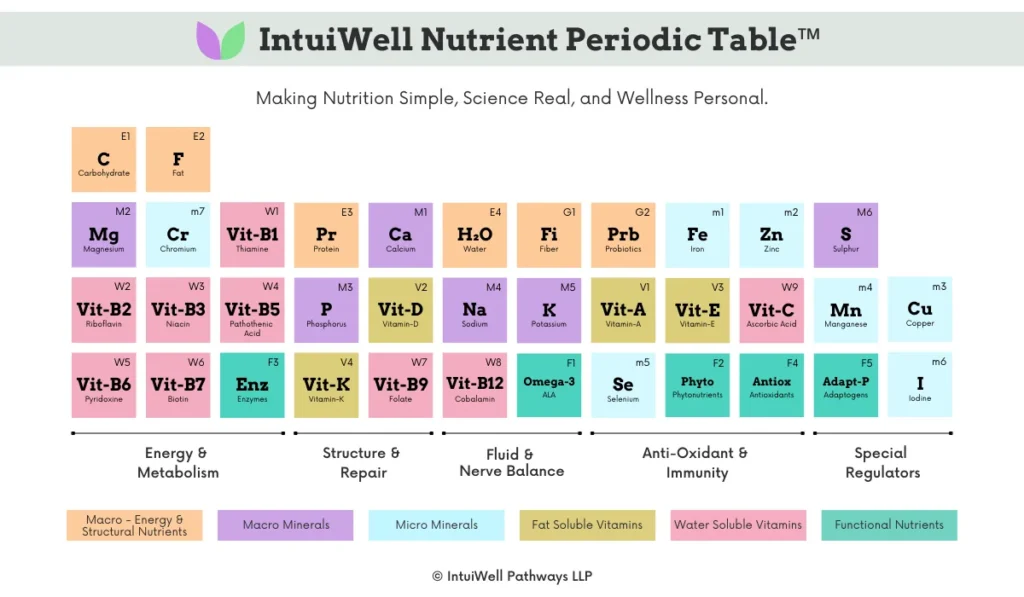
In the IntuiWell Nutrient Periodic Table™, Sodium (M4) represents the body’s primary extracellular electrolyte responsible for fluid regulation, electrical signalling, and electrolyte balance.
How This Fits Into The IntuiWell Nutrient Periodic Table™
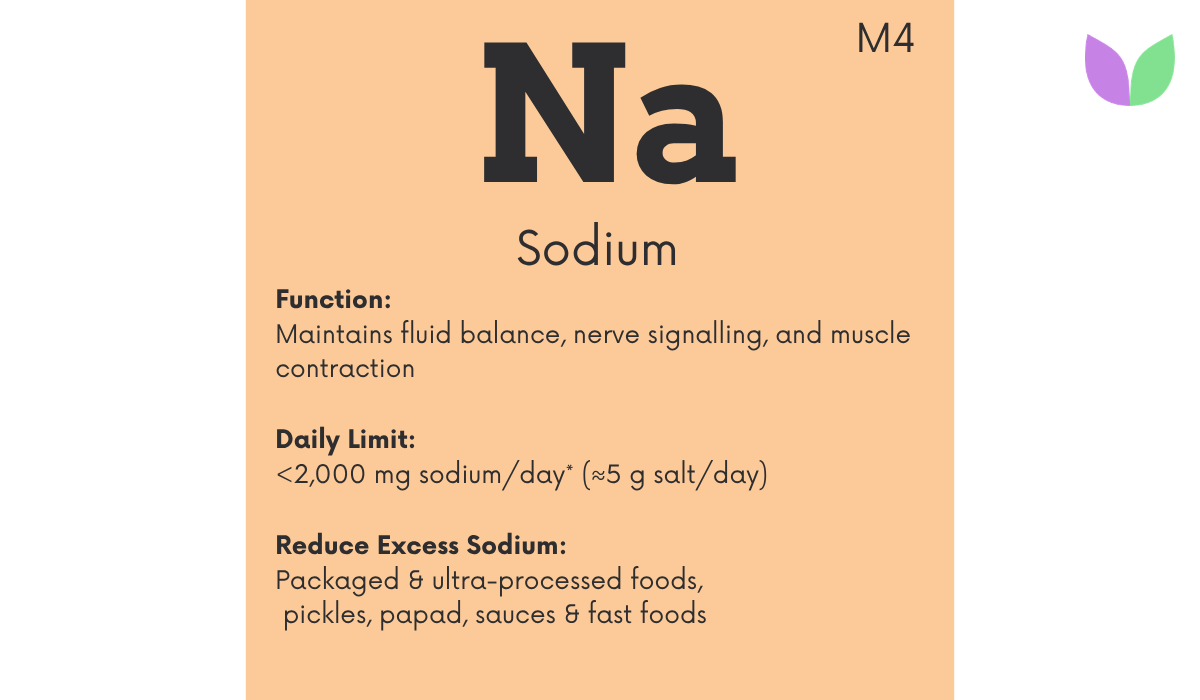
This is the M4 – Sodium tile from the IntuiWell Nutrient Periodic Table™.
It helps you understand why sodium is much more than just “salt.” Sodium is an essential electrolyte that supports fluid balance, nerve signalling, muscle contraction, blood pressure regulation, and cellular function. It works closely with potassium, chloride, and water to maintain the body’s internal balance.
Next in sequence:
Learn how potassium supports heart rhythm, muscle function, nerve signalling, blood pressure regulation, and works together with sodium to maintain healthy electrolyte balance.
Author
Written by: Shivani Jain
Co-founder & Clinical Lead Nutritionist, IntuiWell
Certified Nutritionist, Master’s in Foods & Nutrition
Helping people simplify nutrition through science, tradition, and practical kitchen wisdom.
Summary
Sodium is an essential electrolyte required for fluid balance, nerve signalling, muscle contraction, blood pressure regulation, and normal cellular function. It works closely with potassium, chloride, and water to maintain hydration and electrolyte balance throughout the body.
While sodium is often associated with high blood pressure, the real concern is usually excessive intake from highly processed foods rather than moderate use of salt in a balanced home-cooked diet. Maintaining an appropriate sodium-to-potassium balance, choosing minimally processed foods, and supporting overall dietary quality are often more important than focusing on sodium alone.
FAQs
1. Is sodium the same as salt?
No. Sodium is a mineral, while table salt is sodium chloride. Salt is one of the primary dietary sources of sodium.
2. How much sodium should adults consume each day?
The World Health Organization recommends consuming less than 2,000 mg of sodium per day, equivalent to approximately 5 grams of salt, although individual needs may vary.
3. Which foods contain the most sodium?
Most dietary sodium comes from packaged and restaurant foods rather than the salt added during home cooking. Common sources include instant noodles, chips, processed meats, sauces, bakery products, ready-to-eat meals, restaurant foods, and pickles.
4. Can eating too little sodium be harmful?
Yes. Very low sodium levels (hyponatremia) can affect normal brain, nerve, and muscle function and require medical evaluation.
5. Why is potassium important when discussing sodium?
Potassium helps counterbalance many of sodium’s effects on fluid regulation and blood pressure. A healthy sodium-to-potassium balance is an important part of overall cardiovascular health.
Need Help Applying This To Your Diet?
Sodium is essential, but balance matters more than extremes. Your body needs the right combination of sodium, potassium, hydration, kidney function, and overall dietary quality to maintain healthy electrolyte balance.
At IntuiWell, we help you understand your sodium intake, identify hidden dietary sources, interpret electrolyte-related lab markers, and develop practical nutrition strategies that fit your lifestyle.
Option 1: Book a Paid Nutrition Consultation
Get personalised guidance on sodium intake, blood pressure nutrition, electrolyte balance, hydration, food choices, and long-term dietary planning.
Book a Paid Nutrition Consultation
Option 2: Ask Us on WhatsApp
Have a quick question before booking? Message us on WhatsApp and we’ll guide you on the next best step.
No unnecessary dietary restrictions.
No nutrition myths.
Just practical, food-first guidance built around your body.
Key References
Indian Council of Medical Research (ICMR-NIN). Nutrient Requirements for Indians (2020)
https://www.nin.res.in/RDA_Full_Report_2020.html
National Institute of Nutrition (India). Dietary Guidelines for Indians
https://www.nin.res.in
World Health Organization (WHO). Guideline: Sodium Intake for Adults and Children
https://www.who.int/publications/i/item/9789241504836
National Institutes of Health (NIH). Sodium and Health Resources
https://www.nih.gov
Harvard T.H. Chan School of Public Health. The Nutrition Source – Salt and Sodium
https://nutritionsource.hsph.harvard.edu/salt-and-sodium/