Deep Dive Into E1 – Carbohydrates From The IntuiWell Nutrient Periodic Table™
Educational only. Not a substitute for medical advice. Please work with your doctor or nutritionist for personalised plans.
Quick Takeaways
- Carbs are your primary fuel, not the enemy. The real problem is type, amount, timing, and pairing.
- Most adults do well when 45–65% of daily calories come from carbs, with at least about 100–130 g/day to meet brain glucose needs on a normal mixed diet.
- Focus on quality: whole grains, pulses, vegetables, fruits, and fibre instead of sugar and refined flour.
- Most people handle carbs better earlier in the day than late at night.
- A quick label rule: total carbs ÷ fibre ≤ 10 = decent, ≤ 5 = excellent.
- You don’t need GI charts if you follow four rules: whole > refined, solid > liquid, fibre-rich > fibre-poor, balanced plate > carb-only plate.
What Are Carbohydrates?
Carbohydrates are molecules made of carbon, hydrogen, and oxygen. They include:
- Sugars – like glucose, fructose, sucrose, lactose
- Starches – chains of glucose in grains, tubers, legumes
- Fibres – non-digestible carbs that feed gut bacteria
Simple and complex carbs
- Simple carbs are single or double sugar units. They digest fast.
- Complex carbs include starches and fibres. They digest more slowly and usually come with vitamins and minerals.
Intrinsic and added sugars
- Intrinsic sugars are naturally present in whole foods like fruit, milk, and vegetables.
- Added sugars are table sugar, jaggery, syrups, and similar sugars added during cooking or processing.
The main health risk comes from excess added sugar and refined carbs, not from reasonable amounts of whole fruits or milk.
How carbs move in your body
- In the mouth, chewing and enzymes start breaking down starch.
- In the small intestine, enzymes turn carbs into simple sugars.
- Sugars enter the bloodstream, raising blood sugar.
- The pancreas releases insulin, which helps move glucose into cells.
- The liver stores extra glucose as glycogen and releases it between meals.
Do you always need carbs for your brain?
- On normal diets, guidelines assume about 100–130 g/day of carbohydrate to cover brain glucose needs.
- On very low-carb or ketogenic diets, the brain can use ketones as an alternate fuel, but that needs supervision and isn’t required for most people.
What Do Carbs Do?
Carbs support:
- Brain and red blood cells – both rely heavily on glucose in normal diets.
- Muscles – carbs fuel moderate to high-intensity activity via blood glucose and glycogen.
- Muscle preservation – enough carbs prevent the body from breaking down muscle for energy.
- Gut health – fibre and some starches reach the colon, where bacteria turn them into short-chain fatty acids (SCFAs) that support gut lining, immunity, and metabolism.
- Mood and sleep – carb intake influences serotonin pathways; for many clients, better carb quality and timing reduces mood swings and improves sleep without extreme diets.
Types Of Carbs You Need To Know
Sugars
Found in fruit, milk, honey, table sugar, jaggery, desserts, and drinks.
Whole-food sugars (fruit, milk) come with fibre or protein and other nutrients. Liquid and refined sugars hit fast and hard.
Starches
Found in grains (rice, wheat, millets), tubers (potato, sweet potato), corn, and legumes.
They may be rapidly or slowly digestible, depending on type and processing.
Fibre – Your Gut’s Favourite Carb
- Soluble fibre forms a gel, slows sugar absorption, and supports cholesterol control: Sources: oats, barley, psyllium, some fruits, and legumes.
- Insoluble fibre adds bulk and supports bowel movement: Sources: bran, many vegetables, whole grains.
Both improve satiety, blood sugar control, and gut health.
Resistant Starch In Brief
Some starch escapes digestion and reaches the colon.
Everyday sources:
- Cooked and cooled rice or potatoes
- Legumes and whole pulses
- Slightly underripe bananas
Research shows resistant starch boosts SCFAs and may improve glucose and lipid metabolism in many people, though responses vary.
Where Do Carbs Come From In An Indian Diet?
Whole-food carb sources
- Whole grains – ragi, jowar, bajra, foxtail millet, kodo millet, brown/red rice, hand-pounded rice, whole wheat, barley, oats.
- Starchy vegetables – potato, sweet potato, yam, colocasia (arbi), corn, beetroot, carrot, peas.
- Fruits – apple, guava, orange, pear, mosambi, pomegranate, banana, mango, grapes, chikoo, jackfruit.
- Legumes and pulses – chana, rajma, lobia, tur dal, moong, masoor, chole, sprouts.
- Dairy – milk, curd, buttermilk, paneer (lactose + protein + fat).
Refined and ultra-processed carb sources
- White bread, pav, maida rotis, bakery naan
- Biscuits, cakes, pastries, doughnuts
- Chips, wafers, namkeen, fried snacks
- Sugary breakfast cereals
- Sweets and mithai
- Colas, packaged juices, sweetened teas/coffees, malted powders
In India, a large chunk of calories now comes from refined cereals and added sugar, which is a major driver of diabetes and obesity.
How Much Carbohydrate Do You Need?
Most adults do well when:
- 45–65% of total daily calories come from carbohydrates.
- Total carb intake sits roughly between 100–250 g/day, depending on body size, activity, and goals.
These are ranges, not prescriptions.
Direction by profile
- Sedentary adults
Stay near the lower end. Focus on whole carbs, plenty of fibre, very little sugar. - Active adults or athletes
Need more carbs around training for performance and recovery. - Diabetes, insulin resistance, PCOS
Carb quality, carb amount per meal, and timing are critical. Many clients do best with moderate carbs, high fibre, and higher protein shifted earlier in the day. - Pregnancy
Requires enough carbs for the mother and baby. Avoid extremes. Follow medical advice. - Hypothyroidism or low energy
Very low-carb diets plus low calories often worsen fatigue. Balanced carb intake with fibre and protein usually works better.
Timing And Structuring Carbs
When to eat more carbs
Your body usually handles carbs better earlier in the day than late at night.
- Make breakfast and lunch carb-heavy.
- Keep dinner lighter in carbs and finish 2–3 hours before sleep.
Carbs around exercise
- Before – small to moderate carb plus a bit of protein (banana with peanuts, veg poha, idli with sambar).
- After – carbs plus protein to refill glycogen and repair muscle (dal-chawal with sabzi, millet khichdi with curd, roti with paneer and veg).
Carb Quality Tools
This section gives you simple tools to judge carbs quickly.
Good-Carb Checklist
Before eating, ask:
- Is it whole or minimally processed?
- Does it contain or come with fibre?
- Is there protein or healthy fat in this meal?
- Is the portion reasonable?
- Am I eating this earlier in the day rather than very late?
Four or five “yes” answers = smart carb choice.
Carb-To-Fibre Ratio
Use this for packaged foods:
- Total carbs ÷ fibre ≤ 10 → OK
- Total carbs ÷ fibre ≤ 5 → Excellent
Using GI And GL Without Charts
- Low GI: 55 or less
- High GI: 70 or more
- Low GL per serving: less than 10
- High GL per serving: 20 or more
You rarely need to calculate GL. Use patterns instead:
- Intact grains, pulses, vegetables, fruits → usually lower or moderate GI/GL.
- White bread, refined flours, sugary drinks → usually high GI/GL.
- Big portions make even moderate-GI foods high GL.
- Adding protein, fat, and fibre lowers the overall GI/GL of the meal.
GI values are measured for a single food eaten alone; in real life, mixed meals with protein, fat, and fibre behave differently.
Typical High-GI Foods When Eaten Alone
These raise blood sugar fast when eaten by themselves in big portions:
- White bread, pav, bakery naan, maida rotis
- Cornflakes and refined grain cereals
- Large plates of polished white rice
- Mashed or baked potatoes without skin and fibre
- Sugary drinks, juices, colas, sweet lassi
- Most mithai, cakes, pastries, doughnuts, biscuits
Typical High-GL Patterns
High GL is often about portion and plate balance, not just one food:
- Huge mound of rice plus tiny dal and tiny sabzi
- Tea or coffee with lots of sugar plus many biscuits as a “meal”.
- Breakfast that is only white bread with jam
- A big noodle or fried-rice plate with almost no veg and protein
- Dessert plus a sweet drink on top of a carb-heavy meal
These patterns hurt metabolic health far more than one small roti in a balanced plate.
Carbs In Common Conditions
These are guiding principles, not treatment plans.
- Diabetes or prediabetes
Use low-GL, high-fibre carbs. Limit total carbs per meal. Follow food order: fibre → protein → carbs. Use a glucometer or CGM to test what works for you. - PCOS
Insulin resistance is common. Many PCOS clients improve by upgrading carb quality, adding more protein, and shifting carbs earlier in the day. - Hypothyroidism
Balanced, regular carb intake with enough fibre and protein works better than extreme low-carb for most. - IBS or SIBO
Some fermentable carbs trigger symptoms. A supervised low-FODMAP or customised plan helps. - Athletes
Use carbs strategically around training. Advanced methods like carb cycling and carb loading should match sport and season. - Weight loss
Most people don’t need zero-carb. They need fewer ultra-processed carbs, more fibre, more protein, better portions, and more movement. - Kidney Disease
If you have chronic kidney disease, your carb and protein needs are different – always follow a renal dietitian or nephrologist’s plan.”
Signs Your Carb Strategy Is Off
Too little for your body
- Brain fog
- Low mood
- Persistent fatigue
- Constipation
- Poor exercise performance
Too much or wrong type
- Food coma after meals
- Sugar cravings
- Belly fat gain
- Energy crashes and irritability
Wrong timing or pairing
- Feeling wired then hungry soon after carb-heavy snacks
- Bloating and gas after large carb meals
- Poor sleep after late, heavy dinners
Lab Markers You Should Know
Always interpret these with your doctor. Reference ranges vary by lab and individual context.
- Fasting plasma glucose
- Normal: under 100 mg/dL
- Prediabetes: 100–125 mg/dL
- Diabetes: 126 mg/dL or higher on two separate tests
- HbA1c (3-month average blood sugar)
- Normal: under 5.7%
- Prediabetes: 5.7–6.4%
- Diabetes: 6.5% or higher
- Post-meal or 2-hour OGTT
- Normal: under 140 mg/dL
- Prediabetes: 140–199 mg/dL
- Diabetes: 200 mg/dL or higher
- Fasting insulin and HOMA-IR
There is no single universal cut-off. Higher fasting insulin or higher HOMA-IR often suggests insulin resistance even when glucose looks “normal”. - Triglycerides and HDL
Triglycerides under 150 mg/dL and higher HDL are generally linked with better cardiometabolic health. - Liver enzymes (ALT, AST, GGT)
Elevated values with central obesity and a high-carb/high-fat diet can suggest fatty liver; exact ranges are lab-specific.
Do not self-diagnose based on numbers alone. Use them as conversation starters with your doctor.
Daily Carb Planning Tools
This section turns the science into a simple process you can follow.
Step 1: Audit Two Typical Days
For two normal days:
- Write down what you eat and drink.
- Mark each carb source as:
- W = whole (grain, veg, fruit, pulse, milk)
- R = refined (white bread, biscuits, sweets, juices)
Count:
- How many R items per day?
- How many meals have no clear protein and very little veg?
Goal by the end of Week 1:
- Bring R items down to 1–2 per day.
- Make sure every main meal has protein plus veg.
Step 2: Upgrade One Plate At A Time
For each main meal:
- Use the ½–¼–¼ plate rule:
- ½ plate of vegetables and salad
- ¼ plate of grain or starchy veg
- ¼ plate protein
- Add 1–2 teaspoons of healthy fat
- Move more carbs to breakfast and lunch.
- Keep dinner lighter, with more veg and protein.
Step 3: Carb Tolerance Self-Test
For one chosen meal (say lunch) for 1–2 weeks:
- Eat your upgraded meal.
- Notice how you feel 2–3 hours later:
- Energy – steady or sleepy?
- Hunger – calm or desperate?
- Mood – stable or irritable?
If you feel heavy, sleepy, or very hungry:
- Reduce the carb portion slightly.
- Add more veg and protein.
- Switch from refined to whole carbs.
If you use a glucometer or CGM, track your one-hour and two-hour readings. That shows your real-world carb tolerance.
Food Order Method
When possible, eat in this order:
- Vegetables and salad
- Protein and healthy fat
- Grains and starchy foods
You do not change what you eat, only the order. For many people, this alone reduces glucose spikes and post-meal crashes.
Example Plates For Indian Meals
Breakfast
- Veg upma or poha with peanuts and curd
- Two eggs with one or two phulkas and sabzi
- Idli or dosa with sambar and extra veg
- Overnight oats with fruit, nuts, and seeds
Lunch or dinner
- Dal-chawal with a big serving of sabzi and salad
- Two rotis with paneer or chole or rajma, sabzi, and salad
- Millet khichdi with mixed vegetables and curd
- Fish curry with rice, vegetables, and buttermilk
Myths And Facts
- “Carbs make you fat.”
Fat gain comes from calorie surplus, low movement, poor sleep, and ultra-processed foods, not from one roti in a balanced plate. - “Carbs cause diabetes.”
The problem is years of refined carbs, sugar, low fibre, and inactivity, not one banana. - “Low-carb is always better.”
It is a tool, not a religion. It helps some people, harms others, and always needs context. - “Fruits are bad for sugar.”
Whole fruits in controlled portions are usually fine. Juices and sugary drinks are the bigger issue. - “Millets are always safe.”
Millets still contain carbs. Large portions without protein or fibre will still spike blood sugar.
How This Fits Into The IntuiWell Nutrient Periodic Table
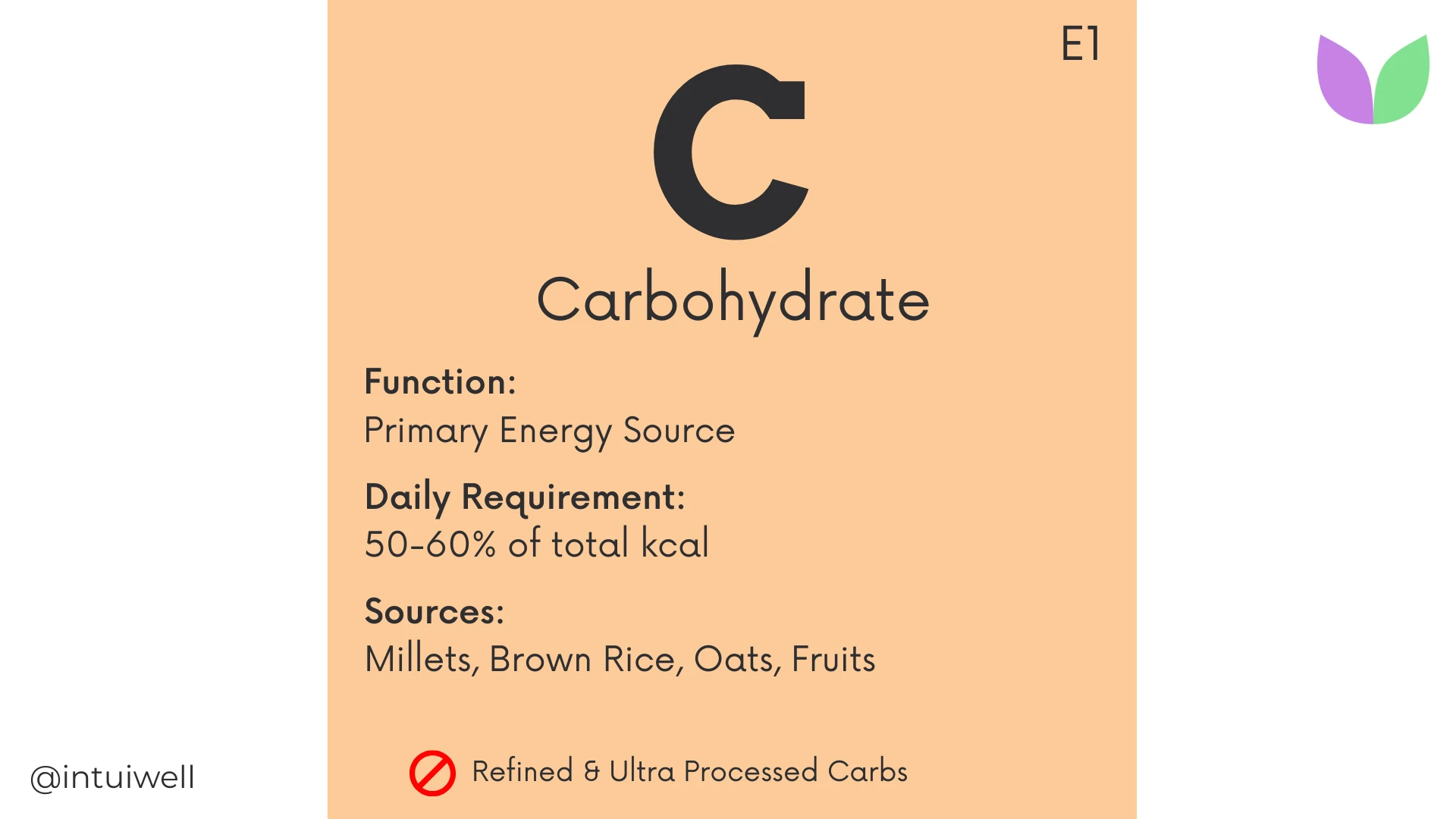
This is the E1 – Carbohydrates tile from the IntuiWell Nutrient Periodic Table™.
Next, you can explore:
- E2 – Protein – your repair and growth system
- E3 – Healthy Fats – your hormone and brain support system
- E4 – Fibre – your gut and blood sugar stabiliser
Together, these tiles give you a simple, science-backed way to design your plate without confusion.
Summary
Carbohydrates aren’t the villain—bad carb choices are. Your body runs on carbs: your brain, muscles, mood, sleep, and gut all depend on them. The real game is quality, quantity, timing, and pairing. Adults generally function best with 45–65% of calories from carbs, focusing on whole grains, pulses, fruits, vegetables, and fibre while cutting down refined cereals, sugars, and ultra-processed foods.
Your body handles carbs better earlier in the day, carbs paired with protein/fat stabilize glucose, and fibre-rich carbs improve gut health and hunger control. Tools like carb-to-fibre ratio, plate balance rules, and food order can dramatically improve metabolic markers without extreme diets.
Most carb myths fall apart when you fix portions, timing, and processing level. Carbs don’t cause diabetes—years of refined carbs and inactivity do.
Use structured steps: audit your plate, upgrade meals, test your carb tolerance, and rely on vegetables + protein as the anchor of every meal. This is the E1 tile of the IntuiWell Nutrient Periodic Table™, forming the foundation for balanced eating.
FAQs
- Do carbs make you gain weight?
Only if you overeat calories or rely heavily on processed carbs. One roti isn’t your problem—biscuits, sugar, and inactivity are. - Are fruits bad for blood sugar?
Whole fruits? No. Fruit juices and sugary drinks? Absolutely. Stop blaming mangoes for what your soft drinks are doing. - How many carbs should I eat per day?
Most people land between 100–250 g/day depending on size, activity, and goals. Below 100 g/day without supervision is unnecessary for most. - Are millets always better than rice or wheat?
Not automatically. Large portions of millet without protein or fibre will spike glucose just like any carb-heavy meal. - Do I need a low-carb diet for diabetes or PCOS?
Not necessarily. You need high-fibre, moderate-carb, protein-rich meals and earlier carb timing. Personal response varies—test, don’t guess. - What is the quickest way to improve carb tolerance?
Eat fibre → protein → carbs. This simple order reduces glucose spikes more than most fancy diets.
Want a personalised plan instead of guessing?
Book a consultation or request a call back with the IntuiWell nutrition team.
Author
Written by: Shivani Jain, Co-founder & Clinical Lead Nutritionist, IntuiWell
- Certified nutritionist based in India (Master’s in Foods & Nutrition)
- Combines scientific diet planning, superfoods, ancient wisdom, and simple kitchen remedies
- Works with clients to attack the root cause of issues like fatigue, weight gain, gut problems, and hormonal imbalances
Key References
- ICMR–NIN Dietary Guidelines for Indians (2024)
National Institute of Nutrition – updated 17-point guidelines for Indian diets, diversity, and carb quality.
Dietary Guidelines for Indians – 2024 (PDF) - ICMR–NIN Recommended Dietary Allowances (RDA) for Indians
Official Indian RDA report covering macro and micronutrient needs for different age and physiological groups.
Recommended Dietary Allowances for Indians (PDF) - Institute of Medicine – Dietary Reference Intakes for Energy, Carbohydrate, and Fiber
Core reference for global carb ranges, minimum carbohydrate needs, and fibre targets.
Dietary Reference Intakes for Energy, Carbohydrate, Fiber, Fat, Fatty Acids, Cholesterol, Protein, and Amino Acids - WHO Guideline: Sugars Intake For Adults and Children
Evidence-based limits for free sugar intake (<10% energy; <5% for additional benefits).
Guideline: Sugars Intake for Adults and Children - WHO Guideline: Carbohydrate Intake for Adults and Children
Focus on carbohydrate “quality”: fibre, digestibility, sugars, and preferred carb sources.
Carbohydrate Intake for Adults and Children - Reynolds et al., 2019 – Carbohydrate Quality and Human Health
Landmark meta-analysis linking fibre and whole-carb quality with reduced mortality, diabetes, and CVD risk.
Carbohydrate Quality and Human Health – The Lancet - Chellappa et al., 2021 – Daytime Eating and Glucose Tolerance
Controlled study showing night eating worsens glucose tolerance; daytime eating prevents circadian misalignment.
Daytime Eating Prevents Internal Circadian Misalignment and Glucose Intolerance in Night Work – Science Advances - Qian & Scheer, 2016 – Circadian System and Glucose Metabolism
Review on how circadian rhythms influence glucose handling and why timing of carbs matters.
Circadian System and Glucose Metabolism – Review - ICMR–MDRF / Nature Medicine – Indian Carb Intake and NCD Risk (Popular Summary)
Large Indian dataset showing ~62% calories from carbs, mostly low-quality sources, and links to NCDs.
Indians Eating Wrong: 62% of Calories from Carbs – Times of India Summary