
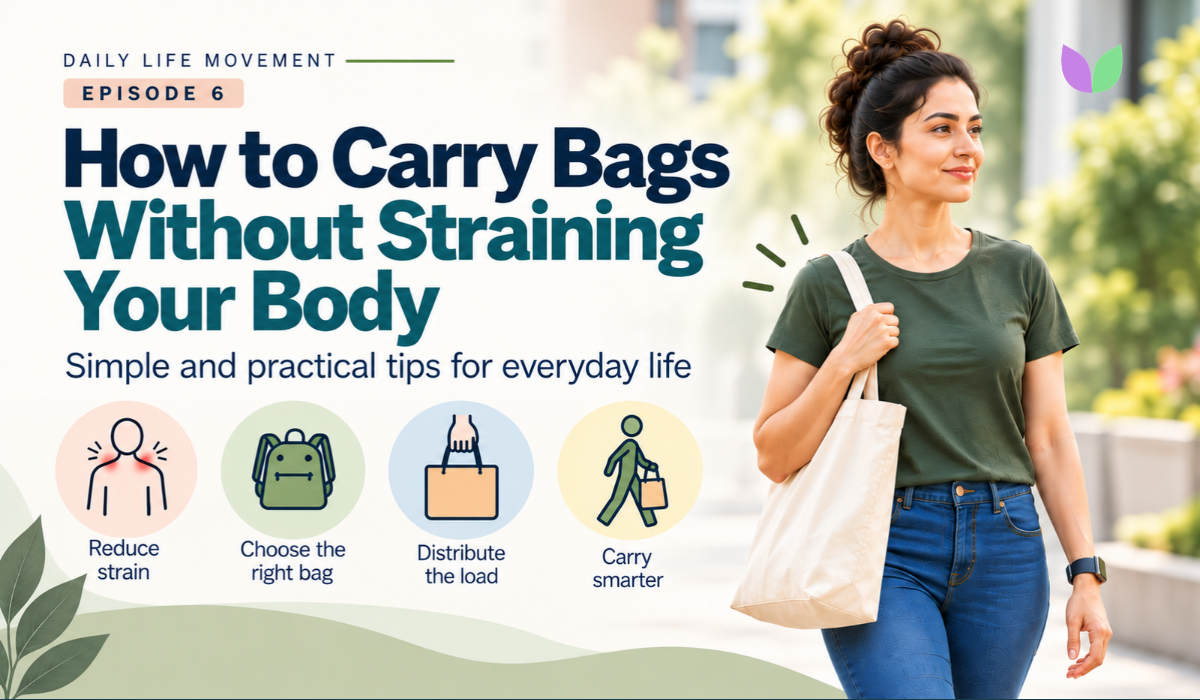
Episode 6: How to Carry Bags Without Overloading One Side
Think about how many bags you carry during an ordinary week.
A handbag.
A laptop bag.
Grocery bags.
A lunch bag.
A gym bag.
Shopping bags.
A suitcase.
Sometimes several at once.
Most of us simply grab the handles and start walking.
But carrying is actually a physical task.
Your hands need to grip the bag. Your arms and shoulders support or stabilize it. Your trunk responds to the load. Your hips and legs keep you moving while your balance system continually adjusts.
And when the load sits predominantly on one side, your body has to manage that asymmetry while you walk.
This doesn’t mean carrying something on one side is automatically harmful.
It means that how heavy the bag is, how far you carry it, how you hold it, and how well your body tolerates the task all matter.
Quick Answer
Carrying groceries, handbags, laptop bags, backpacks, and luggage is a normal part of daily life, but carrying becomes more demanding when loads are heavy, awkward, held far from the body, or carried for long periods.
Carrying something on one side is not automatically harmful. The body can adapt to asymmetrical loads. However, if a bag repeatedly causes fatigue or discomfort, changing the load, carrying position, distance, bag type, or frequency can make the task easier.
Keep heavier loads reasonably close when practical, divide very heavy bags into manageable loads, change carrying strategies when you become fatigued, and use backpacks, carts, or wheeled luggage when appropriate. Sometimes making two trips is more sensible than carrying everything at once.
Strength exercises such as farmer carries, appropriately loaded suitcase carries, rows, sit-to-stands, and grip training can also help develop the capacity needed for everyday carrying.
Important Note
This article is for general movement education. It is not a diagnosis or a replacement for medical advice.
If carrying bags causes severe or persistent back, neck, shoulder, arm, wrist, or joint pain; numbness or tingling; significant weakness; loss of grip; or symptoms following an injury, consult a qualified doctor or physiotherapist for appropriate assessment.
About This Series
Daily Life Movement focuses on improving how you move during everyday activities, not just during workouts.
Many of the physical demands placed on our bodies do not happen in the gym. They happen while getting out of a car, climbing stairs, standing at work, bending toward the floor, carrying groceries, moving around the house, and completing hundreds of other ordinary tasks.
These activities require different combinations of:
- Strength
- Balance
- Mobility
- Coordination
- Grip
- Load tolerance
- Movement control
The purpose of this series is not to create a single “perfect” way to move.
It is to help you understand how small changes in load, position, support, environment, and movement strategy can make everyday activities easier to manage.
Today’s movement is something almost everyone does: Carrying bags.
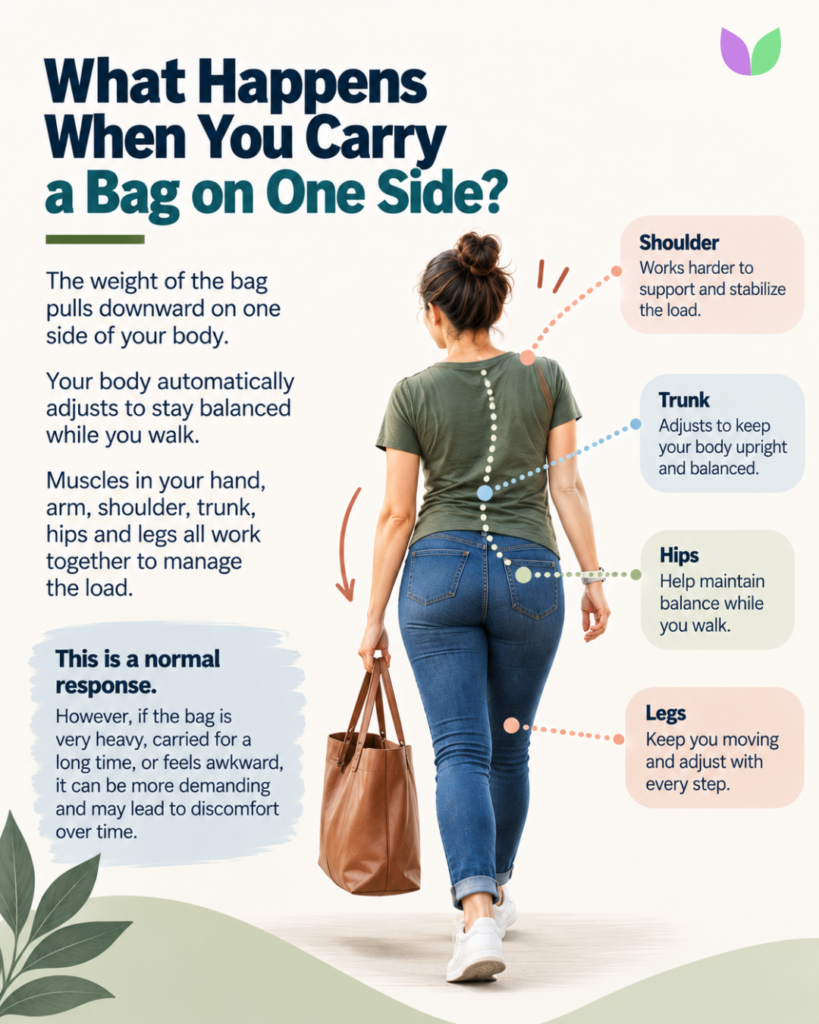
What Happens When You Carry a Bag on One Side?
Imagine holding a grocery bag in your right hand.
The weight is pulling downward on your right side.
Your body has to prevent that load from pulling you off balance.
Muscles around your:
- Hand and forearm
- Shoulder
- Trunk
- Hips
- Legs
all contribute to maintaining your position while you walk.
This is normal.
In fact, the human body is capable of managing asymmetrical loads.
The problem is more likely to arise when the demand becomes greater than your current capacity—for example, when the bag is very heavy, the carry is prolonged, the load is awkward, or you repeatedly use the same strategy despite discomfort.
So the goal is not:
“Never carry anything on one side.”
A more useful goal is:
“Make the load manageable and give your body options.”
Why Some Bags Feel Much Heavier Than Others
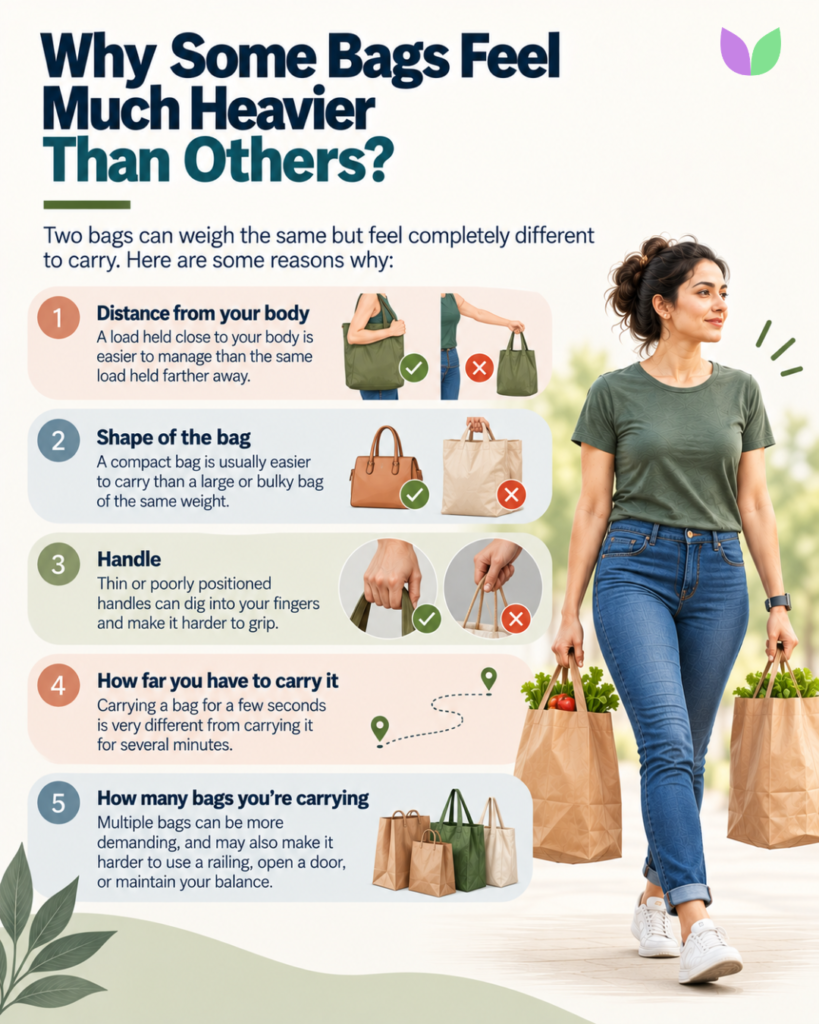
Two bags can weigh exactly the same but feel completely different to carry.
Why?
Because weight is only one part of the task.
1. Distance From Your Body
A load held close to your body is generally easier to manage than the same load held farther away.
This is why carrying a bag with your arm stretched away from you can feel much harder.
Manual-handling guidance from the UK Health and Safety Executive recommends keeping loads close to the body where practical.
2. The Shape of the Bag
A compact bag with comfortable handles may be easier to control than a large, awkward bag of the same weight.
Bulky bags may also change how you walk if they bump against your leg or prevent your arm from moving comfortably.
3. The Handle
Thin handles can dig into your fingers.
Poorly positioned handles can make gripping difficult.
A bag that constantly slips may require repeated grip adjustments.
The problem may therefore be partly how the load is packaged, not simply how strong you are.
4. How Far You Have to Carry It
Carrying something for 20 seconds from the car to the kitchen is very different from carrying the same object for 20 minutes.
Your muscles fatigue over time.
Distance matters.
5. How Many Bags You’re Carrying
Three light shopping bags can become one demanding carrying task.
When your hands are full, you may also have less ability to:
- Use a railing
- Open a door
- Recover your balance
- See around a bulky load
- React to an obstacle
Sometimes making two trips is the smarter movement strategy.
How to Carry Bags More Comfortably
There isn’t one universal carrying technique for every bag.
A handbag, backpack, grocery bag, suitcase, and laptop bag all create different demands.
But a few principles can make many carrying tasks easier.
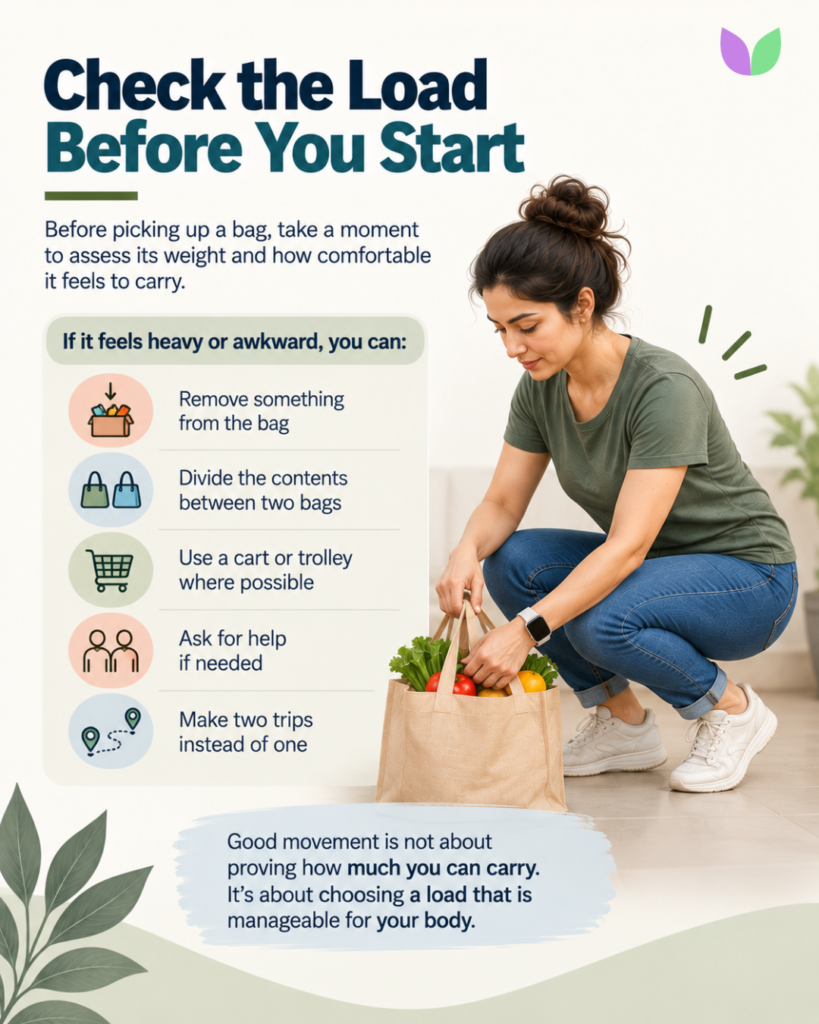
Step 1: Check the Load Before You Start
Before picking something up, get a sense of its weight.
Ask yourself:
Can I comfortably control this?
If the answer is uncertain, you have options.
You can:
- Remove something from the bag
- Divide the contents between two bags
- Make two trips
- Use a cart or trolley
- Ask for help
Good movement is not about proving how much you can carry.
It is about choosing an appropriate strategy for the task.
Step 2: Keep Heavier Loads Relatively Close
When practical, avoid carrying a heavy object unnecessarily far from your body.
A bag hanging naturally beside you will usually be easier to manage than one you are holding outward with your arm extended.
For some loads, holding them securely in front of the body with both hands may be more comfortable.
HSE manual-handling guidance recommends keeping loads close to the body and maintaining a secure hold when possible.
Step 3: Divide the Load When It Helps
Suppose you have one very heavy grocery bag.
Instead of placing everything into that single bag, consider dividing the groceries into two manageable bags.
This can:
- Reduce the load in each hand
- Make gripping easier
- Improve control
- Prevent one bag from becoming unnecessarily heavy
But don’t become obsessed with making both bags weigh exactly the same.
The goal is simply to make the task manageable.
Step 4: Change Sides When Appropriate
If you are carrying a shoulder bag or handbag for a long period, changing sides occasionally can vary which tissues are doing most of the work.
You don’t need to switch sides every few minutes according to a strict schedule.
Use comfort as your guide.
If one shoulder, hand, or side of your trunk is becoming tired, that is useful information.
Change the carrying strategy.
Step 5: Walk Normally
Try not to dramatically lean away from the bag or stiffen your entire body.
Some natural adjustment is expected when carrying an uneven load.
But if the bag is so heavy that you have to significantly change how you walk, repeatedly hike one shoulder, or struggle to maintain balance, the load may simply be too demanding.
Change the load rather than trying to force a “better posture.”
Step 6: Put the Bag Down When You Need a Break
You don’t get extra fitness points for refusing to rest.
If your grip is failing or your shoulder, arm, or back is becoming tired, put the bag down somewhere safe.
Reset your grip.
Rest.
Then continue if comfortable.
For longer carrying tasks, short breaks can be more useful than forcing yourself to finish the entire distance without stopping.
Different Bags Need Different Strategies
Grocery Bags
Avoid packing one bag until it becomes unnecessarily heavy.
Distribute items into manageable loads.
If you have a long distance to walk, consider a shopping cart or trolley.
For a short trip from the car, making two trips may be easier than trying to carry every grocery bag at once.
Handbags
Handbags are often carried on the same side out of habit.
If the bag is light and comfortable, this may not be a problem.
If it becomes heavy, consider:
- Removing items you don’t regularly use
- Changing shoulders periodically
- Using a longer strap when appropriate
- Choosing a backpack for days when you need to carry more
The solution may be reducing what is inside the bag, not constantly correcting your posture.
Laptop Bags
Laptops, chargers, notebooks, water bottles, and other work items can quickly make a shoulder bag heavy.
If you regularly carry a substantial work load over longer distances, a well-fitting backpack or rolling bag may be more practical than loading everything onto one shoulder.
Backpacks
A backpack allows the load to be supported across the back rather than suspended from one hand.
For heavier everyday loads, using both shoulder straps can generally distribute the load more evenly than hanging the entire backpack from one shoulder.
Adjust the straps so the bag feels secure rather than swinging excessively as you walk.
Suitcases
If the suitcase has wheels, use them.
Rolling a heavy suitcase is usually more practical than carrying it unnecessarily.
When lifting luggage into a car or onto another surface, move close to the bag first rather than reaching from a distance.
If the suitcase is too heavy to comfortably control, ask for help.
Common Mistakes While Carrying Bags
Mistake 1: Trying to Carry Everything in One Trip
This is probably one of the most common carrying mistakes.
Six bags in one trip may feel efficient.
But if your fingers are struggling, you cannot see your feet, and you cannot use the railing, the task has become unnecessarily difficult.
Sometimes:
Two easy trips are better than one difficult trip.
Mistake 2: Holding a Heavy Bag Away From Your Body
The farther a heavy load is held from your body, the more demanding it can become.
When possible, keep heavier objects reasonably close.
Mistake 3: Carrying a Heavy Bag on the Same Shoulder for a Long Time
Carrying on one side isn’t automatically harmful.
But if that shoulder or side becomes tired or uncomfortable, continuing to use exactly the same position may unnecessarily increase the demand.
Change sides, change the bag, reduce the contents, or take a break.
Mistake 4: Ignoring Grip Fatigue
Your hands are part of the carrying system.
If your fingers are slipping or your forearms are exhausted, the load is becoming harder to control.
Don’t wait until the bag falls.
Put it down and reset.
Mistake 5: Twisting While Picking Up a Heavy Bag
When lifting a heavier bag from the floor, try to position yourself close enough that you don’t need to combine a large reach with a sudden twist.
If you need to turn, moving your feet can help you reposition the whole body.
Mistake 6: Assuming “Good Posture” Makes Any Load Safe
There is no posture that magically makes an excessively heavy load appropriate.
Load weight, size, distance, frequency, environment, fatigue and individual capacity all matter.
Sometimes the best technique is simply:
Make the load lighter.
If You Already Have Shoulder or Back Discomfort
You don’t necessarily need to stop carrying everything.
Start by reducing the demand.
Try:
- Carrying less at once
- Making additional trips
- Using a backpack instead of a heavy one-shoulder bag
- Using a trolley or wheeled suitcase
- Keeping heavier loads closer
- Taking breaks
- Changing sides when comfortable
- Avoiding unnecessary long-distance carrying during a painful flare
Pay attention to how your symptoms respond.
If a particular bag repeatedly causes discomfort, examine the bag itself.
Is it too heavy?
Are the handles uncomfortable?
Are you carrying unnecessary items?
Would another bag style make the task easier?
Changing the environment can sometimes be more useful than trying to change your body.
When to Get Professional Help
Occasional muscular fatigue after carrying something demanding is different from persistent or significant symptoms.
Seek appropriate professional assessment if carrying is associated with:
- Severe or worsening pain
- Persistent shoulder, neck, or back pain
- Numbness or tingling into the arm or hand
- Significant weakness
- Loss of grip strength
- Repeated dropping of objects
- Significant swelling
- Pain following an injury
- Symptoms that interfere with normal daily activities
A doctor or physiotherapist can help determine whether your symptoms require further assessment and what level of activity is appropriate.
Exercises That Can Make Carrying Easier
Carrying itself requires whole-body strength.
You don’t need complicated exercises, but strengthening the muscles involved in gripping, pulling, stabilizing, and walking can improve your capacity over time.
1. Farmer Carry
Hold a manageable weight in each hand.
Stand tall and walk a short distance at a comfortable pace.
Keep the weights under control rather than allowing them to swing.
Start light.
The goal is to practice grip, walking, and load control together.
2. Suitcase Carry
Hold a manageable weight in one hand and walk slowly.
Your trunk has to control the uneven load.
Keep the distance short at first.
Then switch sides.
This exercise demonstrates an important point:
An uneven load is not automatically a bad load.
When appropriately selected, asymmetrical carrying can actually be trained.
3. Rows
Rows strengthen several muscles around the upper back and shoulders that contribute to pulling and carrying tasks.
A resistance band can be used for a simple home version.
4. Sit-to-Stand
Lower-body strength matters during carrying too.
Your legs need to support your body plus whatever you are carrying.
Sit-to-stand is a simple way to train the hips and legs without requiring gym equipment.
5. Grip Practice
Holding light dumbbells or other appropriate exercise weights for short periods can gradually challenge grip endurance.
You don’t need to squeeze as hard as possible.
Use a manageable load and gradually build tolerance.
The Bigger Picture
Carrying bags teaches an important lesson about everyday movement:
The body does not need perfect symmetry every second of the day.
We carry children on one hip.
We hold phones in one hand.
We carry handbags on one shoulder.
We pick up grocery bags with one arm.
Our bodies are designed to adapt to different positions and loads.
The goal is therefore not to eliminate every uneven movement.
The goal is to develop enough strength, variety, awareness, and capacity that ordinary asymmetrical tasks remain manageable.
And when a load exceeds that capacity, change the task.
Make it lighter.
Move it closer.
Use another bag.
Use wheels.
Take another trip.
Ask for help.
That is intelligent movement.
Key Takeaway
Carrying a bag on one side is not automatically harmful.
What matters is the entire task:
How heavy is it?
How awkward is it?
How far are you carrying it?
How tired are you?
Can you comfortably control it?
Keep heavier loads manageable and reasonably close when practical. Divide loads when helpful. Change sides or carrying strategies when fatigue develops. Use backpacks, carts, or wheels when they make the task easier.
And remember:
The best carrying technique is not the one that looks perfect. It is the one that lets you control a manageable load without unnecessarily fighting your body.
Frequently Asked Questions
1. Is carrying a handbag on one shoulder bad for you?
Not automatically. If the bag is manageable and you are comfortable, carrying it on one shoulder does not necessarily mean you are harming your body. If it repeatedly causes fatigue or discomfort, reduce the load, change sides, take breaks, or consider another bag style.
2. Should grocery bags weigh exactly the same in both hands?
No. Perfect symmetry isn’t necessary. Dividing a heavy load between manageable bags can make carrying easier, but you don’t need to weigh each bag or make them identical.
3. Is a backpack better than a shoulder bag?
It can be useful when carrying heavier loads or walking longer distances because the load can be distributed across both shoulders. Comfort, fit, load, and individual preference still matter.
4. Should I switch sides when carrying a handbag?
You can. Switching sides occasionally provides movement variety and may help if one side becomes tired. There is no mandatory schedule for changing sides.
5. Why does my back hurt when I carry groceries?
There can be many reasons. Load weight, carrying distance, fatigue, grip, how far the bags are held from the body, existing back symptoms, and overall physical capacity can all contribute. Persistent or significant pain should be assessed.
6. Is it better to carry one heavy bag or two lighter bags?
If one bag has become difficult to control, dividing the contents into smaller, manageable loads can reduce the demand of each individual carry.
7. Should I use a trolley for groceries?
If you are carrying heavy groceries over a longer distance, a trolley or cart can be an excellent way to reduce unnecessary manual carrying.
8. What exercises help me carry bags more easily?
Exercises that build grip, upper-body, trunk, hip, and leg strength can help. Farmer carries, appropriately loaded suitcase carries, rows, and sit-to-stands are examples.
Related Posts in This Series
Daily Life Movement Series
Episode 1: Getting Up from the Floor Safely: A Simple Skill That Shows Real Fitness
Episode 2: How to Get In and Out of a Car Without Back or Knee Pain
Episode 3: How to Use Stairs Without Knee Pain
Episode 4: How to Stand for Long Hours Without Back Pain
Episode 5: How to Bend and Pick Things Up Without Back Pain
How This Article Was Created
This article was created by IntuiWell as part of the Daily Life Movement Series.
The goal of this series is to simplify everyday movement education so people can better understand how ordinary activities interact with strength, balance, mobility, load tolerance, and physical capacity.
This post is based on:
- General principles of functional movement and load management
- Practical manual-handling principles
- Considerations such as load weight, carrying distance, asymmetrical loading, grip, and load position
- Publicly available guidance from occupational health and safety organizations
The content is educational. It does not diagnose musculoskeletal conditions or replace individualized medical or physiotherapy care.
It needs to be manageable, adaptable, and appropriate for the task in front of you.
At IntuiWell, we help people understand how everyday movement, strength, nutrition, and lifestyle work together to support long-term health and independence.
Move smarter. Build capacity. Make everyday life easier.


