Episode 5: How to Bend and Pick Things Up Without Back Pain – A Practical Guide for Safer Everyday Movement
Important Note
This article is for general movement education. It is not a diagnosis or a replacement for medical advice.
If you have severe or persistent back pain, pain that radiates into your legs, numbness, tingling, weakness, loss of bladder or bowel control, pain after a fall or injury, or pain that continues to worsen despite self-care, consult a qualified doctor or physiotherapist before trying new exercises or movement strategies.
About This Series
Daily Life Movement focuses on improving how you move during everyday activities, not just during workouts.
Most aches and pains do not develop because of one dramatic movement. They often build gradually from small daily habits repeated over weeks, months, and years. Standing, sitting, climbing stairs, walking, lifting groceries, bending down, or getting in and out of a car may seem ordinary, but these everyday movements reveal a lot about your strength, balance, mobility, and overall movement quality.
If you missed the earlier articles, start with Episode 1: Getting Up from the Floor Safely, where we explored why getting up from the floor is a simple yet powerful indicator of real-life fitness.
Then read Episode 2: How to Get In and Out of a Car Without Back or Knee Pain, where we explained how twisting under load and poor movement control can affect your back, hips, and knees.
Then explore Episode 3: How to Use Stairs Without Knee Pain, where we looked at how strength, control, and foot placement can influence one of life’s most common movements.
In Episode 4: How to Stand for Long Hours Without Back Pain, we explored how prolonged standing can contribute to fatigue and discomfort when the body remains in one position for too long.
Today’s movement is bending and picking things up.
You bend dozens of times throughout the day without giving it much thought.
To pick up laundry.
To lift grocery bags.
To reach for something that has fallen on the floor.
To clean.
To pick up a child.
To move household items.
Because bending is so common, it is also often blamed when back pain suddenly appears.
Many people say:
“I just bent down and suddenly my back started hurting.”
The goal is not to fear bending or avoid using your back.
The goal is to understand how to move and handle everyday loads with greater control and confidence.
How to Bend and Pick Things Up Without Back Pain
Bending is a normal human movement.
Your spine is designed to move. Your hips are designed to move. Your knees, ankles, trunk, and muscles all work together whenever you reach toward the floor and return to standing.
But when bending is combined with a heavy or unfamiliar load, sudden movement, fatigue, awkward reaching, or poor control, the task can become more demanding.
That is when discomfort may appear.
This does not mean there is one perfect way to bend or that rounding your back is automatically harmful.
Different tasks require different movement strategies.
However, for many everyday lifting movements, a few simple adjustments can help you distribute the effort more comfortably across your hips, legs, trunk, and back.
The goal is not to eliminate your back from the movement.
Your back is supposed to participate.
The goal is to avoid asking one area of your body to do more work than necessary.
Why Bending and Lifting Can Trigger Back Pain
Bending itself is not inherently dangerous.
The difficulty often comes from the combination of bending with other demands.
For example:
- Lifting a heavy or unfamiliar object
- Reaching too far away from your body
- Picking something up quickly
- Twisting while handling a load
- Repeating the same movement when tired
- Trying to control a load that is awkward or difficult to manage
Imagine picking up a light towel from the floor.
Now imagine picking up a heavy box positioned far away from your body.
Both involve bending.
But the physical demands are very different.
The heavier the load and the farther it is from your body, the more work your muscles must do to control the movement.
Your hips, legs, trunk, and back are designed to share this work.
Problems may arise when movement becomes rushed, awkward, uncontrolled, or exceeds your current strength and tolerance.
That is why learning to move with awareness can be useful.
Not because bending is dangerous.
But because how you manage the task matters.
How to Bend and Pick Things Up More Comfortably
For many everyday tasks, the following steps can help you move with better control.
You do not need to follow them rigidly.
Think of them as practical movement principles rather than a perfect formula.
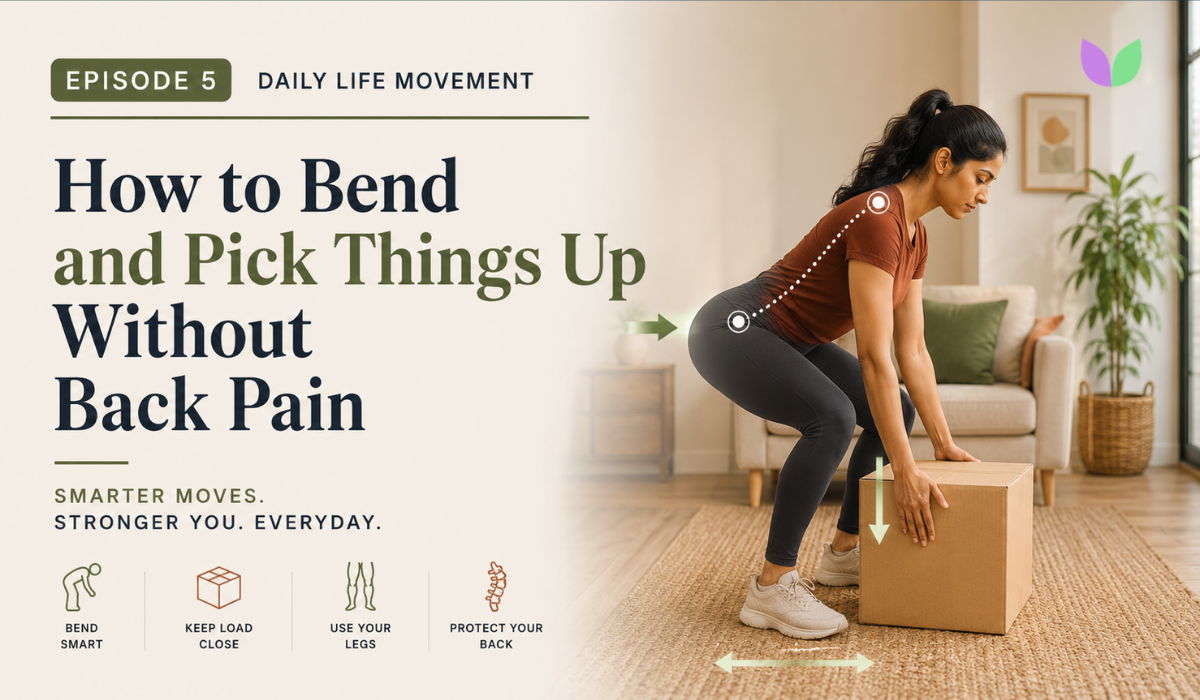
Step 1: Move Your Hips Back as You Reach Down
One useful movement pattern is the hip hinge.
As you reach toward an object, allow your hips to move backward.
Your knees can bend naturally as needed.
This allows your hips and legs to contribute to the movement.
Think:
“Move my hips back as I reach down.”
You do not need to force your back into a perfectly straight position.
Some spinal movement is normal.
The goal is simply to avoid collapsing suddenly into the movement when you are handling something heavy or difficult.
Move in a way that feels controlled.
Step 2: Get Close to the Object
Before lifting something, move your body closer whenever possible.
Avoid reaching far away and trying to pull the object toward you at the same time.
Instead:
- Step closer
- Position yourself comfortably
- Get a secure grip
- Bring the object reasonably close before standing
The farther an object is held from your body, the greater the demand on the muscles supporting your trunk.
This is especially important when the object is heavy.
A simple rule:
If possible, move closer before you lift.
Step 3: Let Your Legs and Hips Help You Stand
As you return to standing:
- Push through your feet
- Allow your legs to help generate force
- Use your hips to contribute to the movement
- Keep the movement smooth and controlled
Your back does not need to remain completely inactive.
Your trunk and back muscles naturally help support and control the movement.
But when your hips and legs contribute as well, the work can be shared more effectively.
Think of lifting as a whole-body movement, not a back-only movement.
Step 4: Avoid Sudden Twisting While Handling a Load
Twisting is also a normal human movement.
You do not need to avoid rotating your spine in daily life.
However, when you are holding a heavy or awkward object, sudden twisting can make the movement harder to control.
If you need to change direction:
- Move your feet
- Turn your whole body
- Keep the movement controlled
Avoid rushing through the turn while carrying the load.
This is particularly useful when lifting grocery bags, moving boxes, carrying laundry baskets, or handling heavier household items.
Quick Real-Life Version
If you remember only four things, remember this:
Move close.
Use your hips and legs.
Keep the load close when practical.
Move with control.
You do not need to overthink every time you bend.
These are simply useful principles for making everyday lifting and bending feel more manageable.
Common Mistakes
1. Holding an Object Too Far Away
The farther a load is from your body, the harder your trunk muscles must work to control it.
Whenever possible, move closer before lifting.
2. Twisting Suddenly While Carrying a Load
Twisting is normal, but rapid twisting while handling a heavy or awkward object can reduce control.
Move your feet and turn your whole body when needed.
3. Moving Too Quickly
Rushing can make it harder to control your body and the object you are lifting.
Slow down when the task requires more effort.
4. Trying to Keep Your Entire Body Completely Rigid
Some people become so concerned about “protecting” their back that they try to keep their spine completely stiff.
That can create unnecessary tension.
Your body is designed to move.
The aim is controlled movement, not rigid movement.
If You Already Have Back Pain
If bending or lifting is currently uncomfortable, you do not necessarily need to stop all movement.
Instead, consider modifying the task.
You can:
- Move at a slower pace
- Reduce the load when possible
- Break a large load into smaller parts
- Keep objects closer to your body
- Avoid sudden or jerky movements
- Ask for help with heavy or awkward objects
- Use a support or elevated surface when appropriate
Avoid forcing through severe or worsening pain.
The goal is to stay active within a comfortable range while respecting your current symptoms.
When to Get Professional Help
Back pain is not always simply a movement issue.
Seek professional medical assessment if you experience:
- Severe or worsening pain
- Pain following a significant fall or injury
- Pain that travels into one or both legs
- Numbness or tingling
- Muscle weakness
- Difficulty walking or standing
- Loss of bladder or bowel control, which requires urgent medical attention
- Persistent pain that does not improve or continues to worsen
A qualified doctor or physiotherapist can assess whether your symptoms may require further evaluation or a more individualized rehabilitation plan.
Everyday Situations This Applies To
The principles in this article can be useful when:
- Picking up laundry
- Lifting grocery bags
- Reaching for something on the floor
- Picking up toys
- Cleaning
- Gardening
- Moving household items
- Repeatedly bending during work
- Lifting and carrying small objects
This is not just a gym movement.
It is a daily life movement.
Exercises That Can Make Bending and Lifting Easier
You do not need complicated workouts to improve your ability to bend and lift.
Building strength and confidence in basic movement patterns can help everyday tasks feel more manageable.
Always begin at a level appropriate for your current fitness and comfort.
Focus on control rather than speed.
Stop if you experience sharp or worsening pain.
1. Hip Hinge Practice
The purpose of this exercise is to become familiar with moving from your hips.
Stand comfortably with your feet about hip-width apart.
Gently move your hips backward while allowing your torso to lean forward.
Allow your knees to soften naturally.
Then return to standing.
You can practice this movement without any weight.
The goal is not to create a perfectly straight back.
The goal is to learn how your hips, legs, trunk, and back can work together.
2. Sit-to-Stand
Sit-to-stand is one of the most practical functional exercises.
Sit on a sturdy chair with your feet comfortably placed on the floor.
Lean slightly forward.
Push through your feet and stand up with control.
Then slowly sit back down.
This exercise helps build strength in the hips and thighs and improves confidence in moving between lower and higher positions.
It is directly relevant to many everyday movements, including bending, lifting, and getting up from a lower position.
3. Glute Bridges
Lie on your back with your knees bent and feet flat on the floor.
Gently lift your hips.
Pause briefly.
Lower yourself with control.
Focus on using your hip muscles rather than forcing your lower back into an exaggerated arch.
Glute bridges can help strengthen the muscles around the hips, which contribute to many everyday movements.
4. Supported Squat or Chair Reach
Stand in front of a sturdy chair or hold a stable support if needed.
Lower yourself slightly by allowing your hips and knees to bend.
Then return to standing.
This helps build confidence in using your hips and legs together.
Start with a comfortable range.
There is no need to force yourself into a deep squat.
The Bigger Picture
Episode 5 brings together many of the ideas from the entire Daily Life Movement Series.
In Episode 1, getting up from the floor showed us how strength, mobility, balance, and confidence work together.
In Episode 2, getting in and out of a car highlighted how control and coordination matter during everyday movements.
In Episode 3, stairs showed us how repeated movements can challenge strength, balance, and load management.
In Episode 4, standing reminded us that the body is not designed to stay completely still for long periods.
Now, bending and lifting add another important lesson:
Your body is designed to move.
You do not need to fear your spine.
You do not need to search for one perfect posture.
And you do not need to avoid bending.
Instead, everyday movement becomes easier when you gradually build strength, develop confidence, and learn how to adapt to the task in front of you.
A light object on the floor may require very little thought.
A heavy box may require more planning.
A repetitive task may require more breaks.
A painful movement may need modification.
Real-life movement is not about following one rigid technique.
It is about understanding the demands of the task and responding appropriately.
Key Takeaway
Bending is a normal part of life.
Your back is designed to move and participate in everyday activities.
When you are handling a load:
Move close.
Let your hips and legs help.
Keep the object close when practical.
Avoid sudden, uncontrolled movement.
Turn your whole body when changing direction under load.
You do not need a perfect way to bend.
You need a movement strategy that helps you handle the task with confidence and control.
Real fitness is not only about what you do during exercise.
It is reflected in how comfortably and confidently you move through everyday life.
Blog Summary
Bending is a normal movement and does not automatically cause back pain. However, discomfort can occur when bending is combined with heavy or unfamiliar loads, awkward reaching, sudden movement, fatigue, or uncontrolled twisting.
When picking something up, it can help to move closer to the object, allow your hips and legs to contribute, keep the load reasonably close to your body, and move with control. The goal is not to keep your back completely rigid or eliminate spinal movement. Your hips, legs, trunk, and back are designed to work together.
Exercises such as hip hinge practice, sit-to-stand, glute bridges, and supported squats can help build strength and confidence for everyday bending and lifting.
However, severe, persistent, or worsening back pain, pain after an injury, pain radiating into the legs, numbness, weakness, or changes in bladder or bowel control should be assessed by a qualified healthcare professional.
Frequently Asked Questions (FAQs)
1. Is bending bad for your back?
No. Bending is a normal movement. The spine is designed to move. However, bending may become more demanding when combined with heavy loads, awkward positions, fatigue, sudden movement, or poor control.
2. Should I keep my back completely straight when lifting?
Not necessarily. You do not need to force your spine into one perfectly straight position. Some spinal movement is normal. For heavier or more demanding lifts, controlled movement, appropriate load management, and allowing the hips and legs to contribute can be helpful.
3. What is the best way to pick something up from the floor?
Move close to the object, get a secure grip, allow your hips and knees to contribute, keep the load reasonably close when practical, and stand up with control.
4. Should I squat or hip hinge when picking something up?
It depends on the task, the object, your mobility, and what feels comfortable for you. A hip hinge can be useful for many tasks, while a deeper knee bend or squat may be more appropriate for others. There is no single technique that works perfectly for every situation.
5. Is twisting while lifting dangerous?
Twisting is a normal movement. However, sudden or uncontrolled twisting while handling a heavy or awkward load can make the movement harder to control. When possible, move your feet and turn your whole body.
6. Why does my back hurt when I bend down?
Back pain can have many possible causes. The pain may be related to the demands of the movement, an existing back condition, muscle sensitivity, fatigue, or other factors. If the pain is persistent, severe, or worsening, professional assessment is appropriate.
7. What exercises can help with bending and lifting?
Hip hinge practice, sit-to-stand, glute bridges, and supported squats can help build strength, movement confidence, and control. Start gradually and choose exercises appropriate for your current ability.
8. When should I see a doctor or physiotherapist for back pain?
Seek professional help if pain is severe or worsening, follows an injury, radiates into your legs, is associated with numbness or weakness, affects your ability to walk, or is accompanied by changes in bladder or bowel control.
Related Posts in This Series
- Episode 1: Getting Up from the Floor Safely – A Simple Skill That Shows Real Fitness
- Episode 2: How to Get In and Out of a Car Without Back or Knee Pain
- Episode 3: How to Use Stairs Without Knee Pain
- Episode 4: How to Stand for Long Hours Without Back Pain
How This Article Was Created
This article was created by IntuiWell as part of the Daily Life Movement Series.
The goal of this series is to simplify everyday movement education so people can better understand how daily habits influence strength, posture, mobility, balance, joint comfort, and long-term independence.
This article is based on:
- Practical movement education used in physiotherapy and functional rehabilitation.
- Common movement principles relevant to bending, lifting, load handling, and back discomfort.
- General principles of movement variability, load management, strength, and gradual adaptation.
- Publicly available guidance from trusted healthcare organizations.
The content is educational and is not intended to diagnose or replace professional medical care.
References
- NHS Inform – Exercises for Back Pain
- Harvard Health Publishing – Posture and Back Health
- Harvard Health Publishing – Stretching and Strengthening Exercises to Relieve and Prevent Lower Back Pain
- Mayo Clinic – Back Pain: Symptoms and Causes
- Mayo Clinic – Back Pain: Diagnosis and Treatment
- CDC/NIOSH – Ergonomics and Musculoskeletal Disorders
Bending and lifting are not movements to fear.
They are everyday skills that can become easier when you build strength, move with greater awareness, and gradually develop confidence in what your body can do.
At IntuiWell, we focus on everyday habits that help you move, feel, and live better.
Start with a simple conversation.