Sulphur : The Mineral That Helps Build Proteins and Support Essential Cellular Processes
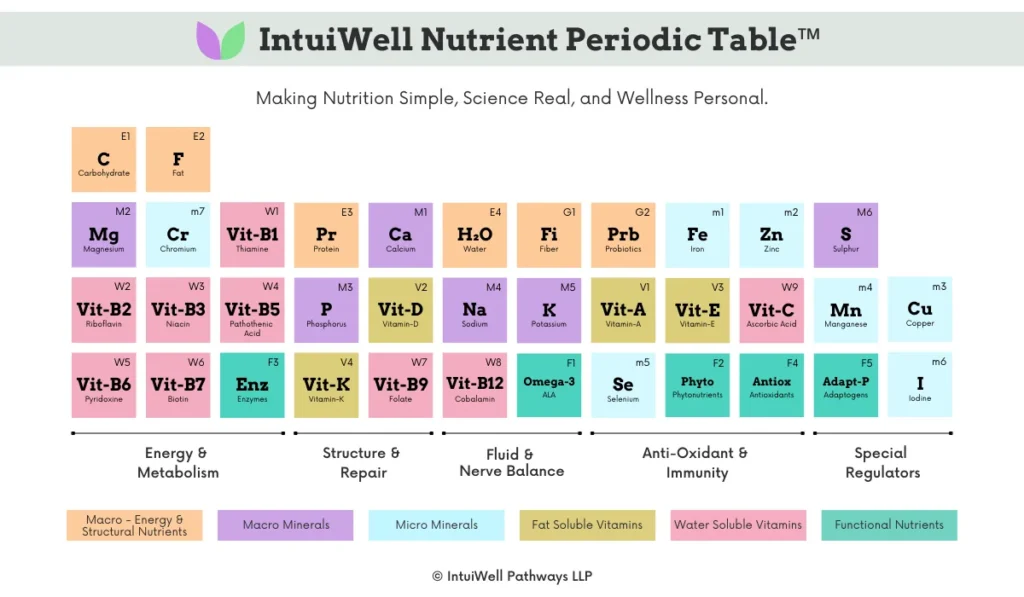
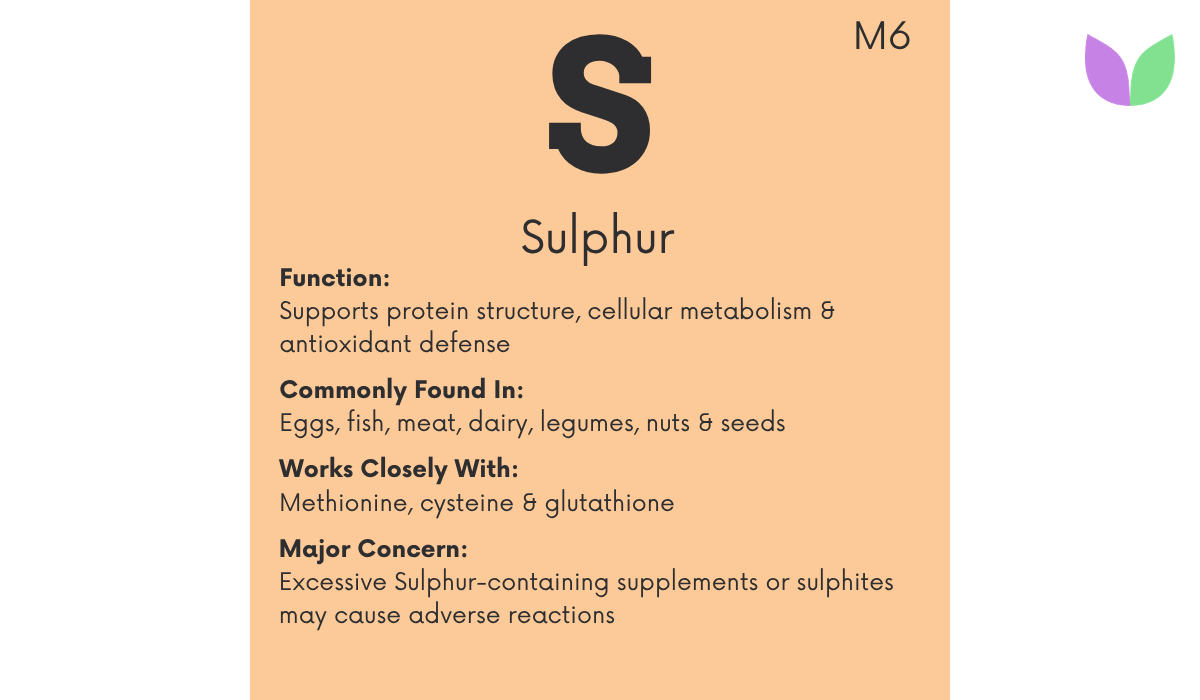
Deep Dive Into M6: Sulphur From The IntuiWell Nutrient Periodic Table™
“Sulphur is woven into the chemistry of life—from the proteins that give our tissues structure to the molecules that help cells function, protect themselves, and carry out essential reactions.”
Quick Takeaways
Sulphur is an essential mineral found throughout the body. Unlike minerals such as calcium or potassium, dietary Sulphur is primarily obtained through Sulphur -containing amino acids, especially methionine and cysteine, rather than as a standalone mineral.
- Sulphur is an essential component of the amino acids methionine and cysteine, which are incorporated into proteins throughout the body.
- Cysteine can form disulfide bonds that help maintain the structure and stability of many proteins.
- Sulphur -containing compounds are involved in important processes including protein synthesis, cellular metabolism, and antioxidant defense.
- Sulphur is part of several biologically important molecules, including glutathione, coenzyme A, taurine, and S-adenosylmethionine (SAM).
- Good dietary sources include eggs, meat, fish, dairy products, legumes, nuts, and seeds, largely because they provide Sulphur -containing amino acids.
- Vegetables such as garlic, onions, broccoli, cauliflower, and other cruciferous vegetables also provide biologically active Sulphur -containing compounds.
- There is no established standalone RDA for Sulphur . Nutritional Sulphur needs are primarily addressed through adequate intake of protein and Sulphur -containing amino acids.
- Sulphur deficiency is uncommon when the diet provides adequate protein and essential amino acids.
- Sulphur should not be confused with sulfites, sulfates, or elemental Sulphur . These are different chemical forms with different properties and biological roles.
Sulphur is not simply a mineral to “take.” It is an essential component of the molecules your body uses to build, maintain, and regulate cells.
1. What Sulphur Is and How Your Body Uses It
Sulphur is an essential mineral nutrient found throughout the body. However, unlike calcium, magnesium, sodium, or potassium, Sulphur is not generally discussed as a standalone dietary mineral.
Most nutritional Sulphur comes from Sulphur -containing amino acids, particularly methionine and cysteine, which are obtained through dietary protein.
Your body uses Sulphur to:
- Build and maintain proteins
- Help maintain the three-dimensional structure of certain proteins
- Produce important Sulphur -containing molecules
- Support cellular metabolism
- Contribute to antioxidant defense through compounds such as glutathione
- Support biochemical reactions involved in normal cellular function
Sulphur is therefore closely connected to protein nutrition. Methionine is an essential amino acid that must be obtained from the diet, while cysteine can be synthesised by the body from methionine when adequate methionine is available.
Sulphur is also incorporated into several biologically important compounds, including glutathione, coenzyme A, taurine, and S-adenosylmethionine (SAM).
Rather than thinking of Sulphur as a mineral that needs to be supplemented independently, it is more accurate to view it as an essential component of the amino acids and molecules that support normal body function.
2. Primary Functions of Sulphur
Sulphur participates in several fundamental processes throughout the body.
Protein Structure
Sulphur -containing amino acids are important building blocks of proteins.
Cysteine residues can form disulfide bonds, which help stabilise the structure of proteins such as keratin and many enzymes and receptors.
These bonds are important for maintaining the shape and function of proteins.
Cellular Metabolism
Sulphur is incorporated into compounds involved in numerous metabolic reactions.
One example is coenzyme A, which participates in the metabolism of carbohydrates, fats, and amino acids.
Antioxidant Defense
Sulphur -containing compounds contribute to the body’s antioxidant systems.
Glutathione, one of the body’s major intracellular antioxidants, contains cysteine and plays an important role in protecting cells from oxidative damage.
Methylation and Biochemical Reactions
Methionine is used to form S-adenosylmethionine (SAM), an important methyl-group donor involved in numerous biochemical reactions.
These reactions contribute to processes including the synthesis and modification of DNA, proteins, neurotransmitters, and other molecules.
Connective Tissue and Structural Proteins
Sulphur -containing bonds contribute to the structure of proteins such as keratin, which is abundant in hair, skin, and nails.
However, Sulphur should not be viewed as a standalone “hair, skin, and nails” nutrient. Adequate overall protein and micronutrient nutrition are important for maintaining these tissues.
Sulphur ‘s importance comes from the many molecules and proteins in which it participates—not from a single isolated function.
3. Sulphur Regulation: How the Body Maintains Balance
The body does not regulate Sulphur as a single circulating mineral in the same way it regulates electrolytes such as sodium or potassium.
Instead, Sulphur is continually incorporated into and released from Sulphur -containing amino acids and other Sulphur compounds as proteins and metabolites are synthesised, broken down, and recycled.
Methionine and cysteine are central to this process.
Methionine can be converted through metabolic pathways into cysteine and other Sulphur -containing compounds. Sulphur -containing metabolites are then used for protein synthesis and other biochemical processes, while excess Sulphur is ultimately metabolised and excreted, primarily through the kidneys.
Sulphur metabolism is closely connected with:
- Protein intake and amino acid metabolism
- Methionine and cysteine metabolism
- Glutathione synthesis
- Methylation pathways
- Liver function
- Kidney function
- Overall metabolic health
The body therefore maintains Sulphur availability largely through amino acid metabolism and protein turnover, rather than through a dedicated Sulphur storage system.
This is one reason why a healthy diet containing adequate protein generally provides sufficient Sulphur for normal physiological needs.
There is also no established clinical concept of routinely monitoring a person’s “Sulphur level” in the way serum sodium, potassium, or calcium may be measured. When Sulphur -related metabolism is clinically relevant, specific metabolites or related biochemical markers may be evaluated according to the underlying condition.
4. Sulphur and Protein Structure: The Core Connection
Sulphur is closely connected to protein nutrition because two amino acids—methionine and cysteine—contain Sulphur .
Methionine is an essential amino acid that must be obtained from food. Cysteine can be produced by the body from methionine when sufficient methionine is available.
Cysteine has a particularly important structural role because its Sulphur -containing groups can form disulfide bonds between parts of a protein.
These bonds help proteins:
- Fold into their appropriate three-dimensional structure
- Maintain structural stability
- Perform their specific biological functions
This is particularly important for proteins such as keratin, which contributes to the structure of hair, skin, and nails.
However, Sulphur should not be treated as a standalone “beauty nutrient.” The health of these tissues depends on adequate protein and overall nutritional status, along with several other nutrients and physiological factors.
The key point is that Sulphur contributes to protein structure through the amino acids that contain it.
5. Sulphur and Glutathione: Supporting Cellular Protection
Sulphur also has an important role in the body’s antioxidant defense system.
One of the best-known Sulphur -containing molecules is glutathione, a small molecule found throughout the body and particularly important within cells.
Glutathione contains cysteine, making adequate availability of Sulphur -containing amino acids important for its synthesis.
Glutathione helps cells:
- Manage reactive oxygen species
- Maintain the redox balance of cells
- Support the activity of certain enzymes
- Participate in the metabolism of reactive compounds
The body continuously produces and recycles glutathione as part of normal cellular metabolism.
However, this does not mean that consuming more Sulphur automatically increases glutathione levels or prevents disease. Glutathione metabolism is influenced by multiple factors, including overall nutrition, cellular demand, and metabolic health.
Sulphur -containing foods therefore support normal physiology primarily by providing the amino acids and other compounds required for these pathways, rather than acting as direct antioxidant supplements.
6. Daily Sulphur Requirements
Unlike calcium, magnesium, sodium, or potassium, there is no established standalone Recommended Dietary Allowance (RDA) for Sulphur .
This is because nutritional Sulphur is primarily supplied through Sulphur -containing amino acids, particularly methionine and cysteine, within dietary proteins.
Therefore, Sulphur adequacy is generally considered in the context of overall protein and amino acid requirements, rather than a separate daily Sulphur target.
Good-quality protein sources such as:
- Eggs
- Fish and meat
- Dairy products
- Soy and other legumes
- Nuts and seeds
can provide methionine and cysteine as part of their protein content.
The body’s Sulphur needs are influenced by protein turnover, growth, tissue maintenance, and metabolic requirements.
For most healthy individuals consuming an adequate and varied diet, Sulphur deficiency is unlikely to occur as an isolated nutritional problem.
This is also why routinely taking a “Sulphur supplement” is not necessary simply to meet nutritional Sulphur needs.
For Sulphur , the better question is not “How much Sulphur should I take?” but “Am I consuming adequate protein and a varied diet that provides Sulphur -containing amino acids?”
7. Where Your Sulphur Really Comes From
Unlike sodium or potassium, Sulphur is not usually consumed as a standalone mineral. Most dietary Sulphur comes from Sulphur -containing amino acids present in protein-rich foods.
Major Dietary Sources
Animal Foods
- Eggs
● Fish
● Meat
● Dairy products
Plant Foods
- Lentils and other legumes
● Soybeans
● Nuts
● Seeds
These foods provide methionine and cysteine as part of their protein content.
Sulphur -containing plant compounds are also found in vegetables such as:
- Garlic
● Onions
● Broccoli
● Cauliflower
● Cabbage and other cruciferous vegetables
These vegetables contain distinctive Sulphur -containing compounds that contribute to their characteristic aromas and flavours.
However, these plant compounds should not be treated as equivalent to the Sulphur -containing amino acids supplied by protein foods.
For most people, a varied diet containing adequate protein plus a range of vegetables provides the Sulphur needed for normal physiological function.
8. Timing and Practical Use
There is no need to time Sulphur intake around meals or exercise.
Because nutritional Sulphur is primarily obtained through protein and Sulphur -containing amino acids, the practical focus should be on adequate and varied protein intake throughout the day.
Simple habits can help:
- Include a variety of protein-rich foods across your meals.
- Combine different plant protein sources when appropriate to increase dietary variety.
- Include vegetables such as onions, garlic, broccoli, cauliflower, and cabbage as part of a varied diet.
- Avoid focusing on a single “Sulphur -rich” food as a solution for a specific health concern.
- Prioritise overall dietary adequacy rather than trying to increase Sulphur intake independently.
For most healthy individuals, there is no need for Sulphur supplementation when the diet provides adequate protein.
9. Signs You May Be Low on Sulphur
An isolated dietary Sulphur deficiency is uncommon, particularly when overall protein intake is adequate.
There is also no established routine blood test used to diagnose a simple “Sulphur deficiency” in otherwise healthy individuals.
If dietary protein and Sulphur -containing amino acids are severely inadequate, the resulting problems are more appropriately considered within the broader context of protein-energy malnutrition and amino acid deficiency, rather than as an isolated Sulphur deficiency.
Possible consequences of inadequate protein nutrition can include:
- Muscle loss
- Poor growth in children
- Reduced tissue repair
- Weakness and fatigue
- Impaired immune function
These signs are not specific to Sulphur deficiency and can have many other causes.
Therefore, unexplained symptoms should not be treated with Sulphur supplements without identifying the underlying cause.
For most people, ensuring adequate overall protein intake and dietary variety is a more meaningful approach than attempting to measure or supplement Sulphur independently.
10. When Sulphur Can Backfire
Sulphur is essential, but more Sulphur is not automatically better.
For most people, Sulphur obtained naturally through protein-containing foods does not pose a problem. The body metabolises Sulphur -containing amino acids through several pathways and regulates the resulting compounds according to physiological needs.
The concern is different when people consume concentrated Sulphur -containing supplements or products, or when certain Sulphur -containing additives are relevant to an individual’s tolerance.
If you suspect sensitivity to sulphites or other Sulphur -containing additives, check the Ingredients list on packaged foods for terms such as:
- Sulphur dioxide
● Sodium metabisulphite
● Other sulphite/sulfite ingredients
Some packaged foods, including dried fruits, processed foods, sauces, pickled foods, and certain baked products, may contain sulphiting agents.
Their presence does not automatically mean that a food is unhealthy or that everyone needs to avoid it. The relevance depends on the individual, the product, and the amount consumed.
Similarly, supplements containing compounds such as MSM, NAC, glutathione, or SAMe should not be treated as interchangeable with dietary Sulphur . These are chemically distinct compounds with different uses and effects.
Depending on the compound and dose, excessive use of certain Sulphur -containing supplements may cause:
- Gastrointestinal discomfort
● Nausea or diarrhoea
● Other compound-specific adverse effects
If you experience persistent or significant reactions after consuming a suspected sulphite-containing product, seek evaluation from a healthcare professional rather than eliminating all Sulphur -containing foods from your diet.
For most healthy individuals, the goal is not to increase Sulphur intake beyond normal dietary needs. Adequate protein and a varied diet are generally sufficient.
11. Sulphur and Common Health Conditions
Protein-Energy Malnutrition
Because much of dietary Sulphur comes through methionine and cysteine in proteins, inadequate protein intake can reduce the availability of Sulphur -containing amino acids.
In this situation, the priority is addressing overall protein and energy adequacy, rather than prescribing Sulphur alone.
Liver Health
The liver plays a central role in Sulphur amino acid metabolism, including pathways involving methionine, cysteine, and glutathione.
However, this does not mean that taking Sulphur supplements improves liver health. Any intervention should be based on the underlying clinical condition.
Oxidative Stress
Sulphur -containing molecules such as glutathione participate in antioxidant and redox systems.
However, increased dietary Sulphur or Sulphur supplementation has not been established as a general treatment for oxidative stress or chronic disease.
Hair, Skin & Nails
Sulphur is present in keratin and contributes to the structure of these tissues through Sulphur -containing amino acids and disulfide bonds.
However, hair, skin, and nail health depends on overall nutritional status and multiple physiological factors. Sulphur supplementation should not be promoted as a standalone treatment for hair loss or other cosmetic concerns.
Kidney Function
The kidneys contribute to the excretion of Sulphur -containing metabolites.
In significant kidney dysfunction, the handling of various Sulphur -containing compounds can change. Nutritional recommendations should therefore be individualised according to kidney function and the overall clinical picture.
Certain Gastrointestinal Conditions
Some Sulphur -containing foods and compounds may influence gastrointestinal symptoms in susceptible individuals. This does not mean Sulphur itself is universally harmful to the gut.
Dietary tolerance is individual, and unnecessary elimination of Sulphur -containing foods should be avoided without a clear reason.
12. Lab Markers Related to Sulphur
Unlike sodium, potassium, calcium, or magnesium, there is no routine serum Sulphur test used to assess Sulphur nutritional status in healthy individuals.
Sulphur nutrition is generally evaluated indirectly through:
- Overall protein intake
- Dietary amino-acid adequacy
- Clinical and nutritional assessment
- Kidney and liver function when clinically relevant
Specific Sulphur -containing metabolites may be measured in specialised clinical or research settings, but these are not routine tests for identifying a simple dietary Sulphur deficiency.
For this reason, an isolated “Sulphur level” is not a standard nutritional marker.
If there is concern about protein or amino-acid adequacy, the more useful approach is to assess the person’s overall dietary intake, nutritional status, clinical history, and relevant laboratory findings.
A laboratory test should only be ordered when its result is likely to change clinical management.
13. Sulphur in Different Life Stages
Sulphur is needed throughout life because Sulphur -containing amino acids are essential components of dietary protein and normal cellular metabolism. However, there is no separate Sulphur requirement established for each life stage.
Children and Adolescents
Sulphur -containing amino acids contribute to protein synthesis, tissue growth, and normal development. During periods of rapid growth, adequate overall protein and essential amino acid intake is particularly important.
Adults
For adults, adequate dietary protein provides the methionine and cysteine needed for normal protein turnover, cellular metabolism, and synthesis of Sulphur -containing compounds.
Older Adults
Maintaining adequate protein intake becomes particularly important with ageing because of the need to preserve muscle mass and support tissue maintenance. Sulphur needs should therefore be considered within the context of overall protein adequacy rather than as an isolated nutrient target.
Pregnancy and Lactation
Protein requirements increase during pregnancy and lactation to support maternal tissues, fetal growth, and milk production. Adequate protein provides the Sulphur -containing amino acids required for these processes.
For all life stages, the practical priority is adequate, varied protein intake, rather than supplementation with Sulphur itself.
14. Common Sulphur Myths
“Sulphur is something you need to supplement.”
Not usually. Most people obtain sufficient nutritional Sulphur through protein-containing foods that provide methionine and cysteine.
“Sulphur -rich foods detox the body.”
This is an oversimplification. Sulphur -containing compounds participate in normal metabolic and antioxidant pathways, including glutathione metabolism, but there is no basis for describing ordinary Sulphur -rich foods as a general “detox” treatment.
“Eating Sulphur -rich foods automatically increases glutathione.”
Not necessarily. Glutathione synthesis depends on several factors, including cysteine availability, cellular demand, and overall metabolic conditions. More dietary Sulphur does not automatically translate into higher glutathione levels.
“Sulphur is mainly important for hair, skin, and nails.”
No. Sulphur is present in structural proteins such as keratin, but its biological roles extend far beyond these tissues. It participates in protein structure, metabolism, antioxidant defense, and numerous biochemical reactions.
“The Sulphur in eggs, onions, and supplements is all the same.”
No. Different foods and supplements contain different Sulphur -containing compounds. Methionine, cysteine, glutathione, sulfates, sulfites, MSM, and elemental Sulphur are chemically distinct and should not be treated as interchangeable.
15. Practical IntuiWell Sulphur Framework
Rather than trying to increase Sulphur specifically, focus on providing the body with the protein and dietary variety it needs to obtain Sulphur -containing amino acids and other beneficial Sulphur compounds.
Step 1: Prioritise Adequate Protein
Include appropriate protein sources across the day based on your individual nutritional needs.
Step 2: Vary Your Protein Sources
Include a mix of eggs, dairy, fish, meat, legumes, soy, nuts, and seeds according to your dietary pattern and preferences.
Step 3: Include Sulphur -Containing Vegetables
Garlic, onions, broccoli, cauliflower, cabbage, and other cruciferous vegetables provide a variety of naturally occurring Sulphur compounds.
Step 4: Don’t Chase “Detox” Claims
Sulphur -containing foods support normal biochemical pathways, but they should not be promoted as special detoxifying treatments.
Step 5: Food First, Supplements Only When Needed
For most healthy individuals, there is no nutritional need to take a standalone Sulphur supplement when overall protein intake is adequate.
16. Red Flags: When to See a Doctor
Seek professional evaluation if you experience:
- Unexplained or persistent muscle loss
- Significant weakness or fatigue
- Poor growth or unexplained weight loss
- Persistent digestive symptoms associated with specific foods or supplements
- Signs of significant nutritional deficiency
- Known liver or kidney disease requiring dietary management
- Difficulty meeting protein needs because of restricted food intake
- Symptoms that you suspect are related to a nutritional deficiency
Do not assume that these symptoms indicate Sulphur deficiency. Isolated Sulphur deficiency is uncommon, and similar symptoms can have many different nutritional, medical, or lifestyle-related causes.
If Sulphur -containing supplements are being considered, particularly in the presence of chronic disease or multiple medications, discuss their use with an appropriately qualified healthcare professional.
How This Fits Into the IntuiWell Nutrient Periodic Table™
This is M6 – Sulphur from the IntuiWell Nutrient Periodic Table™.
Sulphur is different from many of the minerals discussed earlier in the series because there is no standalone daily requirement for elemental Sulphur . Its nutritional importance comes primarily through Sulphur -containing amino acids such as methionine and cysteine, as well as other biologically active Sulphur compounds.
The sequence so far highlights different ways essential minerals contribute to human physiology:
- M4 – Sodium: A major extracellular electrolyte involved in fluid balance, nerve signalling, and muscle function.
- M5 – Potassium: The primary intracellular electrolyte, essential for cellular electrical activity, muscle contraction, and heart rhythm.
- M6 – Sulphur : A key component of Sulphur -containing amino acids and biologically important molecules involved in protein structure, metabolism, and cellular protection.
Sulphur therefore reminds us that not every essential nutrient needs to be measured or supplemented as a standalone mineral. Sometimes the most meaningful way to understand a nutrient is through the molecules and metabolic pathways in which it participates.
Author
Written by: Shivani Jain
Co-founder & Clinical Lead Nutritionist, IntuiWell
Master’s in Foods & Nutrition
Helping people simplify nutrition through science, tradition, and practical kitchen wisdom.
Summary
Sulphur is an essential mineral nutrient found throughout the body and incorporated into numerous biologically important compounds.
Its nutritional importance is closely connected to the Sulphur -containing amino acids methionine and cysteine. These amino acids contribute to protein synthesis and structure, while cysteine is also required for the production of glutathione and other Sulphur -containing molecules.
Sulphur participates in processes involving protein structure, cellular metabolism, antioxidant defense, methylation, and normal cellular function.
Good dietary sources include eggs, meat, fish, dairy products, legumes, nuts, and seeds because they provide Sulphur -containing amino acids. Garlic, onions, broccoli, cauliflower, and other cruciferous vegetables also contain a variety of naturally occurring Sulphur compounds.
There is no established standalone RDA for Sulphur . For most healthy individuals, adequate protein and a varied diet provide sufficient nutritional Sulphur without the need for Sulphur supplementation.
Sulphur should also not be confused with sulfites, sulfates, or elemental Sulphur . These are chemically different substances with different biological properties.
The practical takeaway is simple: focus on adequate protein and dietary variety rather than trying to increase Sulphur independently.
Frequently Asked Questions (FAQs)
1. Do I need a daily Sulphur supplement?
Usually, no. Most healthy individuals obtain sufficient Sulphur through protein-containing foods that provide methionine and cysteine.
2. Which foods are highest in Sulphur ?
Eggs, meat, fish, dairy products, legumes, nuts, and seeds provide Sulphur -containing amino acids. Garlic, onions, broccoli, cauliflower, and other cruciferous vegetables provide other naturally occurring Sulphur compounds.
3. Is Sulphur good for hair, skin, and nails?
Sulphur contributes to proteins such as keratin, which is important in hair, skin, and nails. However, these tissues depend on overall protein and nutritional status, so Sulphur should not be viewed as a standalone beauty nutrient.
4. Does eating Sulphur -rich foods increase glutathione?
Not automatically. Sulphur -containing amino acids provide substrates needed for glutathione synthesis, but glutathione levels are influenced by multiple metabolic and cellular factors.
5. Is Sulphur the same as sulfite or sulfate?
No. Sulphur , sulfite, and sulfate are chemically different forms and should not be treated as interchangeable.
6. Can too much Sulphur be harmful?
Excessive intake of certain Sulphur -containing supplements or compounds can cause adverse effects, but normal dietary Sulphur from a balanced diet is generally not a concern for healthy individuals.
Need Help Applying This To Your Diet?
Understanding Sulphur is less about counting milligrams of a mineral and more about ensuring that your diet provides adequate protein, essential amino acids, and dietary variety.
At IntuiWell, we help you assess your overall dietary pattern, identify nutritional gaps, interpret relevant laboratory findings, and develop practical nutrition strategies that fit your health goals and lifestyle.
Option 1: Book a Paid Nutrition Consultation
Receive personalised nutrition guidance based on your dietary pattern, health goals, relevant laboratory reports, and overall nutritional needs.
Book a Paid Nutrition Consultation
Option 2: Ask Us on WhatsApp
Have a question before booking? Send us a message on WhatsApp, and we’ll help you understand the next best step.
No unnecessary supplements.
No nutrition myths.
Just practical, evidence-based nutrition designed for real life.
Key References
- ICMR–National Institute of Nutrition (ICMR-NIN). ICMR-NIN — Nutrient Requirements for Indians
- ICMR–National Institute of Nutrition (ICMR-NIN). ICMR-NIN — Dietary Guidelines for Indians 2024
- National Academies of Sciences, Engineering, and Medicine. Dietary Reference Intakes for Water, Potassium, Sodium, Chloride, and Sulfate.
- Brosnan JT, Brosnan ME. The Sulphur -containing amino acids: an overview. Journal of Nutrition. 2006.
- Stipanuk MH. Sulphur Amino Acid Metabolism: Pathways for Production and Removal of Homocysteine and Cysteine. Annual Review of Nutrition. 2004.