When Criticism Feels Like a Public Punch
You’re in a meeting.
On a team call.
Or in a family or friends’ WhatsApp group.
You share an idea.
Give an update.
Do your best.
Then it happens — in front of everyone:
- “This is not up to the mark.”
- “I don’t know what you were thinking.”
- “You always do this.”
Silence.
Your face heats up.
Your chest tightens.
You want to defend yourself. Or disappear.
This is not “just feedback”.
It feels like judgment.
And you have an audience.
I’ve seen this play out with working professionals, leaders, and even teenagers we coach at IntuiWell.
The pattern is always the same: the words land in seconds, but the sting stays for days.
This is where Radical Composure isn’t theory.
It’s survival.
What Public Criticism Really Is
Let’s name it clearly.
Public criticism is any negative comment about you made in front of others — in a meeting, on a group call, in a WhatsApp group, at a social gathering, or even online.
It hurts more than private feedback because it hits three things at once:
- Social safety
Your brain treats public rejection like physical pain.
That’s why your stomach drops, your throat closes, and your mind goes blank. - Identity
You don’t just hear “this task is bad”.
You hear “you are not good enough” — especially if you already hold yourself to high standards. - Status
You worry about what others now think:- “Did I just lose respect?”
- “Will this affect my growth?”
- “Is everyone judging me?”
So you swing between two extremes:
- Attack – argue, justify, interrupt, talk over the critic.
- Collapse – nod, agree, say nothing… and then replay the scene all night.
Radical Composure offers a third path:
You stay steady.
You protect your dignity.
You respond with intent, not impulse.
What Is Radical Composure?
Radical Composure is the skill of staying emotionally steady and strategically sharp when your buttons are pushed.
It doesn’t mean you feel nothing.
It means you feel everything — and still choose your next move with care.
At IntuiWell, after working with many clients who struggle with public shaming, harsh feedback, and tense meetings, we distilled a simple method that actually works in real life.
The Radical Composure Method (5 Steps)
Use this whenever you are criticized in front of others — at work, at home, or online.
- Notice the Hit
“I just got called out in front of others. My body is reacting.” - Name the Emotion
“Embarrassment.”
“Anger.”
“Fear of looking stupid.”
Naming the emotion reduces its grip. - Reset Your Nervous System
Take one slow breath in.
One slow breath out.
Even 5 seconds can stop a full emotional hijack and give your thinking brain a chance. - Ask the 5-Year Question
“What outcome do I want in 5 years — not 5 minutes?”
Do you want to win the argument now, or build respect and trust over time? - Respond to the Long Game
Choose words and actions that help your future — not your ego in this moment.
That’s Radical Composure:
Feel the fire.
Hold the line.
Move with intention.
Now, let’s apply it to real scenes.
Scenario 1: Your Manager Criticizes You in a Meeting
You’re sharing an update in front of the team.
Your manager interrupts:
“This slide is confusing. I don’t think you prepared enough.”
You feel everyone’s eyes on you.
Radical Composure in action:
- Notice the Hit
“My chest is tight. I feel exposed.” - Name the Emotion
“This is shame and anger.” - Reset
One slow breath.
Look at the screen, not the faces. - Ask the 5-Year Question
“In 5 years, what matters more — defending this slide, or being known as someone who takes feedback and improves under pressure?” - Respond to the Long Game
Option A: Calm Acknowledgment + Control
“Got it. I can see how this might look crowded. Let me clarify the key point in one line now, and I’ll simplify the slide for the next review.”
Option B: Clarify, Then Commit
“Thanks for calling that out. The main message here is X. I’ll rework this so it’s cleaner and easier to follow.”
You did three powerful things:
- You didn’t freeze or attack.
- You showed ownership and maturity.
- You protected your reputation in front of the room.
Later, in private, you can talk about tone or fairness.
In the room, you protect your composure and your long-term image.
Scenario 2: A Colleague Publicly Blames You
On a team call, your colleague says:
“The delay happened because you didn’t send the final numbers on time.”
You know that’s not the full story.
Radical Composure in action:
- Notice the Hit
“This feels unfair. My jaw is tight.” - Name the Emotion
“I feel attacked and misrepresented.” - Reset
One breath.
Feet on the floor.
Ground yourself. - Ask the 5-Year Question
“Do I want to win this argument, or be seen as clear, factual, and composed under pressure?” - Respond to the Long Game
Option A: Correct Gently, In Real Time
“Let me add some context there. I sent the numbers on Tuesday after we received the client’s final inputs. The main delay came from the late change in scope. Going forward, I can share a simple timeline after each change so we all stay aligned.”
Option B: Defer Detailed Discussion
“There are a few moving parts behind that delay. For now, the key is how we prevent it next time. I’m happy to walk through the actual timeline after the call so we’re all working with the same facts.”
You’re not silent.
You’re not aggressive.
You calmly re-center the truth.
Later, you can speak one-on-one:
“In today’s call, it felt like the delay was put on me alone. Next time, can we stick to the actual timeline so we don’t create wrong impressions?”
That’s a boundary — without drama.
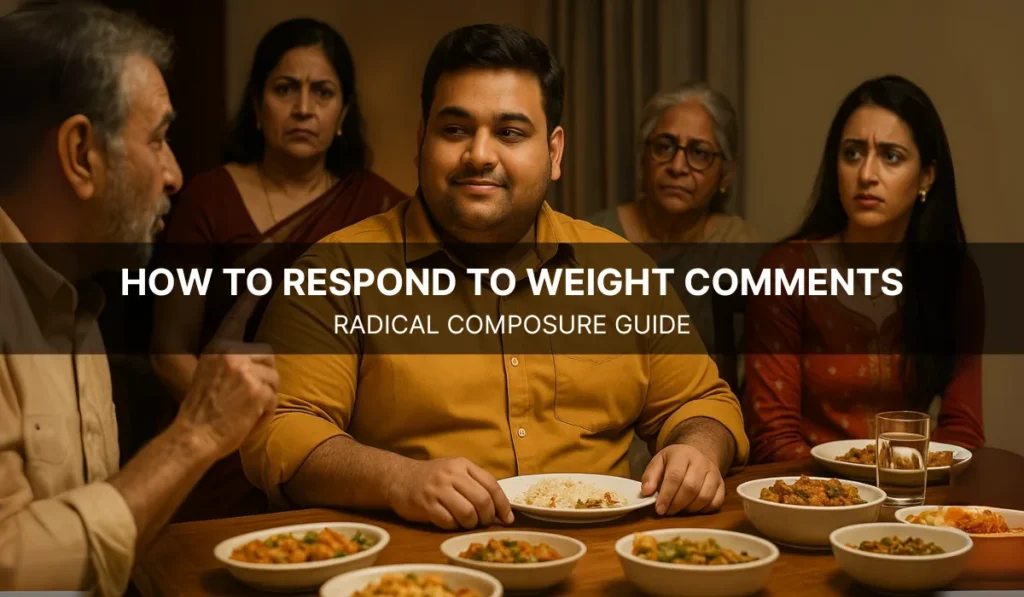
Scenario 3: Public Shaming in Family or Social Settings
At a family gathering, someone says loudly:
“You never show up on time. You only care about work these days.”
People laugh.
You feel judged and misunderstood.
Radical Composure in action:
- Notice the Hit
“That comment stung in front of everyone.” - Name the Emotion
“I feel hurt and defensive.” - Reset
One quiet breath.
Drop your shoulders. - Ask the 5-Year Question
“In 5 years, do I want more drama in this moment — or to be known as someone who holds their own with dignity?” - Respond to the Long Game
Option A: Light but Firm
“I know it can look that way. Work has been heavy, but I’m here because you matter to me, too.”
Option B: Boundary with Calm
“I’d prefer if my priorities weren’t a public joke. I’m working on balance, and I’m open to real conversations — not punchlines.”
Option C: Minimal Response + Exit
Small smile. No reaction. Then change the subject:
“Anyway, how did the event go last week? I heard it was a big success.”
You are not here to fix the entire family system.
Your job is to protect your self-respect.
When Should You Respond at All?
Radical Composure is not about replying to every jab.
It’s about choosing where your energy goes.
Ask yourself three questions:
- Is this person important for my future?
Boss, key stakeholder, close family vs random acquaintance or troll. - Is there something useful in this criticism?
Is there even 10% truth you can use to grow? - Will speaking up now help my long-term outcome?
Will it create clarity, respect, or change?
Or will it only create more drama?
Sometimes the most powerful move is a calm:
“Noted.”
And then you quietly work on the part you do control.
Quick FAQ: Public Criticism & Composure
Q: Is it okay to defend myself in public?
Yes — as long as you stay factual, calm, and brief. You’re correcting the record, not starting a fight.
Q: What if the criticism is valid but the delivery was harsh?
Separate the two. Use the content to improve. Address the tone later in a private, calm conversation if needed.
Q: What if this is constant and feels like bullying?
Radical Composure is not about tolerating abuse. If criticism turns into repeated humiliation, document incidents, seek support (HR, a mentor, or a professional), and protect your mental health.
Micro-Action for This Week
Pick one recent moment where you were criticized in front of others.
- Write down:
- What was said.
- Who was present?
- How your body reacted.
- What you actually did.
- Now rewrite the scene using the Radical Composure Method:
- What would you notice?
- What emotion would you name?
- How would you reset in 5 seconds?
- How would you answer the 5-Year Question?
- What words would you use to respond to the Long Game?
You don’t have to get it perfect live on day one.
You teach your brain the new pattern on paper first.
Then it becomes easier in the moment.
Remember This
Public criticism is not the end of your story.
It is a test of your inner foundation.
You cannot control:
- Who comments.
- How they speak.
- Who is watching.
You can control:
- Whether you collapse or stay rooted.
- Whether you react or respond.
- Whether this moment shrinks you or shapes you.
Radical Composure doesn’t mean you accept disrespect.
It means you handle it with precision, not panic.
When others speak loudly, you stay steady.
When others attack, you stay anchored.
That’s how you protect your dignity and your future at the same time.
Train in Radical Composure
You can read this once and feel better for a day.
Or you can train this skill so it becomes your default.
Inside IntuiWell’s Transform You: Personal Growth Program, we go deeper into:
- Rewiring your response to triggers.
- Practising real-life scenarios (work, family, relationships).
- Building a calm, unshakable inner core you can rely on — even when the room turns against you.
If you want structured, hand-held support to build Radical Composure in your daily life,
explore the program here: Transform You: Personal Growth Program by IntuiWell.
SUMMARY
Public criticism hits harder than private feedback because it threatens three things at once: social safety, identity, and status. Most people either attack or collapse when called out publicly, which ultimately damages their credibility. Radical Composure offers a third path — staying steady while choosing a response that protects both your dignity and your future.
The method is simple: notice your body’s reaction, name the emotion, reset your nervous system, ask what matters in five years (not five minutes), and respond in a way that supports your long-term reputation.
The blog breaks down real-life scenarios – criticism from managers, blame from colleagues, and public jabs from family – showing exactly how to respond without losing composure. The core message: you can’t control others’ tone, but you can control your response. Radical Composure is a trainable skill that reshapes how you handle pressure in public.
FAQ
1. Why does public criticism feel worse than private feedback?
Because your brain treats public rejection like physical danger. It threatens your social safety, identity, and status — so the emotional hit is stronger.
2. How do I respond without looking defensive?
Stay factual, maintain a flat tone, correct misinformation briefly, and move on. Your goal is clarity, not victory.
3. What if the criticism is unfair?
Correct the facts calmly in the moment. Address tone or behaviour privately later. Public fights only damage your credibility.
4. What if I freeze under pressure?
One slow breath resets your nervous system. That five-second reset is often enough to keep your thinking brain online.
5. When should I not respond at all?
If the person isn’t important for your long-term goals, or the comment is meant to provoke drama, silence protects your energy better than engagement.
6. What if public criticism has become a pattern or feels like bullying?
Stop normalising it. Document incidents, escalate if needed, and protect your mental health. Composure is not tolerance for abuse.
Want help building unshakeable composure in real-life situations?
Book a consultation call or request a call back to learn how IntuiWell can help you train Radical Composure.